
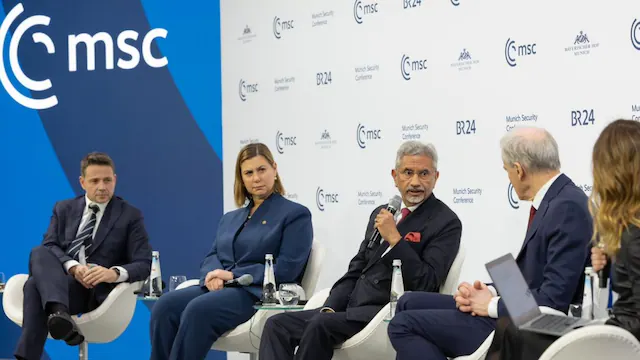
Global Democracy In the intricate dance of international diplomacy, every word and action matters. Nations project their values, influence, and political ideologies across borders. The rise of nationalism, the erosion of democratic institutions in some countries, and growing skepticism about the effectiveness of global governance mechanisms have brought the very concept of global democracy under intense scrutiny. With geopolitics becoming more contentious and polarized, questions about the future of democracy on the world stage are becoming more pronounced.
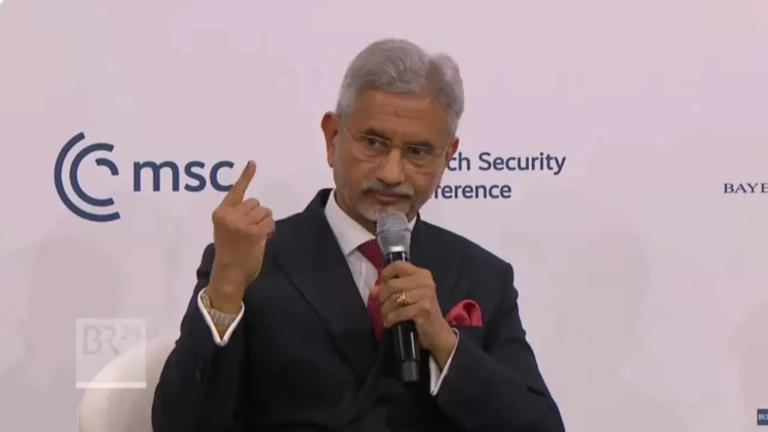
A noteworthy voice in the conversation about global democracy is Dr. S. Jaishankar, India’s Minister of External Affairs. Known for his sharp intellect and candid remarks, Jaishankar has often questioned the current world order and its implications on global governance. His statement, “Will start by sticking up my finger…,” made in response to a journalist’s question during an international forum, was not just a casual remark. It was a pointed critique aimed at the hypocrisy and imbalances within the global system, particularly when it comes to the preservation of democratic values worldwide.
This blog delves into the broader context of Jaishankar’s sharp counter, its significance in the modern geopolitical landscape, and the evolving threats to global democracy. By examining his statement and its implications, we aim to understand how rising authoritarianism, the failure of multilateral institutions, and the emergence of new global powers are reshaping the future of democracy.
The Concept of Global Democracy
Democracy, traditionally understood as a system of government where power lies with the people, has always been considered one of the most significant achievements of modern civilization. Globally, however, the story of democracy is uneven. While countries like the United States, India, and many in Europe proudly showcase democratic values, numerous others have either stagnated or regressed into authoritarian regimes.
Global democracy is an idea that stretches beyond the boundaries of individual nations. It is the idea that democracies should not only thrive within their own borders but also be a guiding principle in the international order. Global democracy suggests that countries should engage in diplomacy that reflects shared values like human rights, freedom of expression, equality, and justice. But, as Jaishankar’s comments underscore, the concept of global democracy today faces significant challenges.
The Erosion of Democracy: A Global Phenomenon
Across the globe, democracies are under threat, and not just in the traditional sense. Authoritarian regimes are on the rise, or at the very least, becoming more emboldened. From Russia’s Vladimir Putin to China’s Xi Jinping, from Turkey’s Recep Tayyip Erdoğan to Brazil’s Jair Bolsonaro, the past decade has seen a rise in populist leaders who openly challenge democratic norms, often prioritizing nationalist and authoritarian tendencies over the rule of law, free elections, and political pluralism.
These leaders use democracy to justify their agendas, manipulating political systems to maintain power while undermining the very freedoms that make democracy work. Their tactics often involve stoking division, employing populist rhetoric, curbing freedom of the press, and suppressing opposition. While this phenomenon is prevalent in some parts of the world, it is clear that even established democracies are not immune to these trends.
The Role of Multilateral Institutions
The United Nations, the World Trade Organization, the European Union, and other multilateral institutions were conceived in the aftermath of World War II to foster peace, stability, and cooperation among nations. Over time, these institutions became instrumental in supporting democratic values globally. However, as the world has become more multipolar and competitive, these organizations have faced challenges in adapting to new realities. Some critics argue that these institutions are outdated, ineffective, and disproportionately reflect the interests of powerful nations.
Jaishankar, a staunch advocate for India’s rightful place in the global order, has consistently pointed out the flaws in multilateral organizations. He argues that institutions like the UN Security Council are in dire need of reform, particularly to accommodate emerging powers like India, Brazil, and others in the Global South, who are often sidelined in decision-making processes. These disparities between the global north and south, alongside power imbalances within the United Nations, have further complicated efforts to promote a democratic, fair global order.
In his response, Jaishankar’s frustration reflects the growing disillusionment many countries feel with global governance systems that are not representative of their populations, needs, or aspirations. He has long argued that the global governance framework is inherently flawed in many ways, making it difficult for emerging democracies to challenge the status quo effectively.
Jaishankar’s ‘Sharp Counter’ to Global Democracy
In his recent remarks, Jaishankar took a direct aim at what he perceives as the hypocrisy of the West’s approach to global democracy. His comment, “Will start by sticking up my finger…” was not a random gesture. It was a pointed critique of the way democratic ideals are often selectively promoted and manipulated for political gain by Western powers.
The Context of the Remark
The comment came during a panel discussion at the Raisina Dialogue, an annual international conference on geopolitics and global security. Jaishankar was responding to questions about global democracy and the international order’s effectiveness in upholding democratic values. The remark was intended as a retort to Western countries that often lecture others on human rights and democracy but fail to practice what they preach.
His words were particularly directed at the West’s double standards in foreign policy. For example, the United States and European powers have often criticized countries like Russia, China, and Turkey for authoritarian practices, yet have also supported or even enabled such regimes for geopolitical or economic purposes. Jaishankar’s remark reflects India’s growing frustration with the prevailing world order, in which certain nations, often those with colonial histories, attempt to impose their democratic ideals on others while overlooking their own failings.
The Double Standards of Western Diplomacy
In many respects, Jaishankar’s remarks are a critique of the selective application of democratic values by Western powers. Over the years, countries like the United States and the United Kingdom have been quick to champion democracy in places like the Middle East and Africa, but have often supported authoritarian regimes when it suits their strategic interests.
For instance, Western powers were instrumental in the overthrow of democratically elected leaders in countries like Iran in 1953 and Chile in 1973, supporting authoritarian military coups instead. Similarly, while the West frequently condemns human rights violations in China and Russia, it continues to engage with these countries diplomatically and economically, often turning a blind eye to their abuses.
Jaishankar’s sharp counter was a way of highlighting this hypocrisy and calling out the contradictions within global diplomacy. By “sticking up his finger,” he symbolized his intent to draw attention to the glaring discrepancies in Western policies on democracy and human rights.
India’s Position on Global Democracy
India, as the world’s largest democracy, has long been a proponent of a rules-based international order. Jaishankar’s statements also reflect India’s growing assertiveness on the global stage. Under Prime Minister Narendra Modi’s leadership, India has taken a more active role in international forums, advocating for reforms to multilateral institutions and the promotion of inclusive democracy.
India, while committed to democratic ideals within its own borders, recognizes that the global system is not always conducive to the promotion of democracy worldwide. It has called for greater representation of emerging economies in global governance and often emphasizes the need for more equitable international institutions. Jaishankar’s remarks are a reflection of India’s desire to be seen as a leader of the Global South, advocating for a more democratic and inclusive world order that reflects the interests of a wider array of nations.
The Future of Global Democracy
Jaishankar’s remarks are a reminder that democracy is an evolving concept in an increasingly complex world. While many democratic nations face significant challenges from within — including rising populism, disillusionment with the political process, and deepening divisions — the fight for democratic ideals must continue on the international stage as well.
The future of global democracy depends on several factors:
- Reform of Multilateral Institutions: As Jaishankar has pointed out, there needs to be a reform of institutions like the United Nations, so they reflect the political realities of the 21st century. This means providing a voice to emerging powers and ensuring fair representation for all nations.
- Addressing Rising Authoritarianism: Global democracy cannot thrive if the world’s most powerful nations ignore the rise of authoritarianism. This means holding countries accountable for violations of human rights, ensuring that democratic norms are respected, and supporting democratic movements across the globe.
- Promoting Inclusivity: True global democracy must be inclusive, taking into account the needs and aspirations of countries in the Global South, who often feel marginalized in global decision-making processes. The idea of democracy must be one that benefits all people, regardless of their nation’s size or economic power.
- Leveraging Technology: Technology has the potential to be both a threat and a tool for global democracy. It can be used to spread disinformation and manipulate elections, but it can also empower citizens and increase transparency. Finding ways to harness the positive potential of technology will be crucial for the future of democracy.
Conclusion: A Call to Action
Jaishankar’s sharp counter to the notion of global democracy should not be seen as a simple diplomatic rebuke. Instead, it is a call to action for the international community to critically examine the current state of global governance, question the prevailing norms, and push for a more equitable, inclusive, and effective system.
As democracy faces increasing challenges from authoritarianism, nationalism, and rising populism, it is more important than ever for nations to reaffirm their commitment to democratic principles and work towards an international order that upholds these ideals. Jaishankar’s remark was a poignant reminder that the fight for democracy does not end at national borders but must extend into the global arena. Only through collective effort and reform can global democracy survive and thrive in the years to come.
Read More Latest News

