

“I Will Not Allow Detention Camps in Bengal Until My Last Breath”: CM Mamata Banerjee’s Stand on NRC, Notices, and Border Security
In the political landscape of India, few leaders command as strong a regional influence as CM Mamata Banerjee. Known for her uncompromising stance on federal autonomy, citizen rights, and Bengali identity, she once again made national headlines with a bold declaration: “I will not allow detention camps to be built in Bengal until my last breath.” This powerful statement came amid the rising tensions over NRC notices, concerns about border security, and fears of demographic uncertainty in West Bengal.
This blog explores the political, social, and emotional significance of her statement, the historical trajectory of the NRC debate, the central government’s position, the reactions from opposition groups, and the broader implications for the people of Bengal. Throughout this analysis, we will examine the multi-layered narrative behind CM Mamata Banerjee’s declaration and why it resonates deeply with millions of citizens.
1. Context: The NRC Debate Moves to Bengal
The National Register of Citizens (NRC) has remained one of the most debated issues in India since its implementation in Assam. The final list in Assam, which excluded nearly 19 lakh people, sparked nationwide debates about citizenship, documentation, and the humanitarian impact of such exercises.
As discussions of a nationwide NRC began circulating, fear gripped several states. Bengal, with its long historical association with migration due to Partition, the Bangladesh Liberation War, and cross-border displacement, felt especially vulnerable.
It was in this backdrop that CM Mamata Banerjee made her defiant statement. From the very beginning, she has positioned herself as a staunch opponent of any NRC-style process in Bengal, calling it “anti-people” and “politically motivated.” Her words, emotional yet decisive, struck a chord across communities who feared the consequences of documentation-based identity validation.
2. “No Detention Camps in Bengal”: The Heart of Mamata’s Message
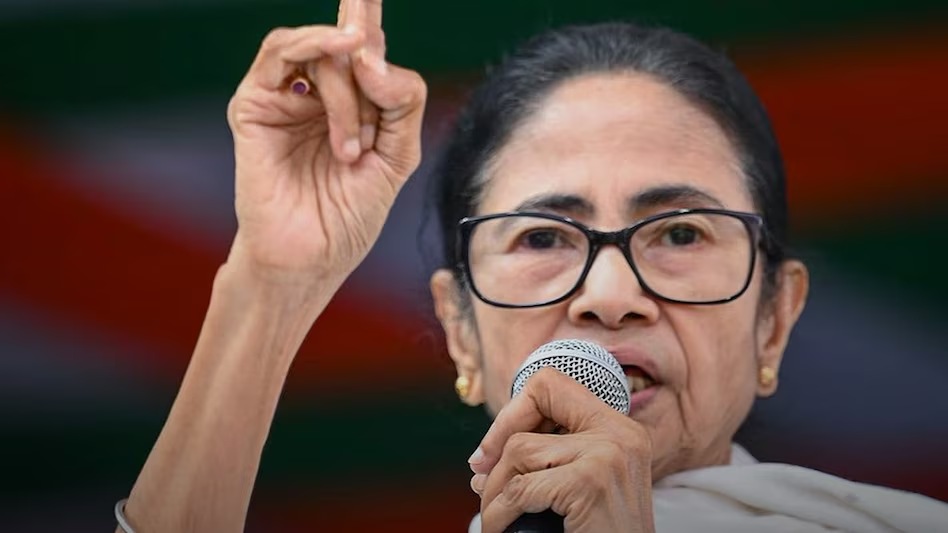
When CM Mamata Banerjee exclaimed, “I will not allow detention camps to be built in Bengal until my last breath,” it wasn’t merely a political slogan. It was a pledge—symbolic and direct—that Bengal would not follow the path seen in Assam, where detention centers were established for individuals whose citizenship status was under scrutiny.
Her message conveyed:
- Protection of vulnerable communities
- Reassurance to minorities
- Reinforcement of Bengali identity and rights
- Resistance against centralization
By repeating her stand across multiple public meetings, press conferences, and administrative gatherings, CM Mamata Banerjee attempted to counter the fear created by NRC notices and misinformation. Her rhetoric placed her firmly as a defender of the marginalized, a narrative she has cultivated for many years.
3. Political Significance of Her Stand
The statement from CM Mamata Banerjee has immense political implications. In Bengal’s political terrain, where identity politics, religious dynamics, and regional pride intersect, the NRC debate has become a defining issue.
A. Consolidation of Minority Support
Her strong opposition to detention camps and NRC is seen as an attempt to consolidate the minority vote bank, which has consistently supported her. By asserting that she would fight until her “last breath,” CM Mamata Banerjee positions herself as the primary shield protecting these communities.
B. Creating a Regional Resistance Narrative
Much like her earlier fights against the Land Acquisition Act in Singur and the central government’s policies on GST compensation, this stand reinforces her image as a leader who prioritizes Bengal over New Delhi’s directives. This strategy strengthens regional pride.
C. Political Counterweight to the BJP
The BJP’s narrative around NRC, CAA, and border control is based on national security and curbing illegal immigration. CM Mamata Banerjee’s stand provides the ideological counterweight—focusing on humanitarian, inclusive, and constitutional values. This contrast helps sharpen electoral divisions.
4. NRC Notices and Rising Public Anxiety
Many Bengal residents, especially in border districts such as Cooch Behar, Murshidabad, Malda, and North 24 Parganas, reported receiving notices related to documentation and voter list verification. Even though these notices were part of routine administrative checks, panic spread due to memories of the Assam NRC experience.
CM Mamata Banerjee repeatedly emphasized that these notices were not related to an NRC rollout and reassured the public that no one would be displaced. In several public addresses, CM Mamata Banerjee urged people not to fear these notices or fall prey to rumors.
5. Detention Camps and Their History
Detention camps are facilities meant to hold individuals declared as illegal immigrants. The concept gained notoriety after visuals emerged from Assam’s camps, where inmates alleged poor conditions and prolonged detention. Human rights activists across India condemned these camps, calling them “inhumane” and “undemocratic.”
CM Mamata Banerjee’s declaration directly challenged the establishment of such facilities. According to her, Bengal’s multicultural and humanitarian ethos leaves no room for such structures. She often invokes Bengal’s legacy—from the Bengal Renaissance to Rabindranath Tagore’s universalism—to highlight that the state does not believe in exclusion.
6. Border Security: Mamata Dual Narrative
While CM Mamata Banerjee opposes detention camps, she does not oppose strong border security. In fact, she has consistently maintained that Bengal shares one of the longest international borders in India, making it important to have vigilant security measures.
Her narrative on border security includes:
- Cooperation with BSF and central agencies
- Demanding respect for state authority during operations
- Opposing the expansion of BSF jurisdiction inside rural areas
- Calling for humane treatment of civilians near border areas
This dual stance allows CM Mamata Banerjee to maintain a delicate balance between protecting human rights and ensuring safety.

7. The Humanitarian Viewpoint
At the core of CM Mamata Banerjee’s resistance is her humanitarian approach. Bengal, historically, has been a refuge for people fleeing crises—whether during the Partition or the 1971 war.
Her argument stresses:
- No individual should lose their home due to missing documents
- Citizenship is not a privilege but a constitutional right
- Identity should not be questioned based on paperwork
- The elderly and marginalized should not suffer bureaucratic harassment
By positioning herself as a guardian of human rights, CM Mamata Banerjee connects deeply with Bengal’s emotional and cultural ethos.
8. Critics and Opposition Reactions
Opposition parties, particularly the BJP, argue that CM Mamata Banerjee is “misleading people” about NRC and detention camps. They claim that her narrative fosters panic and prevents the state from addressing illegal immigration.
Others criticize her for politicizing a national security issue. However, her supporters believe these criticisms are attempts to weaken regional autonomy.
Despite the debates, it cannot be denied that CM Mamata Banerjee’s stand has changed the NRC conversation in Bengal. Her forceful rhetoric has prevented the issue from being implemented unilaterally.
9. Public Response: Fear, Relief, and Hope
For many residents, especially minorities, slum dwellers, migrant workers, and people living in border districts, the NRC evokes fears of displacement. Her assurance provides psychological relief. Videos of her speeches spread across social media, calming worried families.
Educated youth and civil society groups have also rallied behind her message, viewing it as a defense of constitutional principles and federal rights.
For them, CM Mamata Banerjee is not merely a political leader but a defender of dignity and equality. Her ability to connect emotionally with the masses shapes this image.
10. The Future of NRC in Bengal
With the evolving political landscape, the NRC debate is unlikely to fade anytime soon. However, CM Mamata Banerjee’s unwavering stand ensures that Bengal will remain a strong voice in the national conversation.
Her promise that there will be “no detention camps” as long as she is in power is a pivotal marker of her governance philosophy. Whether the central government revisits the NRC plan or not, her resistance sets a precedent for other states to question unilateral implementation.
11. Conclusion: Mamata Promise and Bengal Identity
In her iconic style, CM Mamata Banerjee’s declaration was firm, emotional, and deeply tied to the cultural fabric of Bengal. Her words, “I will not allow detention camps in Bengal until my last breath,” resonate far beyond political boundaries—they symbolize resistance against fear, defense of constitutional rights, and the promise of protection for every vulnerable citizen.
With CM Mamata Banerjee repeating that no one in Bengal needs to fear NRC notices or detention, the state stands at a crucial juncture. For millions, her voice represents strength, belonging, and assurance that humanitarian values will not be overshadowed by political pressures.
As Bengal moves forward, the legacy of this statement will likely remain a defining moment in its political history—a moment when a leader vowed to defend her people until the very end.
Read More latest news

