
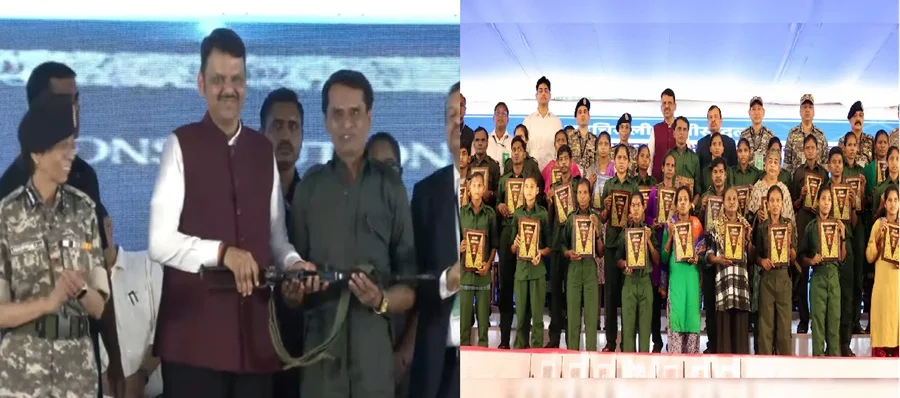
Historic Surrender in Gadchiroli: 60 Naxalites, Including Top Commander Mallojula Venugopal Rao (Bhupati), Lay Down Arms Before CM Devendra Fadnavis
Introduction: A Landmark Day in Maharashtra’s Fight Against Naxalism
In a powerful symbol of peace and transformation, nearly 60 Naxalites, including the dreaded Naxal commander Mallojula Venugopal Rao alias Bhupati, surrendered before Maharashtra Chief Minister Devendra Fadnavis at the Gadchiroli Police Headquarters on Tuesday. This mass surrender marks one of the biggest blows to the Naxalite insurgency in the region in over a decade and stands as a testament to the success of Maharashtra’s surrender-and-rehabilitation policy and the growing reach of governance in remote tribal belts.
CM Devendra Fadnavis, addressing the emotional and historic ceremony, said:
“This surrender is not just an end to violence, but a new beginning for peace, progress, and development. Those who once held guns against the state are now choosing the path of reform and nation-building.”
This blog explores the background, political significance, and human dimensions of the surrender — analyzing how this event could reshape the future of the Naxal movement in Maharashtra and across India.
1. The Event: A Dramatic Morning at Gadchiroli Police Headquarters CM Devendra Fadnavis
The ceremony at the Gadchiroli Police Headquarters was held under tight security but carried an atmosphere of relief and optimism.
Around 60 armed Naxalites, including senior cadres and area commanders, arrived under police escort, laid down their weapons — rifles, grenades, and ammunition — and pledged to join mainstream society.
The star figure among them was Mallojula Venugopal Rao alias Bhupati, one of the senior-most leaders in the Naxal hierarchy. Known for his operational leadership in the Dandakaranya region, Bhupati’s surrender signifies the crumbling morale and weakening structure of the Maoist organization in western India.
CM Devendra Fadnavis personally congratulated the surrendered cadres, urging them to rebuild their lives with dignity.
“You have made the right choice. Maharashtra welcomes you back. Our government will ensure your safety, rehabilitation, and reintegration,” he said.

2. Who is Mallojula Venugopal Rao (CM Devendra Fadnavis)? The Big Catch
Mallojula Venugopal Rao, better known by his alias Bhupati, is a name that once struck fear in the dense forests of Gadchiroli and neighboring states.
A native of Andhra Pradesh, Rao had joined the Naxalite movement in the early 1990s, rising through the ranks to become a Central Committee member of the CPI (Maoist). For decades, he masterminded ambushes, recruitment drives, and training operations across Maharashtra, Chhattisgarh, and Telangana.
According to security officials, Rao had become increasingly disillusioned with the Maoist ideology over the past few years. The combination of health issues, continuous police pressure, and internal factionalism pushed him toward surrender.
His decision is being viewed as a moral and strategic setback for the entire Maoist movement, as Rao was one of the few remaining veterans with deep organizational knowledge and field experience.
3. The Journey Toward Peace: Maharashtra’s Anti-Naxal Strategy CM Devendra Fadnavis
Maharashtra, particularly the Gadchiroli district, has been one of the state’s most Naxal-affected regions. For decades, the forested terrain provided shelter to insurgents who used guerrilla tactics to attack police and state infrastructure.
However, in recent years, a multi-pronged strategy by the Maharashtra government has changed the equation:
- Development with security: Roads, schools, and healthcare centers have reached remote villages once controlled by Naxals.
- Surrender and rehabilitation policy: Surrendered Naxalites receive financial assistance, vocational training, and housing support.
- Intelligence-driven policing: The Maharashtra Police’s C-60 commandos have carried out several successful anti-Naxal operations.
- Community engagement: Local tribal youth have been integrated into civil jobs, reducing Maoist recruitment potential.
CM Devendra Fadnavis credited this “policy of balance — firmness with compassion” for the growing number of surrenders.
4. Inside the Surrender Program: Rehabilitation and Reintegration CM Devendra Fadnavis
Under Maharashtra’s Surrender-cum-Rehabilitation Policy, each surrendered Naxalite receives a one-time financial grant, assistance for housing, and access to education and job programs.
Officials confirmed that:
- Each surrendered cadre will be provided ₹6 lakh as an initial assistance package.
- Skill development training will be offered under government schemes like Skill India and PM Kaushal Vikas Yojana.
- The state will assist them in securing employment or starting small businesses.
This humanitarian approach, according to CM Devendra Fadnavis, has not only weakened the insurgency but has also given a second chance to hundreds of youth misled by extremist ideologies.

5. The Human Angle: Stories of Transformation CM Devendra Fadnavis
Several surrendered Naxalites shared emotional testimonies during the event.
One former area commander, known by the alias Savita, said:
“We were told the government is our enemy, but when we saw schools, roads, and hospitals coming up in our villages, we realized the truth. The gun only brought fear, not change.”
Another surrendered cadre mentioned how the welfare programs for tribal families inspired them to return.
Many cited the police’s humane approach — offering surrender options rather than lethal encounters — as a key factor in their decision.
These personal stories underscore the growing realization among the lower ranks that the era of armed rebellion is over, and development is the new revolution.
6. Political and Strategic Significance CM Devendra Fadnavis
This surrender is a political victory for CM Devendra Fadnavis, who has consistently prioritized security with development in Maharashtra’s Naxal-hit zones. His presence at the event signals the government’s political confidence in having successfully tackled one of India’s oldest internal threats.
Strategically, the surrender deals a massive blow to Maoist morale. Analysts believe that the loss of Bhupati and his associates will disrupt communication networks, logistics, and recruitment in the Dandakaranya-Maharashtra corridor.
Security expert Col. R.P. Singh (Retd.) remarked:
“The surrender of Bhupati is comparable to removing a queen from the chessboard. It changes the balance of power in the Naxal heartland.”
7. Gadchiroli: From Conflict Zone to Symbol of Change
Once known as a “red zone”, Gadchiroli is slowly becoming a green zone of growth and stability.
New infrastructure projects — including roads, electricity lines, and internet connectivity — are bringing opportunities that were unthinkable two decades ago.
The government has launched several initiatives to empower the tribal population:
- Van Dhan Vikas Kendras to promote forest-based entrepreneurship.
- Educational hostels for tribal children.
- Healthcare outreach programs targeting remote villages.
With each new school and health center, the ideological grip of Maoists weakens further.
As CM Devendra Fadnavis noted:
“The pen and plough are replacing the gun in Gadchiroli. This is the true victory of democracy.”
8. Security Forces’ Role: The Silent Heroes
Behind this peaceful surrender lies years of dedicated groundwork by the Maharashtra Police’s C-60 force, the CRPF, and intelligence agencies.
These forces worked tirelessly to build trust with local communities while maintaining strong pressure on Naxal networks.
A senior police official revealed that the surrender was the result of months of backchannel dialogue and confidence-building measures.
Unlike previous decades, when the state relied on pure military action, the new approach blends security, psychology, and compassion.
“We are not fighting our own people. We are fighting an ideology that misled them,” said one senior Gadchiroli police officer.
9. What This Means for the Broader Naxal Movement
The surrender of Bhupati and his cadre is likely to trigger a domino effect across central India.
The Maoist organization is already under pressure due to:
- Leadership losses in Chhattisgarh and Jharkhand.
- Declining recruitment among tribal youth.
- Financial disruption due to improved policing.
- Erosion of ideological influence.
Experts believe that Maharashtra’s model — combining firm policing with rehabilitation — could serve as a national template for counter-insurgency.
If replicated across other states, India could see the virtual collapse of the Naxal movement within the next decade.
10. Opposition Reaction and Public Response
The opposition, including leaders from the Congress and NCP, welcomed the development but urged the government to focus on rehabilitation transparency.
Congress leader Nana Patole stated:
“The surrender is a positive step, but the government must ensure that surrendered Naxalites truly get the promised benefits. Otherwise, the cycle of disillusionment could restart.”
Public sentiment in Gadchiroli and surrounding districts has been overwhelmingly supportive.
Local residents celebrated the event as a “Diwali of peace.”
In several villages, people lit diyas to symbolize the end of fear and violence.
11. CM Devendra Fadnavis’ Broader Vision: Peace Through Development
For CM Devendra Fadnavis, this surrender fits into a broader state vision of inclusive growth.
He reiterated that Maharashtra’s development cannot be complete until its most remote citizens feel safe, empowered, and heard.
“The gun cannot feed families; the government can. We will reach every village, every forest, every person,” CM Devendra Fadnavis declared.
His long-term goal is to make Maharashtra completely Naxal-free through continued development in education, health, and employment.
12. The Road Ahead: Challenges and Opportunities
While this surrender is a major victory, the road to total peace remains complex.
Challenges ahead include:
- Preventing re-radicalization of surrendered cadres.
- Monitoring splinter groups that may continue isolated attacks.
- Ensuring smooth rehabilitation and social reintegration.
- Sustaining development momentum in tribal areas.
However, the opportunities far outweigh the risks.
With government support, surrendered Naxalites can become ambassadors of peace, helping to discourage others from joining extremist movements.
13. A Turning Point in India’s Internal Security Landscape
The Gadchiroli surrender will go down in history as one of the largest voluntary disarmaments in India’s fight against left-wing extremism.
It signals a clear shift — from confrontation to reconciliation, from fear to hope.
For decades, Naxalism represented one of India’s deepest internal challenges. But with this event, the narrative is changing.
India’s democracy, backed by compassion and resilience, is proving stronger than the bullet.
Conclusion: From Guns to Growth — A New Dawn in Gadchiroli
The surrender of Mallojula Venugopal Rao (Bhupati) and his cadre before CM Devendra Fadnavis marks a historic milestone in Maharashtra’s journey toward peace. It symbolizes not just the weakening of Naxalism but the moral victory of governance, dialogue, and democracy.
As Gadchiroli turns a new page, the message is clear — violence breeds only darkness, but development brings light.
From the forests once echoing with gunfire, now rises the sound of rebuilding — schools, homes, and dreams.
And as CM Devendra Fadnavis aptly said:
“This is not just a surrender of weapons; it’s the surrender of hate, and the rise of hope.”
Read More latest news

