

Modi, Ursula von der Leyen at India-EU Business Forum: PM Sharp Message to the World After Historic Free Trade Deal.
Introduction: A Historic Moment at Bharat Mandapam
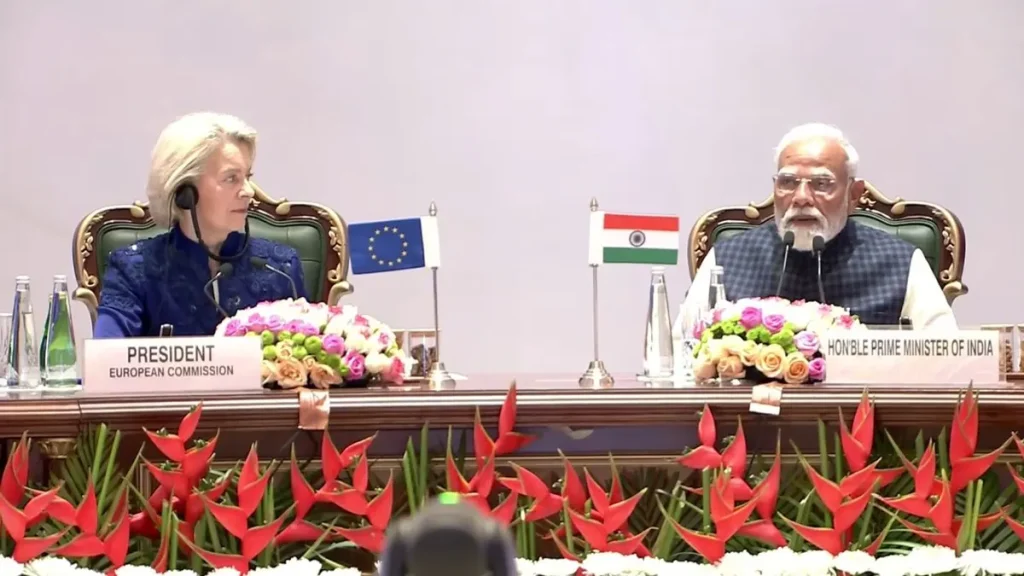
India’s economic diplomacy entered a decisive new phase following the trade deal between India and the European Union. Soon after concluding the agreement, Prime Minister Narendra Modi and European Commission President Ursula von der Leyen jointly addressed the India-EU Business Forum at Bharat Mandapam, New Delhi.
The event was not just a celebration of economic cooperation but a powerful political and strategic statement. While highlighting the opportunities emerging from the trade deal, PM Modi delivered a pointed message to the global community—particularly to leaders who believe in protectionism and trade wars. Without naming anyone, Modi’s remarks were widely seen as a sharp attack on former US President Donald Trump and his tariff-heavy approach to global trade.
The forum marked a turning point, underscoring how the free trade deal is reshaping India’s global economic positioning while redefining partnerships based on trust, transparency, and mutual growth.
India EU Free Trade Deal A Long Road to Success
The India-EU trade deal did not materialize overnight. Negotiations spanned over a decade, facing multiple hurdles related to tariffs, market access, sustainability standards, and data protection norms. However, shifting global realities and economic uncertainties accelerated consensus on both sides.
The finalization of the trade deal signals a shared belief that open markets—not economic isolation—drive prosperity. The agreement aims to reduce tariffs, expand investment flows, enhance supply-chain resilience, and create millions of jobs across India and Europe.
Bharat Mandapam: Symbolism and Strategy
Choosing Bharat Mandapam as the venue was deeply symbolic. Built as a representation of India’s civilizational confidence and modern ambition, it reflected the spirit of the trade deal—a partnership rooted in equality rather than dependency.
Addressing global CEOs, investors, and policymakers, PM Modi emphasized that India is no longer hesitant about engaging with the world. Instead, it is shaping global economic narratives through bold agreements like the free trade deal with the EU.
PM Modi Speech Trade Trust and Transparency
While discussing the free trade deal, PM Modi strongly advocated for rule-based global trade. He stressed that sustainable growth comes from cooperation, not confrontation.
“When countries trust each other, businesses thrive. When markets are open, innovation flourishes,” Modi said, indirectly critiquing policies that rely on tariffs and sanctions.
Though he did not mention Donald Trump by name, references to unilateral tariffs and trade wars left little doubt about the target of his remarks.
A Subtle Attack on Protectionism
PM Modi’s comments during the free trade deal celebration were interpreted as a clear rejection of the protectionist policies championed by Trump during his presidency.
Key indirect references:
- Opposition to tariff wars
- Criticism of “pressure-based trade”
- Advocacy for dialogue over sanctions
- Emphasis on mutual respect in global commerce
These remarks positioned the free trade deal as India’s answer to economic nationalism that disrupts global supply chains.
Ursula von der Leyen: Europe’s Commitment to India
European Commission President Ursula von der Leyen described the free trade deal as “a partnership for the future.”
She emphasized:
- Europe’s confidence in India as a growth engine
- Shared democratic values
- Commitment to sustainable and inclusive trade
According to her, the free trade deal reflects Europe’s desire to diversify partnerships and reduce over-reliance on any single market.

Why the Free Trade Deal Matters Globally
The India-EU free trade deal comes at a time when global trade faces fragmentation due to geopolitical tensions.
Global implications:
- Reinforces multilateralism
- Strengthens supply-chain resilience
- Encourages rules-based trade
- Counters protectionist narratives
This agreement sends a strong signal that major economies can still come together through dialogue and compromise.
Business Forum Highlights: New Opportunities Unlocked
At the India-EU Business Forum, industry leaders hailed the free trade deal as a game-changer.
Sectors set to benefit:
- Automobiles and EVs
- Pharmaceuticals
- Renewable energy
- IT and digital services
- Manufacturing and MSMEs
The free trade deal is expected to significantly boost bilateral trade volumes in the coming years.
Cheaper Goods and Competitive Markets
One of the immediate outcomes of the free trade deal will be reduced prices for consumers.
Likely impacts:
- Cheaper European machinery
- Affordable high-end automobiles
- Better access to medical devices
- Increased consumer choice
For Indian exporters, the free trade deal opens doors to a massive EU market with lower entry barriers.
Jobs, Investment, and Growth
Employment generation was a key theme at the forum. PM Modi highlighted how the free trade deal will drive job creation across India.
Employment drivers:
- Expansion of manufacturing
- Growth of export-oriented MSMEs
- Infrastructure investments
- Technology-led startups
The free trade deal is projected to create millions of direct and indirect jobs over the next decade.
Strategic Message to the United States
Though diplomatic in tone, PM Modi’s message during the free trade deal celebration was unmistakable.
By aligning with the EU and promoting open trade, India signaled that:
- It rejects coercive trade tactics
- It prefers partnership over pressure
- It values stability in global markets
This positioning indirectly contrasts with Trump’s “America First” trade philosophy.
India’s Rising Global Confidence
The free trade deal reflects India’s growing confidence on the world stage.
Unlike earlier decades, India is now negotiating from a position of strength:
- Large domestic market
- Strong economic growth
- Strategic geopolitical importance
- Skilled workforce
The agreement reinforces India’s image as a reliable and forward-looking economic partner.
EU’s Strategic Shift Towards India
For Europe, the free trade deal marks a strategic shift.
Why the EU is prioritizing India:
- Diversification away from risky supply chains
- Expanding presence in Indo-Pacific
- Long-term market potential
- Shared democratic principles
The free trade deal anchors this evolving partnership.
Countering Trade Wars with Cooperation
PM Modi stressed that trade wars hurt everyone. The free trade deal, he said, represents the opposite philosophy—shared growth.
This message resonated strongly at the business forum, especially among global investors fatigued by uncertainty caused by trade disputes.
Technology, Sustainability, and the Future
Another major focus of the free trade deal is sustainability.
Collaboration areas:
- Clean energy
- Green hydrogen
- Climate-friendly manufacturing
- Digital innovation
Both leaders emphasized that the free trade deal aligns economic growth with environmental responsibility.
India-EU Business Forum: A Turning Point
The forum showcased how the free trade deal goes beyond commerce.
It represents:
- Strategic trust
- Political alignment
- Economic ambition
PM Modi’s remarks reinforced India’s commitment to shaping a fair and open global economic order.
Political Messaging Without Naming Names
The indirect reference to Donald Trump was a calculated move.
By avoiding direct confrontation while promoting the free trade deal, Modi demonstrated diplomatic maturity—sending a strong message without escalating tensions.
Reaction from Business Leaders
Industry leaders welcomed the free trade deal, calling it:
- Predictable
- Growth-oriented
- Investor-friendly
Many CEOs announced expansion plans in India following the forum.
Challenges Ahead
Despite optimism, the free trade deal will require careful implementation.
Key challenges:
- Protecting sensitive sectors
- Ensuring fair competition
- Aligning regulations
- Managing transition costs
PM Modi acknowledged these challenges while expressing confidence in India’s preparedness.
A New Template for Global Trade
The free trade deal could serve as a model for future agreements.
It proves that large, diverse economies can find common ground without resorting to economic coercion.
Conclusion: India’s Clear Message to the World
The India-EU free trade deal is not just an economic milestone—it is a geopolitical statement.
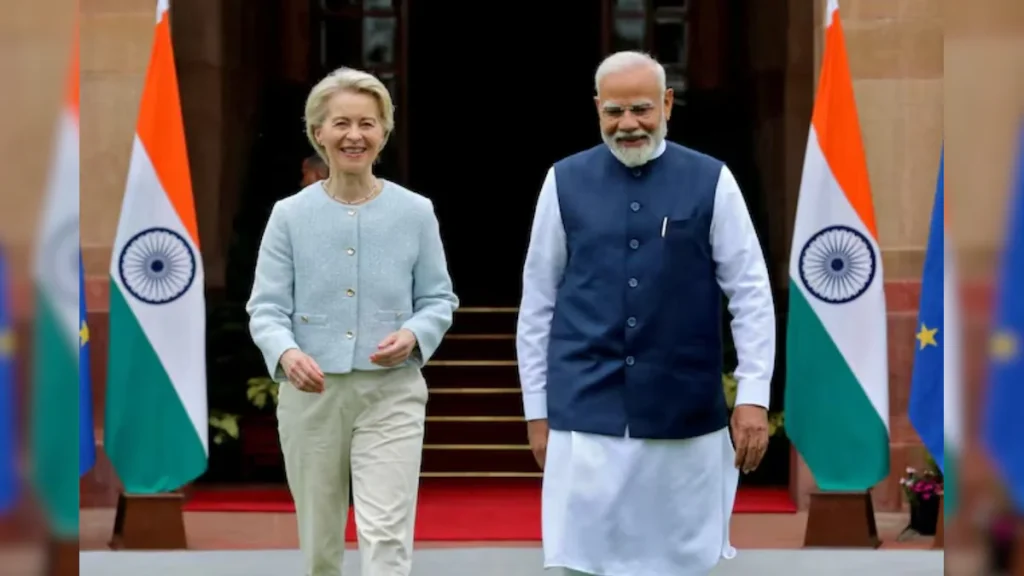
By standing alongside Ursula von der Leyen at Bharat Mandapam, PM Modi sent a clear signal: India believes in cooperation, not confrontation; partnerships, not pressure; and openness, not isolation.
Without naming Donald Trump, Modi’s message was loud and clear. In a world divided by trade wars, India and the EU are choosing a different path—one defined by trust, shared prosperity, and a forward-looking trade deal.
Read More latest news

