
“Swaraj Will Not Be Achieved by Spinning the Charkha…”: Why RSS Chief Mohan Bhagwat’s Kolkata Speech Matters
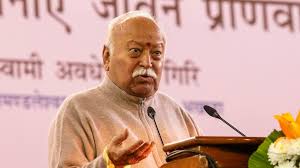
Listen to why RSS chief Mohan Bhagwat said this during a program in Kolkata! A single sentence spoken from a public platform can sometimes ignite a far-reaching ideological debate. Such was the case in Kolkata, where a statement by the head of the Rashtriya Swayamsevak Sangh triggered widespread discussion across political, academic, and social circles. When RSS chief Mohan Bhagwat remarked that “Swaraj will not be achieved by spinning the charkha,” he was not merely making a historical observation but delivering a deeper message about India’s present and future path.
The remark, delivered during a public program in West Bengal’s capital, was layered with philosophical, historical, and ideological meaning. To understand why the statement has generated such intense debate, it is important to unpack the context, intent, and broader implications behind it.
The Context of the Kolkata Program
The event where RSS chief Mohan Bhagwat made the statement was not a political rally but an ideological interaction focused on national self-reliance, social harmony, and India’s civilizational ethos. Addressing an audience that included students, intellectuals, and social workers, he spoke about India’s freedom movement, post-independence challenges, and the evolving idea of Swaraj in modern times.
According to those present, the speech was reflective rather than confrontational. Yet, one sentence stood out and quickly became the headline, drawing both praise and criticism.
Understanding the Reference to the Charkha
The charkha, or spinning wheel, is one of the most powerful symbols of Mahatma Gandhi’s freedom movement. It represented economic self-reliance, resistance to colonial exploitation, and grassroots empowerment. When RSS chief Mohan Bhagwat invoked this symbol, critics initially interpreted it as an attempt to undermine Gandhian philosophy.
However, a closer reading of his speech suggests otherwise. He did not dismiss the charkha’s historical importance but argued that symbolic actions alone cannot achieve Swaraj in contemporary India.
Swaraj: Beyond Political Independence
In his address, RSS chief Mohan Bhagwat emphasized that Swaraj should not be narrowly understood as freedom from foreign rule. True Swaraj, he argued, is about self-discipline, social responsibility, economic strength, and cultural confidence.
According to him, India achieved political independence in 1947, but mental, social, and economic independence remain ongoing processes. His remark about the charkha was meant to illustrate that methods must evolve with time.
A Message on Modern Challenges
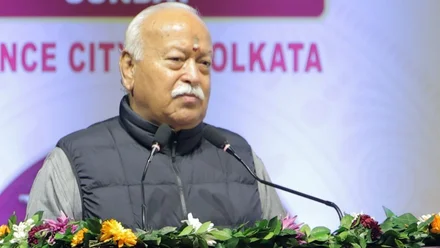
The speech by RSS chief Mohan Bhagwat focused heavily on present-day challenges—technological dependence, social fragmentation, and economic inequality. He argued that while historical tools were effective in their era, modern India needs new approaches rooted in the same core values.
He spoke about innovation, skill development, and social unity as modern instruments of Swaraj, stressing that nostalgia should not hinder progress.
Ideological Roots of the Statement
Those familiar with RSS thought say that RSS chief Mohan Bhagwat was echoing a long-standing organizational belief: that national strength comes from character-building and collective responsibility.
The RSS traditionally emphasizes daily discipline, social service, and cultural awareness over symbolic gestures. The Kolkata remark fits into this ideological framework rather than standing as an isolated comment.
Political Reactions and Criticism
Predictably, opposition parties reacted sharply. Several leaders accused RSS chief Mohan Bhagwat of disrespecting Mahatma Gandhi and diminishing his role in the freedom struggle.
Social media amplified these criticisms, with hashtags questioning the intent behind the statement. However, supporters argued that the criticism was selective and ignored the broader context of the speech.
Supporters’ Interpretation
Supporters of RSS chief Mohan Bhagwat clarified that the statement was not anti-Gandhi but anti-complacency. They argued that Gandhi himself was a reformer who adapted strategies based on circumstances.
According to this view, invoking the charkha was symbolic of a larger point—that clinging to past methods without adapting to present realities can hinder national progress.
Bengal Historical Significance
Delivering this speech in Kolkata added another layer of meaning. Bengal has historically been a hub of intellectual debate, reform movements, and revolutionary thought. RSS chief Mohan Bhagwat acknowledged this legacy while speaking about the need for contemporary forms of nationalism.
By choosing Kolkata, he addressed an audience deeply aware of India’s ideological diversity and historical complexity.
Swaraj in the 21st Century
One of the core arguments made by RSS chief Mohan Bhagwat was that Swaraj in the 21st century must include technological self-reliance, ethical governance, and social cohesion.
He spoke about reducing dependence on foreign technology, strengthening indigenous research, and building an economy driven by domestic innovation rather than imports.
Cultural Confidence and Identity
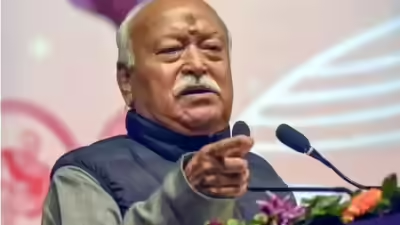
Another key theme in the speech by RSS chief Mohan Bhagwat was cultural confidence. He argued that true freedom comes when a society respects its roots while engaging confidently with the global world.
According to him, cultural insecurity leads to blind imitation, which undermines genuine self-rule.
Education as a Tool of Swaraj
Education featured prominently in the address. RSS chief Mohan Bhagwat stressed the need for an education system that produces responsible citizens rather than mere job-seekers.
He linked education with national character, suggesting that informed and ethical citizens are essential for sustaining Swaraj.
Economic Dimensions of Freedom
The speech also touched upon economic independence. RSS chief Mohan Bhagwat argued that an economy driven solely by consumption and foreign capital cannot ensure lasting freedom.
He emphasized local entrepreneurship, ethical business practices, and community-based economic models as pathways toward sustainable Swaraj.
The RSS Worldview Explained
For many observers, the Kolkata speech provided insight into the contemporary RSS worldview. RSS chief Mohan Bhagwat articulated a vision where nationalism is not aggressive but introspective, focusing on internal strength rather than external opposition.
This perspective challenges both colonial-era thinking and modern dependency mindsets.
Media’s Selective Focus
While the speech covered multiple themes, media attention remained fixated on a single line. RSS chief Mohan Bhagwat himself later remarked, indirectly, that complex ideas are often reduced to sound bites.
Analysts argue that such selective focus oversimplifies ideological discussions and fuels unnecessary polarization.
Historical Evolution of Symbols
Historians point out that symbols like the charkha were powerful in their time, but even Gandhi saw them as means rather than ends. RSS chief Mohan Bhagwat appeared to echo this historical understanding by urging society to focus on outcomes rather than rituals.
This interpretation aligns with a pragmatic reading of India’s freedom movement.
National Unity Above Ideology
A recurring theme in the speech was unity. RSS chief Mohan Bhagwat emphasized that Swaraj cannot exist in a divided society. Social harmony, mutual respect, and shared responsibility were presented as foundational pillars.
He warned that internal divisions weaken national sovereignty more than external threats.
Youth and the Future of Swaraj
Addressing the youth, RSS chief Mohan Bhagwat urged them to see Swaraj as a living responsibility. He encouraged innovation, service, and ethical leadership rather than ideological rigidity.
The message resonated with many young attendees who see nationalism through the lens of opportunity rather than struggle.
Broader National Implications
The statement has implications beyond the RSS. RSS chief Mohan Bhagwat sparked a national conversation on how India should interpret its freedom legacy while navigating modern challenges.
The debate reflects a larger tension between tradition and transformation in Indian society.
Conclusion: A Statement That Demands Reflection
The Kolkata speech by RSS chief Mohan Bhagwat was not a rejection of history but a call to reinterpret it responsibly. His remark about the charkha was a metaphor urging Indians to move beyond symbolic comfort zones and embrace practical self-reliance.
Whether one agrees or disagrees, the statement has succeeded in provoking thought. It reminds the nation that Swaraj is not a static achievement but a continuous process requiring awareness, effort, and evolution.
In a time of rapid change and global uncertainty, the words of RSS chief Mohan Bhagwat invite Indians to reflect on what freedom truly means—and how it can be sustained in the modern era.
Read More latest news

