

Winter Session Debate: Priyanka Gandhi Highlights Pollution Crisis During 150th Anniversary Discussion on Vande Mataram.
Priyanka Gandhi spoke The Winter Session of Parliament has always been a crucial marker in India’s political calendar. But this year, the session has drawn even more attention because of the special discussion held to commemorate the 150th anniversary of Vande Mataram—a patriotic hymn that ignited the country’s freedom movement and continues to shape national identity. The debate was expected to revolve around the historical, cultural, and emotional significance of the song. However, Congress MP Priyanka Gandhi added a powerful and unexpected dimension to the discussion by drawing attention to an urgent contemporary crisis: pollution in India’s major cities.
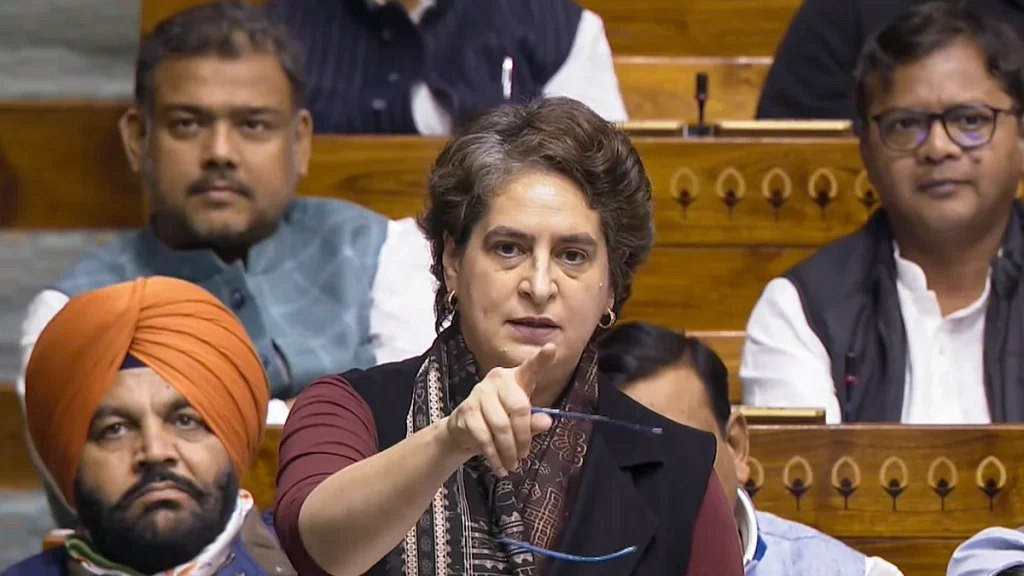
Participating in the ongoing debate, Priyanka Gandhi remarked:
“Big cities are polluted, and we’re talking about small things.”
Her statement echoed through the House, forcing both ruling and opposition benches to reflect on the contrast between celebratory discussions and real-world challenges faced by millions of citizens.
1. The Occasion: 150 Years of Vande Mataram
The debate in Parliament was intended to pay homage to one of India’s most iconic patriotic compositions. Written by Bankim Chandra Chattopadhyay in the 1870s, Vande Mataram played a defining role in India’s struggle for independence. Over generations, it has evolved into more than just poetry—it’s a symbol of unity, sacrifice, resistance, and national awakening.
The Winter Session, already politically charged with multiple legislative agendas and ongoing policy battles, offered a moment of collective reflection. Members from across parties praised the ideals represented by the song, its role in shaping nationalist consciousness, and its deeply emotional appeal. They spoke about devotion to the motherland, the responsibilities of modern India, and the values that bind the nation together.
But amidst these passionate speeches, Priyanka Gandhi’s intervention stood out.
2. Priyanka Gandhi’s Sharp Intervention: “Big Cities Are Polluted”
When Priyanka Gandhi rose to participate, expectations were high. Known for her articulate speeches, empathetic tone, and ability to reflect public sentiment, she used the opportunity not merely to praise the country’s heritage but to point out an uncomfortable truth.
Priyanka Gandhi’s comment —
“Big cities are polluted, and we’re talking about small things” —
was not just a criticism; it was a reality check.
Her words questioned whether Parliament was prioritizing symbolic discussions over substantive issues that directly impact people’s health and everyday life. By calling pollution a “big issue” and ongoing debates “small things,” Priyanka Gandhi framed the problem not as an ideological dispute but as a humanitarian crisis.
This was not to undermine the importance of Vande Mataram but to highlight the urgency of environmental action.
3. Why Priyanka Gandhi Remarks Hit Hard
There are several reasons why Priyanka Gandhi’s comment became one of the most discussed interventions of the day:
A. Pollution Is at an All-Time High
Delhi and NCR regions have been repeatedly ranked among the most polluted cities in the world. Thick smog, hazardous AQI levels, respiratory illnesses, school closures, and health emergencies have become annual realities.
B. Public Frustration Is Rising
People feel that pollution-related discussions in Parliament are minimal compared to the severity of the crisis. Priyanka Gandhi directly voiced this public frustration.
C. Symbol Vs. Substance
While Vande Mataram is emotionally significant, the contrast between celebrating the nation and neglecting its environment creates moral tension. Priyanka Gandhi highlighted this gap.
D. Parliament’s Priorities Under Scrutiny
Her remarks forced the House to reflect on whether it is truly addressing the most pressing challenges citizens face daily.

4. Political Reactions Inside Parliament
1. Ruling Party Reaction
Members of the ruling side argued that the discussion on Vande Mataram was important for national unity and cultural pride. They suggested that environmental issues are addressed in other discussions and committee meetings.
However, Priyanka Gandhi’s statement clearly made them uncomfortable, as it shifted public attention back to pollution — an issue the government often struggles to manage due to administrative and political complexities.
2. Opposition’s Support
Other opposition leaders applauded Priyanka Gandhi for speaking the truth. They reiterated that pollution cannot be sidelined as a seasonal topic and must become a central legislative priority.
Opposition MPs argued that the government often focuses more on symbolic nationalism and less on fundamental governance issues.
5. The Broader Context: Pollution as India Silent Emergency
India’s pollution crisis is not limited to Delhi. Cities like Mumbai, Kolkata, Lucknow, Chennai, Ahmedabad, and Kanpur face increasing pollution due to:
- Vehicular emissions
- Industrial waste
- Construction dust
- Burning of crop residue
- Poor waste management
- Lack of green cover
- Climate change
By bringing this up during a session celebrating Vande Mataram, Priyanka Gandhi underscored a powerful message:
Patriotism must also include protecting the motherland’s air, land, and future generations.
6. Priyanka Gandhi’s Political Messaging
There is a deeper political strategy behind Priyanka Gandhi’s remarks:
1. A Shift Toward Issue-Based Politics
By focusing on pollution, Priyanka Gandhi signaled Congress’s intention to shift debates from ideological themes to practical governance concerns.
2. Connecting With the Urban Middle Class
Urban voters—especially young professionals and parents—are heavily affected by pollution. Her remarks resonate strongly with this group.
3. Pushback Against Symbolic Politics
Priyanka Gandhi subtly criticized the tendency to prioritize symbolism over policy. By calling pollution the “bigger issue,” she reframed the narrative.
4. Positioning Herself as a Responsible Leader
Her interventions often emphasize real issues—price rise, women’s safety, unemployment, and now environmental health. This builds her image as a grounded and responsible political voice.
7. Symbolism of Her Speech During a Vande Mataram Debate
The choice to raise environmental concerns during a discussion on Vande Mataram carries layered meaning:
- Vande Mataram is about devotion to the motherland.
- Pollution is harming that very motherland.
- Expressing love for the nation requires protecting it.
- True patriotism includes environmental stewardship.
Priyanka Gandhi used the symbolism to strengthen her message:
“A polluted motherland dishonors the ideals of Vande Mataram.”
8. India’s Pollution Crisis: Statistics That Support Priyanka Gandhi Concern
Data across multiple studies shows:
- 21 of the world’s 30 most polluted cities are in India.
- Air pollution kills over 12 lakh (1.2 million) Indians annually.
- Children in polluted cities show reduced lung capacity.
- AQI levels regularly cross hazardous levels in winter.
- Pollution reduces life expectancy by up to 9 years in some regions.
Given these realities, Priyanka Gandhi’s remarks reflect facts, not political exaggeration.
9. Citizens’ Reaction to Priyanka Gandhi’s Speech
On social media, thousands of users praised Priyanka Gandhi for highlighting everyday struggles. Citizens expressed:
- Relief that someone finally raised pollution during a national debate.
- Anger that the issue is repeatedly ignored.
- Demands for immediate solutions.
Many tweeted that while they respect Vande Mataram, their priority is the health of their families — and Priyanka Gandhi gave voice to that sentiment.
10. Why Priyanka Gandhi’s Speech Matters Politically
A. She Shifted the Debate
In a session filled with patriotic rhetoric, Priyanka Gandhi grounded the discussion in reality.
B. She Challenged Parliament’s Priorities
Her remarks serve as a reminder that symbolic discussions must not overshadow urgent crises.
C. She Raised Accountability
Both Central and State governments share responsibility for pollution. Her intervention brought focus to this shared accountability.
D. She Elevated Public Issues
By speaking about pollution, Priyanka Gandhi showed that Parliament must reflect people’s concerns, not political posturing.
11. The Environmental Message Hidden Within Vande Mataram
Even though Vande Mataram was written in the 19th century, its verses contain imagery of:
- lush forests
- rich harvests
- rivers flowing through the land
- gentle winds
- natural beauty of Bharat Mata
Priyanka Gandhi’s intervention can be read as a reminder that the spirit of Vande Mataram includes protecting the environment.
If Bankim Chandra wrote the hymn today, the polluted skies of Indian cities would deeply contradict the vision he celebrated.
12. Priyanka Gandhi’s Role in Parliament: A Rising Voice
In recent years, Priyanka Gandhi has emerged as a powerful parliamentary and public speaker. Her speeches are known for:
- Empathy
- Directness
- Social focus
- Ground-level realism
Her intervention during this debate once again demonstrated her ability to frame issues sharply and meaningfully.
Many political analysts believe that Priyanka Gandhi is positioning herself as a key national leader, focusing on issue-based credibility rather than aggressive political rhetoric.
13. Will the Government Respond?
The government may:
- highlight existing initiatives like the Graded Response Action Plan (GRAP)
- point to steps taken by states
- discuss technological solutions
- talk about long-term plans
However, Priyanka Gandhi’s criticism is that these steps are not enough — nor are they urgent.
The larger question remains:
Will pollution receive the national-level attention it deserves?
Her speech has certainly reignited the debate.
14. The Road Ahead: What India Needs
True patriotism requires concrete steps:
- Stricter air quality laws
- Regional pollution control bodies
- Incentives for green technology
- Reducing vehicular emissions
- Strengthening public transport
- Expanding green cover
- National emergency response mechanisms
- Cross-state coordination
These require political will, budgetary commitment, and regulatory enforcement — not just symbolic debates.
15. Conclusion: Priyanka Gandhi’s Message Reshapes the Debate
The Winter Session debate on Vande Mataram was expected to be purely symbolic. But Priyanka Gandhi transformed it into a deeper reflection on national responsibility.
Her statement —
“Big cities are polluted, and we’re talking about small things.”
— will be remembered as one of the most impactful lines of the session.
By bringing environmental concerns into a patriotic discussion, Priyanka Gandhi demonstrated that love for the nation must also include concern for its air, its people, and its future.
Her intervention was not merely political; it was moral, social, and deeply patriotic.
In speaking for the health of India’s citizens, Priyanka Gandhi upheld the true essence of Vande Mataram — devotion to the motherland.
Read More latest news

