
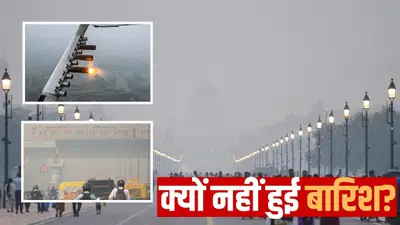
Why Did Cloud Seeding Fail in Delhi? Insights from an IIT Kanpur Scientist on What Went Wrong and What We Can Learn for the Future.
Introduction: A Rain of Expectations That Never Came
cloud seeding For weeks, Delhiites had pinned their hopes on one promising phrase — “cloud seeding.” The city, choking under layers of smog and toxic air, waited anxiously for a miracle from the skies. The idea seemed simple and elegant: spray certain chemicals into clouds to induce rainfall and wash away the pollution. It was supposed to be science meeting necessity — an ambitious plan to bring artificial rain to cleanse Delhi’s foul air.
However, the much-anticipated cloud seeding operation failed to produce the expected results. Despite meticulous planning, government coordination, and high expectations, the skies over Delhi remained largely dry. Many residents were left asking: Why did it fail? Was it the weather, the timing, or something wrong with the technology itself?
To answer these questions, experts from the Indian Institute of Technology (IIT) Kanpur, who were deeply involved in the project, have come forward with explanations grounded in science. Their insights reveal not only the challenges of weather modification but also the limitations of human control over nature.
This blog explores — in detail — why the Delhi cloud seeding attempt did not succeed, what scientists learned from it, and whether such experiments can ever truly work in India’s complex atmospheric conditions.
What Is Cloud Seeding and How Is It Supposed to Work?
Before diving into why it failed, it’s important to understand how cloud seeding actually works.
Cloud seeding is a weather modification technique designed to enhance rainfall by dispersing certain substances into the atmosphere. These substances act as nuclei around which water droplets can form. When enough droplets gather, they become heavy and fall as rain.
The most commonly used seeding agents include:
- Silver iodide (AgI) – mimics the structure of ice crystals, ideal for cold clouds.
- Sodium chloride (NaCl) – commonly known as table salt, used for warm clouds.
- Potassium chloride (KCl) and Dry Ice (CO₂) – also used in various atmospheric conditions.
In Delhi’s case, scientists from IIT Kanpur planned to seed suitable clouds with silver iodide and sodium chloride using aircraft and ground-based generators. The idea was to target specific cloud formations that already contained sufficient moisture but needed a “trigger” to release it as rain.
The concept has worked in several parts of the world — from the UAE’s desert regions to China’s pre-Olympic weather control experiments — so hopes were high that Delhi’s pollution crisis could be mitigated through the same means.

The Context: Why Delhi Turned to Cloud Seeding
Delhi’s air pollution levels in recent years have repeatedly reached hazardous levels. In late October and early November 2025, the Air Quality Index (AQI) frequently crossed 600, making it one of the most polluted capitals on Earth. Schools were shut, flights were delayed, and hospitals reported spikes in respiratory illnesses.
The Aam Aadmi Party (AAP) government, in coordination with the Union Environment Ministry, sought innovative solutions to combat this emergency. Among them, cloud seeding stood out as a potentially transformative approach — if it could work.
The plan was ambitious but necessary. Scientists from IIT Kanpur, under the guidance of Professor Manindra Agrawal, had previously conducted successful pilot tests in Maharashtra’s drought-hit Solapur region. The Delhi operation was to be the first full-scale attempt to use cloud seeding not for drought relief, but for air purification.
The Timeline: What Actually Happened
The Delhi cloud seeding mission was scheduled after careful weather monitoring. Scientists from IIT Kanpur, along with the India Meteorological Department (IMD), identified two potential windows when the atmosphere showed signs of favorable moisture and cloud presence.
Two aircraft were readied — one equipped with chemical flares containing silver iodide and sodium chloride — while another was used for atmospheric observation and data collection. The entire process was coordinated with Delhi’s pollution control authorities.
However, when the operation began, the expected rainfall did not occur. Instead of widespread rain, only light drizzles were reported in some isolated parts of NCR. For a project that cost crores and involved top scientific institutions, this was seen as a setback.
The Main Question: Why Did It Fail?
According to Professor Manindra Agrawal of IIT Kanpur, who led the scientific team behind the project, the failure was due to unfavorable meteorological conditions — particularly, the lack of sufficient cloud density and moisture.
He explained:
“Cloud seeding is not magic. It is a science that depends entirely on the presence of the right kind of clouds. Unfortunately, the weather conditions in Delhi at the time were not ideal. The moisture content in the atmosphere was lower than required.”
Let’s break down the key reasons scientifically:
1. Absence of Suitable Clouds
Cloud seeding can only work when there are “seedable” clouds — those that already contain enough supercooled water droplets. In Delhi’s case, the clouds were too thin and scattered.
Professor Agrawal explained that Cumulus clouds are the best candidates for seeding because of their high vertical development and water content. But the clouds over Delhi were more like Stratocumulus or Altostratus — spread thinly across the sky without sufficient moisture depth.
In simpler terms, there wasn’t enough “raw material” to work with. Seeding a dry or weak cloud is like trying to squeeze water out of a stone.

2. Low Humidity and Weak Updrafts
Cloud formation and rainfall rely heavily on vertical air movement — warm air rising and cooling at higher altitudes. Delhi’s weather during the experiment was dominated by stable air layers that restricted upward movement.
The relative humidity levels were below 60% at seeding altitude — much lower than the 80–90% needed for cloud seeding to be effective. As a result, even though the chemicals were dispersed, they failed to trigger condensation in sufficient quantities to cause rainfall.
3. Wind Shear and Temperature Variations
The wind speed and direction also played a disruptive role. When the aircraft released the seeding agents, winds at higher altitudes scattered the chemicals unevenly, diluting their concentration in the target zone.
Additionally, temperature inversions — where warm air traps cool air below — prevented vertical mixing. This inversion layer acted like a lid, keeping pollutants and seeded particles confined close to the surface, rather than allowing them to rise and form rain-bearing clouds.
4. Timing and Coordination Challenges
Another issue lay in the timing of the operation. Weather patterns in northern India are highly volatile in the post-monsoon season. The seeding mission was delayed several times due to air traffic restrictions, last-minute clearances, and shifting cloud patterns.
By the time the aircraft took off, the ideal cloud conditions had already started dissipating. According to one IIT scientist involved, “Had we been able to start even three hours earlier, the chances of success would have been significantly higher.”
This shows how crucial real-time coordination between scientific teams, air traffic control, and meteorological monitoring is for such operations.
5. Natural Limitations of Cloud Seeding
Cloud seeding, even under ideal conditions, can only enhance existing rainfall by about 10–30%, not create new rain out of thin air. It cannot work in completely dry skies or during heavy pollution when aerosols compete with seeding particles for moisture.
Delhi’s air, saturated with particulate matter (PM2.5 and PM10), already had billions of microscopic particles — natural “condensation nuclei.” The addition of silver iodide may have had minimal additional effect, as the air was already overloaded with aerosols.
6. Shortage of Modern Equipment and Data Gaps
Compared to advanced cloud seeding programs in countries like China or the UAE, India’s operational infrastructure remains limited. Delhi’s mission relied on aircraft fitted with basic flare systems, without Doppler radar guidance or real-time microphysical sensors.
Without high-resolution data on droplet size, vertical cloud structure, and thermal dynamics, it becomes difficult to precisely target the right sections of a cloud. This technological gap significantly reduces the success probability.
Insights from IIT Kanpur: What Scientists Say
Following the failed attempt, scientists at IIT Kanpur emphasized that the project should not be seen as a total failure. Rather, it was an important learning experience that provided valuable data about the behavior of Delhi’s atmosphere during winter pollution episodes.
Professor Agrawal clarified:
“The mission gave us crucial information on atmospheric parameters, humidity levels, and cloud structures. These findings will help us refine our models for future operations. Science evolves through trial and error, and this is a step forward, not backward.”
He added that cloud seeding in India’s northern plains is particularly challenging due to the complex mix of pollution, low humidity, and irregular wind patterns. Unlike coastal or hilly regions, Delhi’s geography doesn’t naturally support convective cloud formation during dry months.
Learning from Global Experiences
Countries like China, Israel, and the United Arab Emirates have been conducting cloud seeding for decades, often with measurable success. However, their success depends on factors absent in Delhi’s case.
For instance:
- China’s cloud seeding programs target existing rain clouds during humid conditions.
- The UAE combines seeding with advanced weather radar systems, allowing precise targeting.
- Israel’s seeding is conducted during cooler months when moisture is abundant.
These regions typically start seeding under favorable meteorological conditions, not during periods of extreme dryness or pollution. Delhi’s experiment was, in contrast, reactive rather than preemptive — a desperate measure amid environmental crisis, rather than a planned seasonal strategy.
The Science Behind Failure: Beyond Simple Explanations
Weather is chaotic — influenced by countless variables that interact in complex ways. Even the most advanced models can’t predict exact outcomes. When dealing with artificial rain, this uncertainty multiplies.
Cloud seeding involves manipulating microphysical processes inside a cloud — something that even powerful supercomputers struggle to simulate accurately. A change in wind direction or temperature at a single altitude layer can alter results dramatically.
Thus, the “failure” was not necessarily due to incompetence or poor planning. It was the result of natural unpredictability combined with the limitations of current technology.
Public Expectations vs. Scientific Reality
One major lesson from the Delhi episode is the gap between public perception and scientific feasibility. For many residents, “cloud seeding” sounded like pressing a button to make rain fall instantly. The reality, as scientists have repeatedly said, is far more nuanced.
Professor Agrawal summarized it best:
“Cloud seeding can enhance rainfall, but it cannot create clouds. People must understand that it’s not a quick-fix for pollution.”
Indeed, air pollution control requires long-term policy solutions — reduction in emissions, cleaner transport, green cover, and industrial regulation — not just technological interventions.
What Could Be Done Better Next Time?
Despite the setbacks, IIT Kanpur and IMD are already analyzing data for future improvements. Based on scientific insights, here are key recommendations for future cloud seeding attempts:
- Better Timing: Target the monsoon withdrawal phase when moisture levels are higher.
- Advanced Equipment: Use radar-guided systems and real-time atmospheric sensors.
- Continuous Monitoring: Build a cloud climatology database for Delhi and northern India.
- Inter-Agency Coordination: Streamline permissions between DGCA, IMD, and research institutions.
- Public Communication: Manage expectations through transparent updates and awareness campaigns.
With these improvements, India could develop a more scientifically robust cloud seeding framework — not as a panic tool, but as a supplementary weather management technique.
The Broader Lesson: Respect Nature’s Complexity
Delhi’s failed cloud seeding experiment serves as a reminder of the limits of human control. Despite our scientific progress, the atmosphere remains a complex and dynamic system that doesn’t always bend to our will.
While technology can aid us, true environmental solutions lie in restoring balance — reducing emissions, reforesting urban areas, and rethinking development models that choke the air we breathe.
As Professor Agrawal noted,
“Nature has its laws. We can nudge it, but not command it. Our focus must remain on prevention, not artificial correction.”
Conclusion: A Step Forward in Disguise
Even though Delhi’s cloud seeding mission failed to bring rain, it has opened new avenues of research, data collection, and policy debate. Science progresses through such experiments — each attempt adds a layer of understanding that improves the next.
The IIT Kanpur team plans to use this data to develop better predictive models for future weather modification projects. With continued research, improved coordination, and realistic expectations, cloud seeding may still play a role in India’s future — perhaps not as a magic wand, but as a scientifically informed tool in a broader climate strategy.
For now, the skies over Delhi remain gray, but the spirit of inquiry shines bright. The lesson is clear: technology can assist nature, but cannot replace it.
Read more latest news

