

Arvind Kejriwal Targets BJP and Congress: “For the Past 60 Years, Goa Has Been Controlled by 13–14 Families”
Introduction
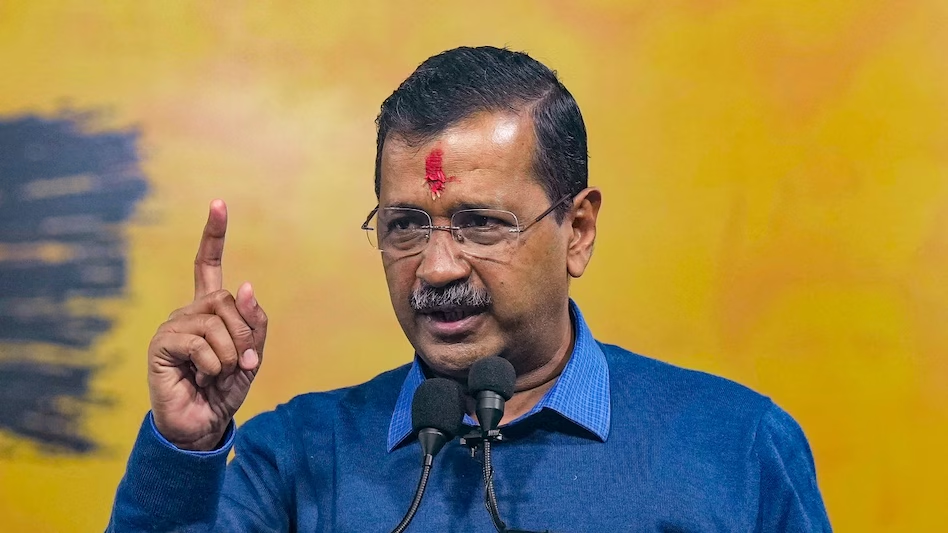
Arvind Kejriwal targeted the BJP and Congress, saying In a fiery political statement that has reignited the debate on dynastic politics and entrenched power structures, Aam Aadmi Party (AAP) convener and Delhi Chief Minister Arvind Kejriwal launched a scathing attack on both the Bharatiya Janata Party (BJP) and the Congress, accusing them of turning Goa into a personal fiefdom for a select few.
Speaking during his visit to the coastal state, Kejriwal declared, “For the past 60 years, Goa has been controlled by 13-14 families from both parties. These are the same people contesting elections and holding power.” His remarks struck a chord with voters disillusioned by decades of political recycling, where the same faces — often from the same families — have alternated between parties but retained control over the state’s governance.
This statement is more than a routine political barb; it reflects the AAP’s attempt to position itself as a fresh, corruption-free alternative to the entrenched political elite in Goa. In this blog, we’ll explore the context, implications, and potential impact of Kejriwal’s explosive claim — delving deep into Goa’s political history, AAP’s strategy, and what this means for the future of the state’s democracy.
1. Understanding Goa’s Political Landscape
Goa, one of India’s smallest yet most politically vibrant states, has a unique political story. Since its liberation from Portuguese rule in 1961, the state has witnessed an unusual mix of regional aspirations, frequent party switching, and coalition politics. Despite its small size, Goa’s politics have always drawn national attention due to its distinct identity and the influence of tourism, mining, and church-backed social movements.
Over the decades, Goa has oscillated between Congress and BJP rule, with short-lived regional alliances occasionally entering the fray. But Kejriwal’s statement highlights an often-overlooked truth — that regardless of the party label, power has remained concentrated within a small network of politically dominant families.
These families have not only dominated electoral contests but have also been deeply entrenched in economic and bureaucratic circles, effectively making Goa’s politics a “closed club” inaccessible to ordinary citizens.
2. Kejriwal’s Statement: The Context
Kejriwal’s remarks came during his visit to Goa as part of AAP’s campaign push ahead of the upcoming elections. With AAP attempting to expand its national footprint beyond Delhi and Punjab, Goa presents a unique opportunity — a literate, urban, politically aware electorate that is increasingly disillusioned by traditional parties.
In his address, Kejriwal did not mince words. He said:
“Goa has been ruled by the same 13-14 families for 60 years. Whether it’s Congress or BJP, the faces remain the same. They switch parties, change slogans, but the corruption, nepotism, and control remain unchanged. The people of Goa deserve new, honest leadership.”
By naming both BJP and Congress in the same breath, Kejriwal aimed to project AAP as the third force — one untainted by Goa’s political legacy of defections, corruption, and power concentration.
3. The Legacy of Political Families in Goa
Kejriwal’s claim is not without basis. Goa’s politics, like many other Indian states, has long been dominated by a handful of families whose members have alternated between political offices for decades.
Some of the most prominent examples include:
- The Rane family – With Pratapsingh Rane serving as Chief Minister multiple times and his son Vishwajit Rane currently holding a key ministerial position, the Ranes have been an enduring political dynasty.
- The Alemao family – Churchill Alemao and his relatives have switched parties several times, moving from Congress to regional outfits and even to BJP, but have remained politically relevant.
- The Monserrate family – Atanasio Monserrate (Babush), his wife Jennifer, and other family members have alternated power and party affiliation.
- The Sardesai family – Vijai Sardesai, leader of the Goa Forward Party, represents another political lineage with significant local influence.
These are just a few names from the political ecosystem Kejriwal was referring to — families whose political presence transcends ideology or party allegiance. Their influence extends into business, mining, and real estate sectors, making them key power brokers in Goan society.
4. The Issue of Political Defections in Goa
One of the most striking features of Goa’s politics is the frequent defection of MLAs. The state has earned an unfortunate reputation for party hopping, where elected representatives switch sides for power or position.
After every election, the same politicians who lose under one party’s banner often reappear in another, ensuring their continued hold over political offices. This pattern has eroded public trust and blurred ideological lines.
In recent years, defections from Congress to BJP (and vice versa) have become routine, leading to unstable governments. Voters increasingly feel that regardless of their vote, the outcome remains the same, as the same set of politicians ultimately control power.
Kejriwal’s remark directly targets this political recycling system, positioning AAP as the party that will break this vicious cycle.
5. AAP’s Political Strategy in Goa
AAP entered Goa’s political arena in 2017, promising clean governance and an alternative to the duopoly of BJP and Congress. Despite fielding strong candidates and conducting a high-voltage campaign, the party could not make a significant electoral breakthrough then.
However, lessons were learned. This time, AAP’s strategy in Goa focuses on grassroots engagement, localized issues, and the promise of new faces. Kejriwal’s narrative that “13-14 families have hijacked democracy” aligns with the AAP’s core message — power should belong to the people, not the elite.
By combining the Delhi model of governance — free electricity, quality schools, healthcare, and transparent administration — with Goan realities like mining employment, tourism regulation, and coastal protection, AAP is attempting to build a relatable and reformist image.
6. The Core of Kejriwal’s Message: Anti-Dynastic Politics
Kejriwal’s statement taps into a deep public sentiment against dynastic politics — a recurring theme across India.
In Goa, where politics often feels like a family inheritance, the promise of new leadership resonates strongly, especially with young and first-time voters.
His speech implied that the BJP and Congress are two sides of the same coin — political entities that serve the same elite interests. AAP, on the other hand, is portraying itself as the party of the common citizen, where ticket distribution and leadership are based on merit rather than lineage.
This anti-dynastic, anti-corruption stance mirrors Kejriwal’s earlier movements in Delhi, where AAP rose from a grassroots anti-corruption campaign to form a government that disrupted traditional politics.
7. Why Goa’s Power Structure Is Hard to Break
While Kejriwal’s criticism is sharp and well-aimed, dismantling Goa’s entrenched political order is not easy. There are historical and structural reasons behind the continued dominance of elite families:
- Small Size and Tight Networks: Goa’s compact geography and close-knit communities mean that political influence often runs through family and local networks.
- Wealth from Mining and Tourism: Families who control these sectors have strong financial leverage in elections.
- Party Fluidity: Switching parties has been normalized in Goan politics, allowing the same figures to retain power despite changing alliances.
- Weak Opposition Base: Regional and new parties have often struggled to maintain consistent voter support or ideological coherence.
However, with voter awareness increasing and technology making governance more transparent, these old patterns are now under scrutiny — something Kejriwal is trying to capitalize on.
8. Public Reaction to Kejriwal’s Statement
The response to Kejriwal’s remarks in Goa has been mixed but largely positive among ordinary citizens.
Many voters acknowledge the truth behind his observation — that politics has become repetitive, with the same leaders switching sides every few years.
On social media, Goans praised the AAP leader for “saying what everyone knows but few dare to admit.” Civil society groups, too, have echoed concerns about political monopoly and lack of accountability among long-standing leaders.
However, leaders from BJP and Congress dismissed Kejriwal’s comments as political theatrics, accusing him of “outsider arrogance” and “simplifying complex local politics.” Some even argued that AAP lacks understanding of Goa’s regional issues.
Despite such pushback, Kejriwal’s message has undeniably struck a chord with voters yearning for genuine change.
9. The Broader National Narrative
Kejriwal’s statement also fits into AAP’s national expansion strategy. Beyond Goa, the party has consistently positioned itself as an alternative to the Congress-BJP establishment.
By framing both major parties as part of the same “old system,” Kejriwal is attempting to occupy the space of a new-age national party rooted in governance, not dynasty.
This “third force” approach is already visible in states like Punjab, Delhi, and Gujarat, where AAP’s governance model and anti-corruption narrative have gained traction. Goa, with its politically aware electorate, serves as a symbolic battleground for this larger ideological positioning.
10. Comparing Goa with Delhi and Punjab
In Delhi, AAP’s success came from showcasing visible governance results — quality education, healthcare, and transparent administration.
In Punjab, the party’s victory stemmed from voters’ disillusionment with long-standing power groups like the Badals and Congress.
Goa presents a similar opportunity. Just as Punjab rejected political monopolies, Goan voters might be ready to move beyond their traditional power families. Kejriwal’s call for ending “60 years of control by 13-14 families” draws direct parallels to the anti-establishment mood that powered AAP’s earlier successes.
11. The Significance of 60 Years
When Kejriwal said that Goa had been “controlled for 60 years,” he was referencing the entire post-liberation period since 1961.
During these six decades, Goa transitioned from a Portuguese territory to an Indian state, yet the political class remained largely unchanged.
Families that entered politics in the 1960s and 70s continue to dominate today, creating a kind of democratic stagnation. The continuity of these families, even as parties changed, reflects the deep-rooted nexus between power and privilege in the state.
12. Kejriwal’s Appeal to the Common Goan
Kejriwal’s political messaging in Goa is rooted in emotional and practical appeal. His speeches emphasize:
- Employment for youth – particularly in tourism, education, and small industries.
- Honest governance – free from nepotism and favoritism.
- Revival of mining with transparency.
- Free electricity and better schools – replicating Delhi’s “model of governance.”
By presenting a contrast between ordinary Goans and elite families, Kejriwal is trying to build a narrative of people versus the establishment, something that resonates deeply in a state that prides itself on independence and identity.
13. The Role of Corruption in Goa’s Political Fatigue
Mining scams, illegal land deals, and misuse of public funds have long plagued Goan politics.
Kejriwal’s anti-corruption image — built since the India Against Corruption movement — gives AAP credibility in this space.
By directly linking corruption to the “13-14 families,” Kejriwal is implying that the root of corruption lies in power monopolization. When the same families control government contracts, bureaucratic appointments, and policy decisions, governance becomes less about public service and more about personal benefit.
This message has strong resonance among small business owners, fishermen, teachers, and youth who feel excluded from the political process.
14. What the BJP and Congress Say
Predictably, both BJP and Congress leaders reacted strongly.
- BJP spokespersons accused Kejriwal of “insulting Goan voters” by implying they had repeatedly elected the wrong people. They argued that Goa’s leadership represents public will, not dynastic privilege.
- Congress leaders, meanwhile, said AAP’s statements were “headline politics”, claiming that the party has failed to understand the complexities of Goan society.
However, neither side could effectively counter the underlying truth — that political power in Goa has indeed been recycled among a limited elite for decades.
15. Can AAP Break the Pattern?
The real test for Kejriwal’s claim lies in whether AAP can convert this rhetoric into results.
In past elections, despite good messaging, the party struggled with local leadership and organization. This time, AAP is focusing on:
- Grassroots volunteers instead of celebrity candidates.
- Transparent ticket distribution to avoid internal rifts.
- Community engagement through door-to-door campaigns and mohalla-style meetings.
- Building trust through visible social work and issue-based politics.
If AAP succeeds, Goa could witness a historic political shift, breaking free from the cycle of family-dominated politics.
16. The Psychological Impact of Kejriwal’s Speech
Kejriwal’s tone was not just accusatory — it was empowering. He framed Goan voters as victims of an elite conspiracy but also as potential agents of change. His words encouraged them to believe that they could reclaim their democracy.
In political communication, this is crucial: creating a sense of moral ownership among voters. By identifying the “13-14 families” as the root of stagnation, Kejriwal positioned AAP as the liberator of Goan democracy.
17. AAP’s Broader Vision: A Decentralized Democracy
At the heart of AAP’s philosophy is the idea of people-led governance — where ordinary citizens have direct control over decision-making through local assemblies, transparency portals, and community audits.
In Goa, this resonates strongly with the panchayat tradition and the Goan identity of local autonomy. Kejriwal’s message thus fits into a broader ideological framework — one that promises to return power from political dynasties to the people.
18. The Role of Young Voters
A crucial factor in Goa’s changing political climate is the rising youth participation. With over 1.2 lakh young voters expected in the upcoming polls, the demand for clean politics and new opportunities is stronger than ever.
AAP’s digital campaigns, student outreach programs, and emphasis on education reforms directly target this demographic. Young voters, less tied to old loyalties, could be the deciding force that validates Kejriwal’s challenge to the traditional political elite.
19. Expert Opinions and Analysis
Political analysts believe Kejriwal’s comments serve both symbolic and strategic purposes.
- Symbolically, they frame AAP as a revolutionary force fighting corruption and privilege.
- Strategically, they help AAP connect with disillusioned Congress voters who feel betrayed by repeated defections.
Analyst Rajeev Desai noted, “Kejriwal’s statement about 13-14 families is not just about Goa — it’s about India. It’s a message to voters nationwide that AAP stands against dynastic politics and in favor of people’s governance.”
20. Conclusion: A New Political Awakening in Goa
Arvind Kejriwal’s statement that “Goa has been ruled by 13-14 families for 60 years” may have stirred controversy, but it has also reignited a critical conversation — who really controls democracy?
By challenging the entrenched political elite, Kejriwal has opened a space for reflection among Goan voters. His call for new leadership, transparency, and clean governance resonates with those tired of the same recycled faces and broken promises.
Whether AAP can translate this sentiment into electoral success remains to be seen. But one thing is clear — Kejriwal has succeeded in shifting the political narrative. No longer can parties rely solely on family names or inherited power. The people of Goa are watching, questioning, and demanding change.
In the end, this is not just a story about Goa. It is a story about India’s evolving democracy — where the power of a few families is finally being challenged by the voice of the people. And in that struggle, Arvind Kejriwal’s words have become both a mirror and a movement.

