

Agni-5 Successfully Tested: India’s 5,000 km Strike Range Missile Strengthens Strategic Power.
Introduction
India, a rising global power, has once again demonstrated its defense capabilities by successfully testing the Agni-5 intercontinental ballistic missile (ICBM) with a strike range of 5,000 kilometers. The test has not only enhanced India’s deterrence capability but also sent a strong message to the world about its strategic preparedness.
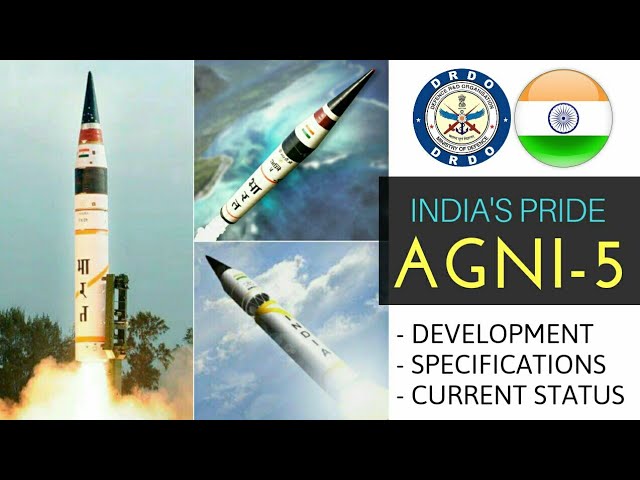
The Agni-5 missile belongs to the prestigious “Agni series” of missiles developed under the Defence Research and Development Organisation (DRDO). While Agni-1, Agni-2, Agni-3, and Agni-4 already form the backbone of India’s nuclear deterrence, the Agni-5 stands apart due to its intercontinental reach, modern technology, and reliability.
This successful test signifies India’s steady progress toward self-reliance in defense, boosting national security and strengthening its voice in international geopolitics.
Background: The Agni Missile Series
India’s journey toward building indigenous missile technology began in the 1980s with the Integrated Guided Missile Development Program (IGMDP) spearheaded by Dr. A.P.J. Abdul Kalam. Under this program, five key missile systems were developed—Prithvi, Trishul, Akash, Nag, and Agni.
- Agni-1: Medium-range ballistic missile with a range of 700–900 km.
- Agni-2: Extended range of 2,000–3,000 km.
- Agni-3: A robust missile with a 3,500 km range.
- Agni-4: Improved version with 4,000 km strike range.
- Agni-5: The crown jewel with a strike range of up to 5,000 km, covering vast regions of Asia, parts of Europe, and Africa.
The Agni series embodies India’s philosophy of “credible minimum deterrence” and its no-first-use nuclear policy.
Technical Features of Agni-5
The Agni-5 is not just another missile—it is a technological marvel showcasing India’s defense capabilities. Some of its notable features include:
- Range: 5,000 km, classifying it as an intercontinental ballistic missile.
- Payload Capacity: Capable of carrying a nuclear or conventional warhead weighing up to 1.5 tons.
- Propulsion: Three-stage solid-fuel rocket engine, ensuring greater reliability and longer shelf life.
- Accuracy: Equipped with Ring Laser Gyroscope (RLG) navigation system and advanced guidance technology, ensuring high precision strike capability.
- Mobility: Can be launched from road-mobile platforms, enhancing survivability.
- Stealth Features: Incorporates carbon composites to reduce radar detection and increase stealth.
- Multiple Independently Targetable Reentry Vehicles (MIRVs): Future versions are expected to carry multiple warheads, enabling strikes on different targets simultaneously.
Strategic Importance of Agni-5
1. Extending India’s Strategic Reach
With a range of 5,000 km, Agni-5 brings almost the entire Asian continent, including major Chinese cities like Beijing and Shanghai, within India’s strike radius. This strengthens India’s deterrence posture against adversaries.
2. Second-Strike Capability
India follows a no-first-use nuclear policy, which means it requires reliable second-strike capability. Agni-5 ensures that even in the event of an enemy attack, India can respond decisively.
3. Boost to Nuclear Triad
India already possesses nuclear-capable aircraft and submarine-launched missiles. With Agni-5, the land-based leg of the triad becomes significantly stronger.
4. Geopolitical Significance
The missile sends a clear message that India is not just a regional power but a strategic global player, capable of protecting its interests across continents.
The Successful Test
The test was conducted from the Dr. A.P.J. Abdul Kalam Island (formerly Wheeler Island) off the Odisha coast.
- The missile was launched from a mobile launcher.
- It followed a precise trajectory, and the payload successfully reached the targeted area in the Indian Ocean.
- All telemetry and radar stations tracked the flight path, confirming the missile’s accuracy and performance.
Officials from DRDO described the test as a “perfect mission,” further enhancing confidence in the missile’s operational readiness.
India’s Defense Policy and Agni-5
India has consistently maintained that its missile development is not offensive but purely defensive, aimed at deterrence. The doctrine of “credible minimum deterrence” ensures that India builds enough strength to deter aggression without entering an arms race.
Agni-5 fits into this doctrine perfectly. It provides India with a secure defense shield without violating its commitment to global peace and disarmament.
Global Reactions
China
China closely monitors India’s missile program. With Agni-5’s range covering major Chinese cities, Beijing has expressed “concern,” though officially it downplays the threat. Chinese analysts argue that India’s missile capability is primarily directed at them.
Pakistan
While Agni-5 is not specifically aimed at Pakistan (since even Agni-3 can cover its entire territory), Islamabad remains wary of India’s advancing missile program. Pakistani experts argue that India’s growing arsenal upsets the regional balance.
United States & Western Powers
The U.S. has largely remained neutral but acknowledges India’s right to self-defense. Strategic experts in the West often view India’s missile program as a counterbalance to China’s growing influence.
Russia
Russia, a long-standing defense partner of India, congratulated the successful test. Russian analysts see Agni-5 as a sign of India’s increasing self-reliance.
Expert Opinions
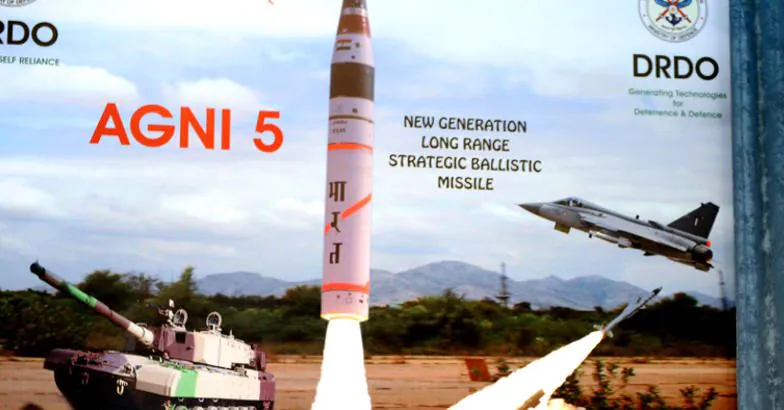
- Defense Analysts: They hail Agni-5 as a “game-changer” in South Asia, ensuring India cannot be coerced by stronger military powers.
- Military Strategists: Point out that Agni-5 strengthens India’s nuclear deterrence while complementing its conventional forces.
- Technologists: Celebrate it as a symbol of indigenous innovation and technological prowess.
Comparing Agni-5 with Global Missiles
- China’s DF-31A: Range of 11,000 km, but Agni-5 offers similar deterrence in Asia.
- U.S. Minuteman III: Intercontinental missile with 13,000 km range—India is catching up in technology, though not yet at parity.
- Russia’s RS-24 Yars: Highly advanced with MIRV capability. India’s future Agni-6 is expected to match closer.
Agni-5 proves that India is among the handful of nations capable of developing long-range ballistic missiles.
Challenges Ahead
While Agni-5 is a significant achievement, challenges remain:
- Ensuring deployment and operational readiness.
- Upgrading to MIRV technology for multiple warhead capability.
- Strengthening command-and-control systems to prevent accidental launches.
- Balancing defense spending with development priorities.
Future Roadmap: Agni-6 and Beyond
Reports suggest that DRDO is already working on Agni-6, which could have a range of 8,000–10,000 km and full MIRV capability. This would place India firmly in the league of advanced nuclear powers like the U.S., Russia, and China.
Additionally, India is investing in:
- Hypersonic Glide Vehicles (HGVs).
- Ballistic Missile Defense (BMD) systems.
- Anti-satellite weapons.
Together, these technologies will ensure India’s dominance in the defense sphere.
Domestic Reaction
The news of the successful Agni-5 test was met with national pride. Political leaders across party lines congratulated DRDO scientists for their hard work. Citizens took to social media with hashtags like #Agni5Success and #IndiaStrong trending nationwide.
This success comes at a time when India is emphasizing Atmanirbhar Bharat (Self-Reliant India) in defense, reducing dependence on foreign weaponry.
Broader Impact on International Relations
- Strengthened Negotiating Power: India’s global standing in forums like the UN and G20 is reinforced.
- Regional Deterrence: Adversaries will think twice before escalating conflicts.
- Defensive Diplomacy: India can use its missile capability as leverage while still promoting peace.
Lessons for the World
India’s Agni-5 story is not just about military might—it is also about perseverance, self-reliance, and technological innovation. It shows how a developing country can rise to global prominence through consistent efforts in research and development.
Conclusion
The successful test of the Agni-5 missile is a monumental achievement in India’s defense history. With a strike range of 5,000 km, it firmly establishes India as a global strategic power, capable of safeguarding its sovereignty and interests.
While the missile strengthens India’s deterrence posture, it also carries a message of peace—India develops such weapons not for aggression but to ensure stability.
As India marches forward with projects like Agni-6, hypersonic weapons, and advanced defense systems, it continues to balance strength with responsibility. The Agni-5 is not just a missile—it is a symbol of India’s scientific excellence, strategic vision, and unwavering commitment to national security.
Read more latest news

