
Mithun Chakraborty’s Bizarre Yet Bold Reply to Bilawal Bhutto: From BrahMos Missile to ‘Dam Tsunami’ Plan
Introduction: The Unlikely War Commentator
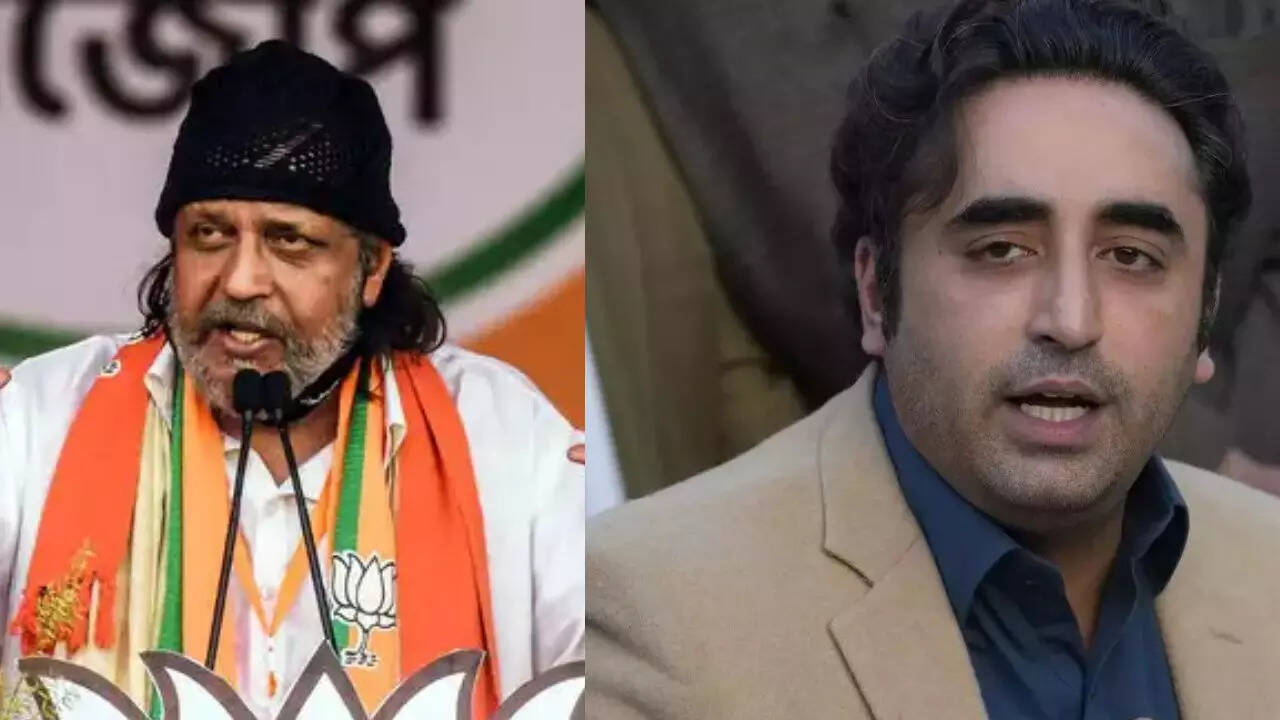
Mithun Chakraborty to react to Bilawal Bhutto’s war statement In Indian politics and cinema, few figures command the mix of respect, curiosity, and surprise quite like Mithun Chakraborty. Known to millions as the “Disco Dancer” of Bollywood and now an active politician under the BJP banner, Mithun is no stranger to making headlines. But this time, the news wasn’t about a new film, a political campaign, or a nostalgic dance performance. Instead, it was about his jaw-dropping reaction to a war statement from Bilawal Bhutto Zardari, Pakistan’s political scion and former Foreign Minister.
When journalists approached Mithun for a comment on Bilawal’s provocative war rhetoric, no one expected a standard diplomatic statement from him. Yet, what he delivered was a blend of military strategy, satire, and outright desi creativity — one that had both the media and the internet buzzing for days.
The Spark: Bilawal Bhutto’s War Statement
Before diving into Mithun’s unusual counter-proposal, it’s important to understand the trigger. Bilawal Bhutto Zardari has often been vocal — sometimes aggressively so — on matters involving India, especially Kashmir. His recent statement, which was perceived as a thinly veiled war threat, was no exception.
In his address, Bilawal painted India as a hostile force and suggested that Pakistan would “respond with full might” if provoked. Such statements, while not new in the tense Indo-Pak diplomatic history, have often been met with stern rebuttals from Indian political leaders, defense experts, and diplomats.
But this time, the microphone reached Mithun Chakraborty, and the conversation took an unexpected turn.
Mithun’s Two-Part Response: BrahMos Missile & the Tsunami Dam
Mithun began his reply with a classic show of Indian military capability:
“If Pakistan tries anything funny, one BrahMos missile is enough to remind them of their place.”
The BrahMos — a supersonic cruise missile jointly developed by India and Russia — has long been a symbol of India’s advanced defense capabilities. With its precision, speed, and versatility, it’s among the most feared weapons in the region. By invoking the BrahMos, Mithun was making it clear that India’s military deterrent was no idle threat.
However, what came next shifted the tone from defense policy to theatrical satire.
Mithun, with his characteristic poker face, outlined an unusual strategy:
“We will build a dam. 140 crore Indians will urinate in it for days. Then we will open the dam gates… and a tsunami will go straight into Pakistan.”
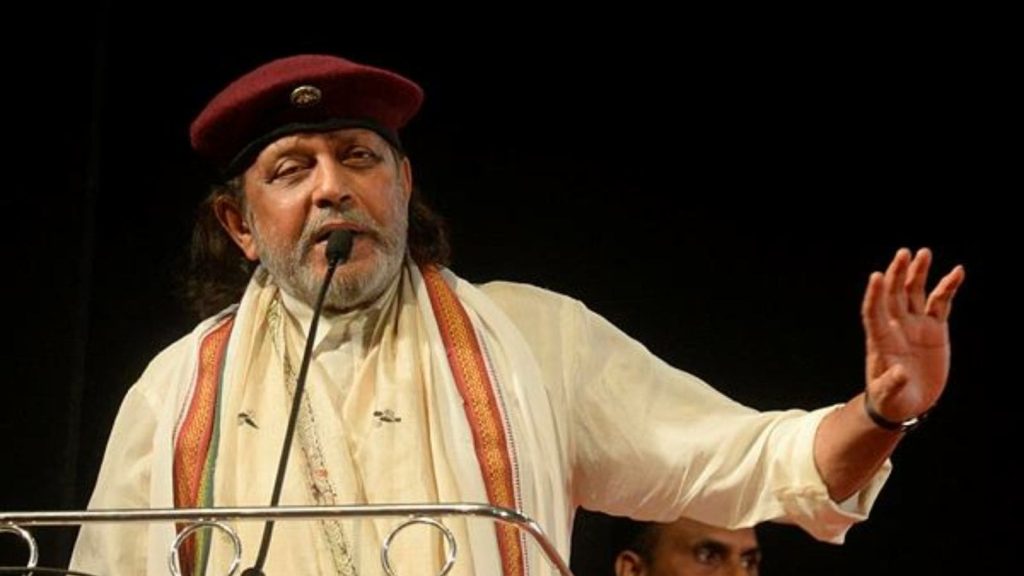
It was an outrageous image — part dark humor, part absurdist nationalism — but it resonated in a way only Mithun could pull off. It wasn’t about literal feasibility; it was about sending a symbolic message that India’s unity and collective willpower could be a force of nature in itself.
Breaking Down the “Dam Tsunami” Metaphor
While some took Mithun’s statement at face value and laughed, others saw a deeper satirical jab at Pakistan’s leadership.
- Unity as a Weapon
The idea of 140 crore Indians participating in a single act — no matter how ridiculous — emphasizes collective strength. Mithun’s exaggeration mirrors the idea that when India stands united, its impact is unstoppable. - Mocking Empty Threats
Just as Bilawal’s war rhetoric was largely symbolic and aimed at domestic audiences, Mithun’s “dam tsunami” plan was equally symbolic — a way of showing that two can play the hyperbolic game. - A Nod to India’s Water Advantage
India holds geographical control over several rivers flowing into Pakistan, and water diplomacy has long been a subtle strategic tool. While urination isn’t exactly a geopolitical policy, the dam analogy touched a nerve by indirectly hinting at control over water resources.
Public Reaction: Laughter, Memes, and Debate
Within hours, Mithun’s statement went viral. Social media platforms were flooded with memes, GIFs, and video edits. Some imagined giant CGI waves sweeping across borders, while others humorously calculated the ‘volume’ of such a dam.
On Twitter (now X), hashtags like #DamTsunami, #BrahMosMithun, and #DiscoDancerDiplomacy trended. Political commentators chuckled at the bizarre imagery but also noted that such statements carry a populist charm — blending patriotism with entertainment.
Facebook pages and WhatsApp groups were quick to circulate video clips of Mithun’s response, often with Bollywood background music from his own films. Some users juxtaposed his war plan with scenes from “Disco Dancer” and “Gunda,” turning it into a full-blown meme fest.
Media Coverage: From Newsrooms to Nightly Debates
Mainstream TV news channels, always eager for an unconventional soundbite, ran the clip repeatedly. Some anchors treated it as comic relief in otherwise serious coverage of Indo-Pak tensions, while others questioned whether such statements trivialized sensitive diplomatic issues.
Certain political panelists defended Mithun, arguing that humor and satire can be powerful tools against fear-mongering rhetoric from adversaries. Others suggested that political figures should stick to conventional, policy-driven responses when it comes to national security.
In print media, op-ed writers dissected the cultural significance of Mithun’s approach. One columnist noted that his response embodied the “chai shop banter” style of Indian political rhetoric — informal, relatable, and emotionally charged, often more effective in connecting with the masses than scripted speeches.

Historical Context: Celebrities in Political Commentary
Mithun’s unexpected war plan wasn’t an isolated incident in Indian history. Over the years, several Indian celebrities — from actors to cricketers — have waded into political and military commentary.
- Navjot Singh Sidhu once famously called Pakistan’s then-Prime Minister Imran Khan a “good friend” despite political tensions, sparking controversy.
- Akshay Kumar, during various interviews, has touched upon national security issues with patriotic undertones, often aligning them with his film releases.
- Sunny Deol, another Bollywood action star turned politician, has also made bold statements on Pakistan, echoing the larger-than-life persona from his films.
In this tradition, Mithun’s response blends the persona of a cinematic hero with the responsibilities of a political figure — a mix that India’s celebrity-politician culture seems to thrive on.
The BrahMos Factor: Real Military Power in the Mix
While the “dam tsunami” was comedic hyperbole, Mithun’s mention of the BrahMos missile was grounded in actual military capability. The missile, with a range of 300-500 kilometers and supersonic speed, could reach key strategic targets in Pakistan within minutes.
Defense experts often cite the BrahMos as a credible deterrent that complicates any aggressive military planning from Pakistan. By pairing the missile reference with his outrageous dam idea, Mithun essentially framed the spectrum of India’s responses — from the high-tech precision strike to the sheer absurdist might of a billion-plus citizens acting in unison.
India-Pakistan: The Tension Beyond the Punchlines
Despite the humor, the backdrop of Mithun’s statement remains tense. India and Pakistan have fought multiple wars since independence in 1947, with Kashmir being the central flashpoint. Even in times of relative peace, diplomatic exchanges often bristle with accusations and threats.
Statements like Bilawal’s keep the tensions simmering, and responses — whether measured or mocking — become part of the larger narrative. While government officials may tread cautiously, public figures like Mithun have more room for rhetorical flamboyance, allowing them to connect emotionally with the public while also sending a signal of resilience.
Why Such Statements Work in Indian Politics
India’s political communication isn’t just about facts and policies — it’s about performance. A successful statement is one that people remember, repeat, and share. In that sense, Mithun’s response was a masterstroke.
- Memorability – The imagery was so outlandish it became unforgettable.
- Relatability – It tapped into everyday humor, making the political point accessible to all.
- Patriotism – The underlying message was that India, united, is unstoppable.
For a politician like Mithun, who has to stand out in a crowded field, this kind of soundbite is political gold.
Social Media Humor: Calculating the ‘Tsunami’
Of course, the internet couldn’t resist taking Mithun’s metaphor literally. Armchair scientists and self-proclaimed engineers began “calculating” the logistics of the dam plan.
- Volume estimates of human urination per day multiplied by 140 crore people.
- Theoretical hydraulic pressure needed to create a cross-border wave.
- “Expert” debates on whether such a dam could physically exist.
While these posts were tongue-in-cheek, they kept the story alive far longer than a conventional political statement might have.
Criticism: Is This Diplomacy or Stand-Up Comedy?
Not everyone was amused. Some political analysts argued that such rhetoric could trivialize national security and be misinterpreted internationally. In the age of instant news, a satirical remark can easily be stripped of context and presented as a genuine policy statement.
Others suggested that while humor is powerful, it should be wielded carefully in the realm of geopolitics, where words can have real consequences.
Conclusion: The Mithun Effect
At the end of the day, Mithun Chakraborty’s reply to Bilawal Bhutto’s war statement was not about actual military strategy — it was about message delivery. In a single exchange, he combined real deterrence (BrahMos missile) with absurdist satire (dam tsunami), capturing both the seriousness and the farce of political grandstanding.
For his supporters, it was a refreshing, no-nonsense, and uniquely Indian way of shutting down aggressive rhetoric from across the border. For critics, it was a reminder that celebrity politicians sometimes blur the lines between entertainment and governance.
What’s certain is that the comment will live on in India’s vast archive of unforgettable political one-liners. And perhaps, in its own way, it has already done what it was meant to do: make Bilawal Bhutto — and the world — take notice.
Mithun Chakraborty’s Bizarre Yet Bold Reply to Bilawal Bhutto: From BrahMos Missile to ‘Dam Tsunami’ Plan
Introduction: The Unlikely War Commentator
In Indian politics and cinema, few figures command the mix of respect, curiosity, and surprise quite like Mithun Chakraborty. Known to millions as the “Disco Dancer” of Bollywood and now an active politician under the BJP banner, Mithun is no stranger to making headlines. But this time, the news wasn’t about a new film, a political campaign, or a nostalgic dance performance. Instead, it was about his jaw-dropping reaction to a war statement from Bilawal Bhutto Zardari, Pakistan’s political scion and former Foreign Minister.
When journalists approached Mithun for a comment on Bilawal’s provocative war rhetoric, no one expected a standard diplomatic statement from him. Yet, what he delivered was a blend of military strategy, satire, and outright desi creativity — one that had both the media and the internet buzzing for days.
The Spark: Bilawal Bhutto’s War Statement
Before diving into Mithun’s unusual counter-proposal, it’s important to understand the trigger. Bilawal Bhutto Zardari has often been vocal — sometimes aggressively so — on matters involving India, especially Kashmir. His recent statement, which was perceived as a thinly veiled war threat, was no exception.
In his address, Bilawal painted India as a hostile force and suggested that Pakistan would “respond with full might” if provoked. Such statements, while not new in the tense Indo-Pak diplomatic history, have often been met with stern rebuttals from Indian political leaders, defense experts, and diplomats.
But this time, the microphone reached Mithun Chakraborty, and the conversation took an unexpected turn.
Mithun’s Two-Part Response: BrahMos Missile & the Tsunami Dam
Mithun began his reply with a classic show of Indian military capability:
“If Pakistan tries anything funny, one BrahMos missile is enough to remind them of their place.”
The BrahMos — a supersonic cruise missile jointly developed by India and Russia — has long been a symbol of India’s advanced defense capabilities. With its precision, speed, and versatility, it’s among the most feared weapons in the region. By invoking the BrahMos, Mithun was making it clear that India’s military deterrent was no idle threat.
However, what came next shifted the tone from defense policy to theatrical satire.
Mithun, with his characteristic poker face, outlined an unusual strategy:
“We will build a dam. 140 crore Indians will urinate in it for days. Then we will open the dam gates… and a tsunami will go straight into Pakistan.”
It was an outrageous image — part dark humor, part absurdist nationalism — but it resonated in a way only Mithun could pull off. It wasn’t about literal feasibility; it was about sending a symbolic message that India’s unity and collective willpower could be a force of nature in itself.
Breaking Down the “Dam Tsunami” Metaphor
While some took Mithun’s statement at face value and laughed, others saw a deeper satirical jab at Pakistan’s leadership.
- Unity as a Weapon
The idea of 140 crore Indians participating in a single act — no matter how ridiculous — emphasizes collective strength. Mithun’s exaggeration mirrors the idea that when India stands united, its impact is unstoppable. - Mocking Empty Threats
Just as Bilawal’s war rhetoric was largely symbolic and aimed at domestic audiences, Mithun’s “dam tsunami” plan was equally symbolic — a way of showing that two can play the hyperbolic game. - A Nod to India’s Water Advantage
India holds geographical control over several rivers flowing into Pakistan, and water diplomacy has long been a subtle strategic tool. While urination isn’t exactly a geopolitical policy, the dam analogy touched a nerve by indirectly hinting at control over water resources.
Public Reaction: Laughter, Memes, and Debate
Within hours, Mithun’s statement went viral. Social media platforms were flooded with memes, GIFs, and video edits. Some imagined giant CGI waves sweeping across borders, while others humorously calculated the ‘volume’ of such a dam.
On Twitter (now X), hashtags like #DamTsunami, #BrahMosMithun, and #DiscoDancerDiplomacy trended. Political commentators chuckled at the bizarre imagery but also noted that such statements carry a populist charm — blending patriotism with entertainment.
Facebook pages and WhatsApp groups were quick to circulate video clips of Mithun’s response, often with Bollywood background music from his own films. Some users juxtaposed his war plan with scenes from “Disco Dancer” and “Gunda,” turning it into a full-blown meme fest.
Media Coverage: From Newsrooms to Nightly Debates
Mainstream TV news channels, always eager for an unconventional soundbite, ran the clip repeatedly. Some anchors treated it as comic relief in otherwise serious coverage of Indo-Pak tensions, while others questioned whether such statements trivialized sensitive diplomatic issues.
Certain political panelists defended Mithun, arguing that humor and satire can be powerful tools against fear-mongering rhetoric from adversaries. Others suggested that political figures should stick to conventional, policy-driven responses when it comes to national security.
In print media, op-ed writers dissected the cultural significance of Mithun’s approach. One columnist noted that his response embodied the “chai shop banter” style of Indian political rhetoric — informal, relatable, and emotionally charged, often more effective in connecting with the masses than scripted speeches.
Historical Context: Celebrities in Political Commentary
Mithun’s unexpected war plan wasn’t an isolated incident in Indian history. Over the years, several Indian celebrities — from actors to cricketers — have waded into political and military commentary.
- Navjot Singh Sidhu once famously called Pakistan’s then-Prime Minister Imran Khan a “good friend” despite political tensions, sparking controversy.
- Akshay Kumar, during various interviews, has touched upon national security issues with patriotic undertones, often aligning them with his film releases.
- Sunny Deol, another Bollywood action star turned politician, has also made bold statements on Pakistan, echoing the larger-than-life persona from his films.
In this tradition, Mithun’s response blends the persona of a cinematic hero with the responsibilities of a political figure — a mix that India’s celebrity-politician culture seems to thrive on.
The BrahMos Factor: Real Military Power in the Mix
While the “dam tsunami” was comedic hyperbole, Mithun’s mention of the BrahMos missile was grounded in actual military capability. The missile, with a range of 300-500 kilometers and supersonic speed, could reach key strategic targets in Pakistan within minutes.
Defense experts often cite the BrahMos as a credible deterrent that complicates any aggressive military planning from Pakistan. By pairing the missile reference with his outrageous dam idea, Mithun essentially framed the spectrum of India’s responses — from the high-tech precision strike to the sheer absurdist might of a billion-plus citizens acting in unison.
India-Pakistan: The Tension Beyond the Punchlines
Despite the humor, the backdrop of Mithun’s statement remains tense. India and Pakistan have fought multiple wars since independence in 1947, with Kashmir being the central flashpoint. Even in times of relative peace, diplomatic exchanges often bristle with accusations and threats.
Statements like Bilawal’s keep the tensions simmering, and responses — whether measured or mocking — become part of the larger narrative. While government officials may tread cautiously, public figures like Mithun have more room for rhetorical flamboyance, allowing them to connect emotionally with the public while also sending a signal of resilience.
Why Such Statements Work in Indian Politics
India’s political communication isn’t just about facts and policies — it’s about performance. A successful statement is one that people remember, repeat, and share. In that sense, Mithun’s response was a masterstroke.
- Memorability – The imagery was so outlandish it became unforgettable.
- Relatability – It tapped into everyday humor, making the political point accessible to all.
- Patriotism – The underlying message was that India, united, is unstoppable.
For a politician like Mithun, who has to stand out in a crowded field, this kind of soundbite is political gold.
Social Media Humor: Calculating the ‘Tsunami’
Of course, the internet couldn’t resist taking Mithun’s metaphor literally. Armchair scientists and self-proclaimed engineers began “calculating” the logistics of the dam plan.
- Volume estimates of human urination per day multiplied by 140 crore people.
- Theoretical hydraulic pressure needed to create a cross-border wave.
- “Expert” debates on whether such a dam could physically exist.
While these posts were tongue-in-cheek, they kept the story alive far longer than a conventional political statement might have.
Criticism: Is This Diplomacy or Stand-Up Comedy?
Not everyone was amused. Some political analysts argued that such rhetoric could trivialize national security and be misinterpreted internationally. In the age of instant news, a satirical remark can easily be stripped of context and presented as a genuine policy statement.
Others suggested that while humor is powerful, it should be wielded carefully in the realm of geopolitics, where words can have real consequences.
Conclusion: The Mithun Effect
At the end of the day, Mithun Chakraborty’s reply to Bilawal Bhutto’s war statement was not about actual military strategy — it was about message delivery. In a single exchange, he combined real deterrence (BrahMos missile) with absurdist satire (dam tsunami), capturing both the seriousness and the farce of political grandstanding.
For his supporters, it was a refreshing, no-nonsense, and uniquely Indian way of shutting down aggressive rhetoric from across the border. For critics, it was a reminder that celebrity politicians sometimes blur the lines between entertainment and governance.
What’s certain is that the comment will live on in India’s vast archive of unforgettable political one-liners. And perhaps, in its own way, it has already done what it was meant to do: make Bilawal Bhutto — and the world — take notice.
Read More latest news

