
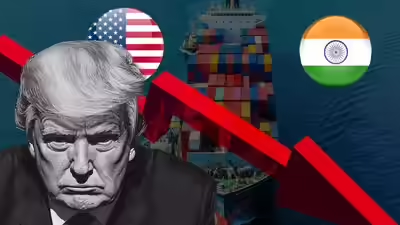
What Will Be the Impact of Donald Trump‘s 25% Tariff on India?
Introduction
impact of Donald Trump’s 25% tariff on India Former U.S. President Donald Trump, currently the Republican frontrunner for the 2024 elections, recently made a bold announcement—if re-elected, he plans to impose a blanket 25% tariff on all foreign imports, a policy that could potentially shock the global economy. While his primary focus is clearly on China and the American domestic industry, the repercussions of this move would be deeply felt in India—one of the fastest-growing economies and a major trading partner of the United States.
This blog takes a deep dive into how Trump’s tariff war could impact India, spanning trade, industry, investment, diplomacy, and geopolitical strategy.
1. Understanding Trump’s 25% Tariff Proposal
Donald Trump’s announcement isn’t just aimed at specific countries. He has floated the idea of a universal tariff of 10% to 25% on all imports, claiming that this would protect American jobs, reduce dependency on foreign nations, and push companies to manufacture locally.
His strategy is rooted in “America First,” a theme he championed during his previous term, which saw trade wars with China and several disputes at the World Trade Organization (WTO).
2. India-U.S. Trade Relations: A Snapshot
Before analyzing the impact, it’s essential to understand the economic linkages between India and the United States:
- India exported goods worth $78 billion to the U.S. in FY 2024.
- U.S. is India’s largest trading partner and a major investor in sectors like technology, defense, pharmaceuticals, and manufacturing.
- Key exports from India include textiles, gems and jewelry, pharmaceuticals, IT services, and auto parts.
A blanket 25% tariff will affect nearly every major export category from India to the United States.
3. Impact on Indian Export Sectors
📦 a. Textiles and Garments
India’s textile industry thrives on U.S. demand. A 25% import tax would:
- Make Indian garments more expensive compared to local or other low-cost suppliers like Bangladesh or Vietnam.
- Force Indian manufacturers to reduce margins or risk losing U.S. clients.
- Shrink textile job creation, especially in northern and southern Indian states.
💎 b. Gems and Jewelry
India exports billions worth of diamonds and gold jewelry to the U.S. annually:
- Increased tariffs would mean American buyers turn to domestic or alternative markets.
- Cities like Surat and Mumbai, which heavily depend on this trade, may face job losses and reduced revenues.
💊 c. Pharmaceuticals
India is a major supplier of generic medicines to the U.S.:
- While some critical drugs may get exemptions, the blanket tariff poses a real threat.
- Indian pharma companies will lose competitive pricing power.
- R&D and investment in low-margin drugs could be hit.
🏭 d. Machinery and Auto Components
- U.S. tariffs will make Indian industrial goods less attractive.
- Auto component exports may shift to Mexico or Canada due to their preferential trade terms under USMCA.
- India’s engineering exports sector could face a downturn.
4. IT Services: Will They Be Affected?
India’s software exports and IT services to the U.S. are valued at nearly $150 billion.
- As services are not typically taxed under import tariffs, Trump’s 25% tariff may not directly impact IT services.
- However, a broader anti-globalization stance may mean stricter H1-B visa regulations, tougher labor movement, and more pressure on outsourcing firms.
- Indian IT giants like TCS, Infosys, and Wipro may see increased compliance scrutiny or new taxes.
5. Impact on Indian Startups and Digital Economy
India’s booming startup ecosystem heavily relies on:
- Venture capital and private equity from the U.S.
- Tech collaboration, including cloud services, SaaS tools, and hardware procurement.
Tariffs could:
- Increase hardware costs for Indian startups.
- Make U.S. investors more cautious about betting on India due to rising regulatory friction.
- Impact tech-transfer and innovation collaboration.
6. India’s Possible Response: Strategic Countermeasures
India is unlikely to retaliate with similar blanket tariffs but may respond through:
- WTO Dispute Resolution Mechanisms
- Bilateral diplomatic dialogues to seek exemptions in specific sectors
- Speeding up free trade negotiations with the EU, UK, and Australia to diversify exports
- Increasing incentives under PLI (Production-Linked Incentive) schemes to become self-reliant and explore other export markets.
7. Impact on Bilateral Ties and Foreign Policy
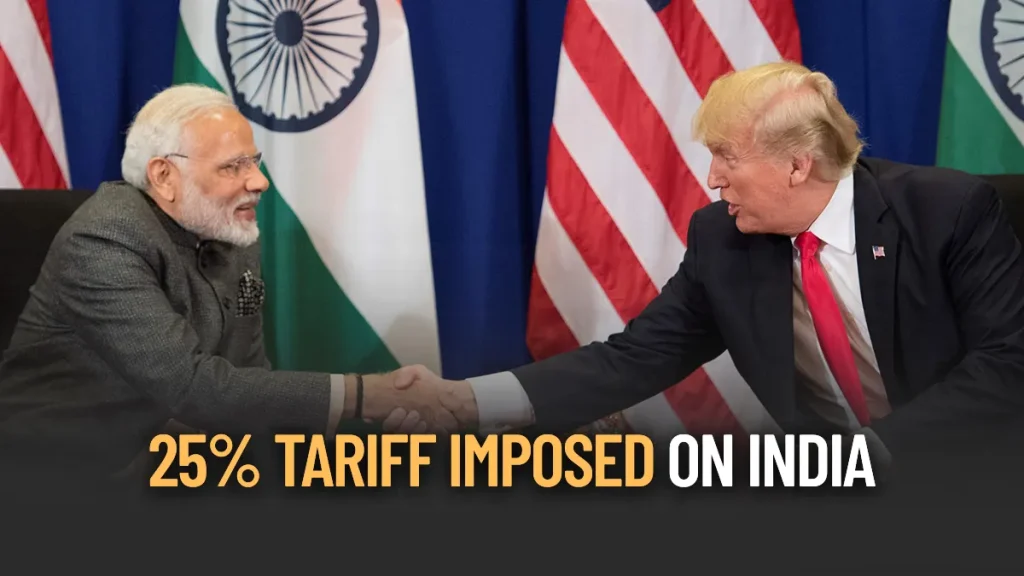
Donald Trump and PM Narendra Modi have enjoyed cordial relations in the past (“Howdy Modi”, “Namaste Trump”). But a hardline tariff move would test this relationship.
- Strategic ties in defense and intelligence-sharing may remain strong, especially in view of China’s rise.
- However, trade friction can strain diplomatic goodwill.
- The Quad (India, U.S., Japan, Australia) cooperation could be undermined if economic resentment builds.
- India may be forced to lean more on Russia and the Global South, as seen in recent BRICS+ movements.
8. Impact on the Indian Economy
Tariffs won’t just affect businesses—they’ll affect the macro economy:
- GDP growth could see downward pressure due to reduced export revenue.
- Job creation in export sectors like textiles, jewelry, pharma would slow down.
- Inflation may increase if India’s imports from the U.S. (like tech hardware) become costlier.
- The current account deficit may widen, pressuring the rupee.
- Stock market volatility may rise, especially in export-heavy sectors.
9. Can India Benefit From the Tariff War?
Paradoxically, India could benefit indirectly if Trump’s tariffs are aimed more at China:
- U.S. companies seeking alternatives to Chinese suppliers may turn to India for low-cost manufacturing.
- Sectors like electronics assembly, chemicals, and food processing could benefit.
- India could attract supply chain investments under the “China+1” strategy.
But this will only happen if:
- India improves infrastructure, logistics, and regulatory ease.
- New trade treaties offer incentives to American firms.
- India manages to balance its diplomacy without antagonizing either the U.S. or China.
10. What Should Indian Businesses Do Now?
With Trump’s re-election still uncertain, this is a risk scenario, not a certainty. Yet, businesses should prepare:
- Diversify export markets beyond the U.S.
- Invest in value-added products to justify higher prices.
- Engage in lobbying and trade dialogues through industry bodies like FICCI and CII.
- Strengthen compliance and quality standards to reduce rejection risk.
- Seek government support through subsidies or soft loans during transition.
11. What Are Economists Saying?
Prominent economists and trade experts in India have reacted cautiously:
- Raghuram Rajan, former RBI Governor, said: “Tariff wars are lose-lose situations. India must invest in competitiveness, not protectionism.”
- Montek Singh Ahluwalia noted: “This will increase global volatility, and India must prepare its MSMEs to adapt.”
- Industry leaders are calling for an Indo-U.S. Economic Dialogue to resolve this before it escalates.
12. The Role of the Indian Government
The Indian Government has a pivotal role to play:
- Use diplomatic channels to push for sector-specific exemptions.
- Protect small and medium exporters through temporary fiscal support.
- Build strong coalitions within WTO and G20 to push back against unilateralism.
- Use the opportunity to boost ‘Make in India’ and attract U.S. firms looking for China alternatives.
Conclusion
Donald Trump’s 25% universal tariff may be aimed at rejuvenating American industry, but it poses a serious risk to India’s export-led growth model. From diamonds to drugs, textiles to tractors—every major sector stands to lose unless proactive measures are taken.
While some strategic opportunities may emerge for India in a reconfigured global supply chain, the overall impact could be disruptive, especially in the short term.
Whether this tariff comes into effect depends on U.S. election outcomes, and more importantly, how India chooses to prepare today for a possible protectionist tomorrow.
Read more latest news

