
Jaishankar Takes a Dig at Jairam Ramesh Over ‘Chindia’ During Operation Sindoor Debate
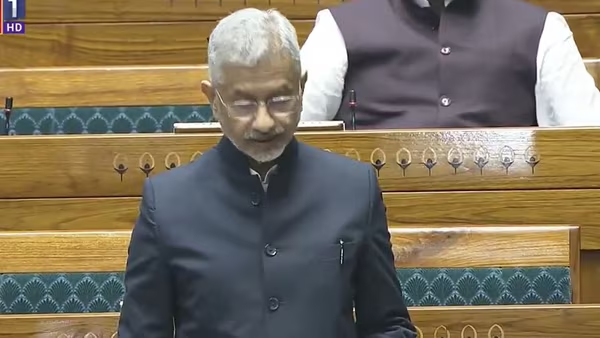
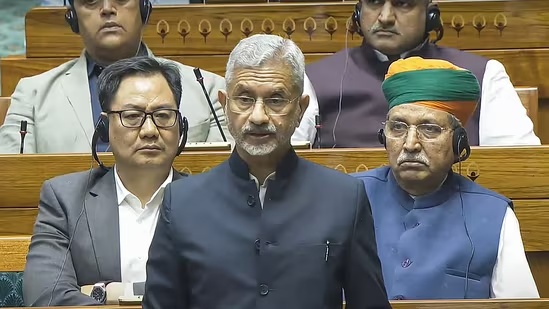
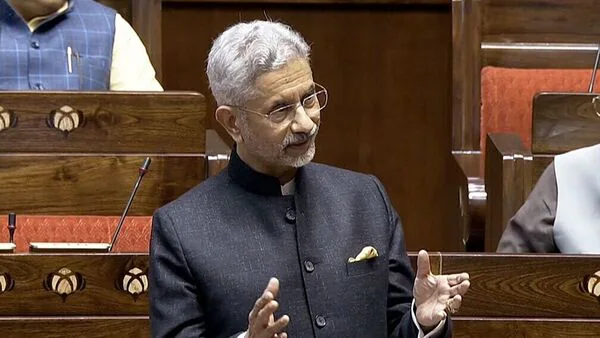
The love for China was so much that they made a treaty called ‘Chindia’. During a high-stakes discussion on Operation Sindoor in the Rajya Sabha, External Affairs Minister Dr. S. Jaishankar stunned the House with a biting remark aimed directly at Congress MP Jairam Ramesh. While defending the Modi government’s strategic assertiveness against China and Pakistan, Jaishankar remarked:
“China se itna prem tha ki ‘Chindia’ naam ka ek samjhauta tak kar diya gaya.”
(“There was so much love for China that a treaty named ‘Chindia’ was created.”)
The comment sparked a political firestorm, with BJP MPs cheering and the opposition bench—particularly Jairam Ramesh—visibly unsettled. Jaishankar was referring to a historical framework that some Congress-era policymakers promoted in the early 2000s, wherein China and India were framed as economic allies rather than adversaries.
Through this sarcastic quip, Jaishankar aimed to contrast the BJP’s current national security posture with the Congress party’s alleged softness towards China, especially in light of recent border tensions. The moment marked yet another escalation in India’s strategic narrative war within Parliament.
🏛️ Introduction: When Diplomacy Turned into Debate
The Indian Parliament is no stranger to heated arguments, but sometimes, a single line can turn a diplomatic conversation into a cultural moment. That’s exactly what happened when Dr. S. Jaishankar, India’s Minister of External Affairs, addressed the Rajya Sabha during a session on Operation Sindoor, and lobbed a satirical bomb at Congress MP Jairam Ramesh:
“China se itna prem tha ki ‘Chindia’ naam ka ek samjhauta tak kar diya gaya.”
The remark instantly went viral. The word “Chindia”—coined in an era of globalization and soft diplomacy—was now being used as a weapon in a parliamentary takedown.
This blog explores the political, diplomatic, historical, and strategic layers of this episode—from the origins of “Chindia” to the Modi government’s aggressive stance on China, and what Jaishankar’s sharp line reveals about the ideological divide between BJP and Congress on foreign policy.
🔍 What is Operation Sindoor?
Before diving into the controversy, it’s crucial to understand the backdrop. Operation Sindoor refers to a recent, classified strategic military operation that targeted hostile infiltrators and strengthened India’s positions along sensitive border sectors. Though full details remain undisclosed, government sources say it reflects India’s enhanced military readiness, surveillance capability, and cross-border response mechanism.
The operation triggered applause from the ruling party and caution from the opposition—especially the Congress, which questioned the lack of parliamentary briefing, possible politicization of defense, and China’s increasing aggression on the Line of Actual Control (LAC).
🎯 Jaishankar’s Attack: “Prem tha China se…”
While responding to Congress criticism—particularly by Jairam Ramesh, a senior leader known for his expertise in climate and foreign affairs—Jaishankar said:
“Woh waqt bhi tha jab China se itna prem tha ki ‘Chindia’ ka nara diya gaya. Woh samjhauta kisne kiya tha? Congress ne.”
Translation: There was a time when the Congress was so affectionate towards China that they coined the term ‘Chindia’.
This was no ordinary remark—it was a pointed reference to Jairam Ramesh’s public support for the concept of India-China economic convergence, especially during the UPA era. The word “Chindia” became symbolic of that vision.
🧠 What is ‘Chindia’? The Concept and Its Origins
The term ‘Chindia’ is a fusion of China + India, originally coined by Chinese-American economist Jian Wang and popularized in India by Jairam Ramesh through his 2005 book, Making Sense of Chindia: Reflections on China and India.
In the early 2000s, as both countries were emerging economic giants, many policymakers, intellectuals, and global economists floated the idea that India and China could collaborate—not compete—in the Asian century.
Jairam Ramesh’s view:
- Advocated economic cooperation over confrontation
- Proposed joint environmental and trade initiatives
- Called for comparative advantage sharing (China for manufacturing, India for services)
The idea, though idealistic, found brief traction in diplomatic circles. But as China’s assertiveness increased, especially post-Doklam and Galwan, the concept began to look dangerously naïve to critics.
⚖️ BJP’s Rebuttal: From ‘Chindia’ to Checkmate
The BJP—and particularly Jaishankar—has rejected the romanticism of the ‘Chindia’ era. Instead, they emphasize:
- Border vigilance and infrastructure: Massive projects along Arunachal Pradesh and Ladakh
- Diplomatic pushback: Ban on Chinese apps, trade scrutiny
- Military modernization: Forward deployment and quick response units
- Strategic alliances: QUAD, Indo-Pacific partnerships, U.S.-India defense ties
For Jaishankar, Congress’s ‘Chindia’ vision is not just outdated—it’s strategically dangerous.
“We were lulled into complacency by the idea that we could be equals. The ground reality is different. China is expansionist. India must respond, not romanticize.”
🗣️ Reaction in Parliament: Cheers and Churn
The moment Jaishankar said “Chindia,” the BJP benches erupted with laughter and applause, while opposition MPs, especially Jairam Ramesh, were visibly irked.
- Jairam Ramesh, in response, defended the concept as a “vision for a peaceful Asia,” but admitted it needs “re-evaluation in the current climate.”
- Chairman Jagdeep Dhankhar allowed the banter, noting that “a little wit sharpens democracy.”
- Congress MPs later demanded that Jaishankar stop mocking intellectual debate and focus on real border threats.
📰 Media and Social Media Reactions
The term “Chindia” started trending across platforms.
Headlines:
- India Today: “Jaishankar’s ‘Chindia’ Swipe Adds Spark to Sindoor Debate”
- The Hindu: “EAM Takes Swipe at Jairam Ramesh, Revives Chindia Debate”
- Republic TV: “Chindia to China Checkmate: Jaishankar Roasts Congress”
On Twitter/X:
- #Chindia trended at No. 2
- #JaishankarRoars flooded with memes and praise
- Congress supporters defended Jairam Ramesh’s legacy, calling the attack “below the belt”
📜 Congress Era China Policy – Softness or Strategy?
Jaishankar’s criticism also reflects deeper ideological differences:
Congress Approach:
- Trade-heavy ties with China
- Strategic ambiguity over border issues
- Cooperation in BRICS, SCO, and environmental forums
- Non-confrontational diplomacy
BJP Approach:
- Border clarity and militarization
- Direct confrontation post-Galwan
- Economic decoupling
- Strategic clarity via Indo-Pacific alliances
By invoking ‘Chindia,’ Jaishankar was accusing Congress of downplaying China’s threat in favor of utopian economic theories.
🧩 The Personal Angle – Jaishankar vs Jairam
Both are seasoned foreign policy thinkers:
- Dr. S. Jaishankar: Former Foreign Secretary, realist, nationalist, strong U.S. alignment
- Jairam Ramesh: Former Environment Minister, globalist, multilateralist, academic
This wasn’t just political—it was a clash of foreign policy ideologies, with the Parliament as its stage.
📈 Strategic Shifts Since Galwan
After the Galwan Valley clash of 2020, India’s China policy changed dramatically:
- De-coupling from Chinese investments
- Banning 200+ Chinese apps
- Accelerated defense partnerships
- Pushback in international forums on China’s BRI and South China Sea expansionism
Jaishankar’s messaging reflects this tectonic shift—and by targeting Congress’s past views, he’s creating a clear contrast in strategic philosophy.
🧭 What the ‘Chindia’ Comment Symbolized
Jaishankar’s comment wasn’t just about Jairam Ramesh. It was about framing a larger narrative:
India under Congress = Naïve Cooperation
India under BJP = Strategic Competition
By mocking ‘Chindia,’ Jaishankar effectively framed the Congress as ideologically outdated, diplomatically weak, and emotionally attached to fantasies of Asian brotherhood.
🔚 Conclusion: When One Word Says a Thousand Things
The word “Chindia” may seem like a small satirical punch—but in the hands of a master diplomat like Dr. S. Jaishankar, it became a weapon of narrative warfare.
It was a moment that symbolized India’s pivot from romanticism to realism, from utopian theories to hard-nosed geopolitics.
While Jairam Ramesh tried to explain the vision behind “Chindia,” the damage was already done. In the era of soundbites, Jaishankar won the round—not just with strategy, but with sarcasm, substance, and surgical precision.
In Indian foreign policy, as in politics, one word—spoken at the right time—can change the conversation.
And for now, “Chindia” is no longer a dream of convergence. It’s a symbol of contrast.
Read more latest news

