
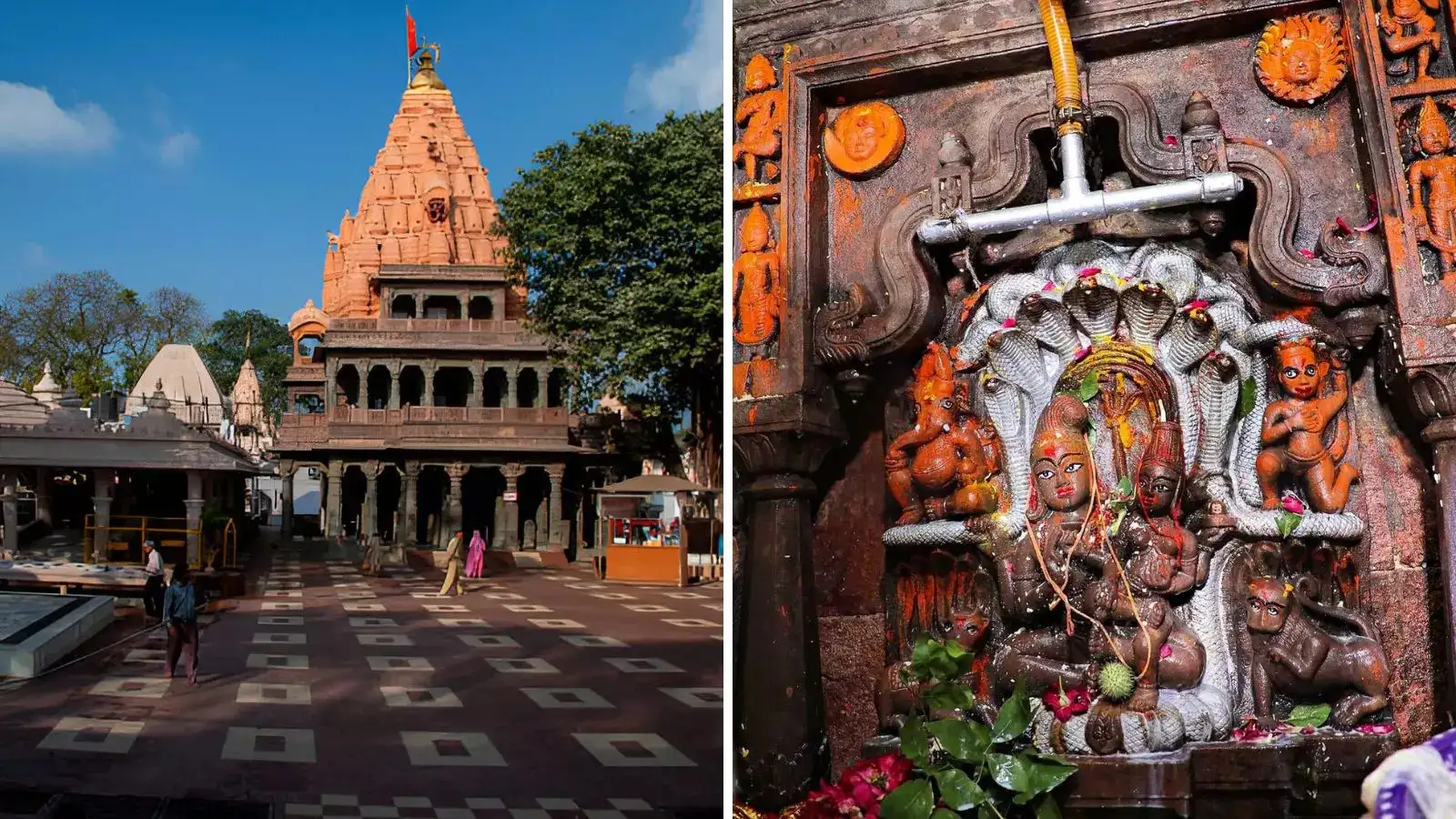
The Nagchandreshwar Temple, located on the third floor of the Mahakaleshwar Temple in Ujjain, Madhya Pradesh, holds immense religious significance and a unique tradition. This ancient shrine is dedicated to Lord Shiva in his Nagchandreshwar form—depicted with a serpent coiled around a Shiva Lingam. What makes this temple exceptionally rare is that it opens only once a year on the night of Nag Panchami, for just 24 hours.
At exactly midnight, the temple doors are opened, drawing lakhs of devotees from across the country who line up to catch a glimpse of the rare deity, whose darshan is believed to fulfill all desires and protect from snake-related fears and misfortunes. The sanctum’s unique architecture, rare idol, and one-day opening give it a mystic aura. According to belief, those who get darshan on this day attain moksha (salvation).
The administration makes elaborate arrangements for crowd management and security during this day. The experience of standing before Nagchandreshwar during the midnight hours of Nag Panchami is considered one of the most spiritually electrifying moments in Ujjain.
1. Ujjain’s Hidden Gem: The Secret of Nagchandreshwar Temple
Nagchandreshwar temple Tucked away on the third floor (uppermost level) of the famed Mahakaleshwar Jyotirlinga Temple in Ujjain, Madhya Pradesh, lies the Nagchandreshwar Temple—a sanctuary unlike any other in India. The temple is uniquely accessible for only 24 hours each year—its gates flung open precisely at midnight on Nag Panchami (Shravan Shukla Panchami), after which it remains shut for the rest of the year.

2. A Temple Shrouded in Legend & Symbolism Nagchandreshwar temple
- Legend of Nagraj Takshak: According to lore, Nagraj Takshak performed intense penance to appease Lord Shiva. Pleased, Shiva granted him immortality. Takshak wished to reside near Shiva but not disturb his meditation—so his presence is honored only once a year through darshan alone.
- This explains why the temple keeps its doors sealed throughout the year—an act of reverence and solitude for Nagdevta.
3. Architecture, Antiquity & the Iconic Idol Nagchandreshwar temple
- Built around 1050 AD by Parmar King Bhoj, and restored in 1732 by Maharaj Ranoji Scindia, the temple holds deep historical value.
- The star attraction is a rare 11th-century idol—depicting Lord Shiva seated on a multi‑headed serpent throne, with Goddess Parvati, Lord Ganesha, Nandi (Shiva’s bull) and a lion (Parvati’s vehicle) flanking him. The backdrop also features a sun–moon motif and serpent wraps around Shiva’s arms and neck—an unparalleled visual in all of Hindu iconography.
- Believed to have originated from Nepal, this depiction of Shiva rather than Vishnu resting on a serpent is regarded as one-of-a-kind globally.
4. The Midnight Opening: Rituals, Devotees & Divinity
⏳ Timing & Ritual
- Gates open at exactly 12:00 AM on Nag Panchami, preceded by Trikaal Puja—the three‑times worship ceremony—conducted by Mahanirvani Akhada’s Mahant (Vineet Giri Maharaj).
- Darshan is allowed for a full 24 hours, with constant worship by priests and devotees until midnight of the following day, when the temple is ceremonially closed again.
🙏 Pilgrim Experience
- The day attracts hundreds of thousands—often up to 2–5 lakh devotees—from across India. They queue from late night, braving crowds and even rain to witness the rare opening and receive blessings.
- Local authorities provide intensive crowd control: 200+ senior officials, around 1,800 police personnel, 2,500 staff, and installation of 560 CCTV cameras ensure orderly darshan. Infrastructure includes temporary shoe stands, aero‑bridge access, medical aid, wheelchair support, lost-and-found booths, and parking zones to handle the surge of pilgrims.
5. Spiritual Significance & Beliefs
- Devotees believe that a single darshan of Nagchandreshwar Mahadev on Nag Panchami is effective in nullifying Kaal Sarp Dosh, alleviating snake-related afflictions, fears, nightmares, and tragedies.
- The temple symbolizes divine protection, patience, and cosmic equilibrium, embodying Shiva as sovereign over the Nagas (serpents). Devotion offers emancipation from karmic burdens and purification of spiritual faults.

6. Step-by-Step Experience for Visitors
- Arrival & Crowd: Pilgrims arrive late night; many queue hours before midnight.
- Midnight Ritual: The Mahant performs Trikaal Puja; gates open as rituals conclude.
- Darshan: Devotees ascend through corridors and aero-bridge to reach the top floor.
- Viewing the Idol: Visitors view the ancient serpent-throne idol of Shiva-Parvati-Ganesha.
- Puja & Offerings: Devotees offer milk, flowers, and pray for spiritual and worldly wellbeing.
- Exit Route: Return along the same bridge, through donut-shaped marble corridors, then proceed out towards Harisiddhi road.
Security personnel manage each zone to maintain calm and flow during the full 24‑hour period.
7. Cultural, Historical & Administrative Notes
- Historical layering: Dating to the Parmar era and later enhanced by the Scindia dynasty, the temple encapsulates Ujjain’s layered kingship and religious patronage.
- Administrative coordination: Ujjain Municipal Corporation, Ujjain Collectorate, Temple Committee, and local police orchestrate this annual ritual to ensure security and comfort.
- Significance of Nag Panchami: Celebrated across India to honor serpent deities, Ujjain’s Nagchandreshwar opening remains the most dramatic and sacred observance of the festival.
8. Why It Captivates Pilgrims & Scholars
- Uniqueness of Access: The temple offers just one-day access annually—creating immense spiritual fervor and anticipation.
- Iconic Sculpture: Depicting Shiva seated on a serpent throne along with his family, it is unmatched in religious art anywhere else in the world.
- Living Faith Experience: The blend of myth, architecture, ritual, crowd energy, and midnight worship makes it a truly immersive spiritual event.
9. Planning to Visit? Key Details
- When: Nag Panchami (July–August) at midnight—opens at 12:00 AM and closes the following midnight, exactly after 24 hours.
- Where: Third (top) floor of Mahakaleshwar Temple Complex—requires climbing through corridors and possibly an aero-bridge if arranged.
- Expect: One-way entry during darshan day. No entry permitted other days.
- Facilities: Temporary provisions for parking, drinking water, medical aid, toilets, lost-and-found, and disabled access are provided.

10. Reflection: Faith, Tradition & Permanence
Nagchandreshwar Temple exemplifies how Hindu tradition interweaves legend, devotion, ritual, art, and exclusivity. In a fast world, it stands as a quiet sentinel—opening just once a year to affirm timeless devotion. Its serpentine symbolism speaks of eternal bonds between mortals, nature, and divinity.
To witness its gates open under the night sky on Nag Panchami is to behold a rare confluence of history, myth, and living tradition—a reaffirmation of India’s rich spiritual tapestry.
read more latest news

