
Introduction
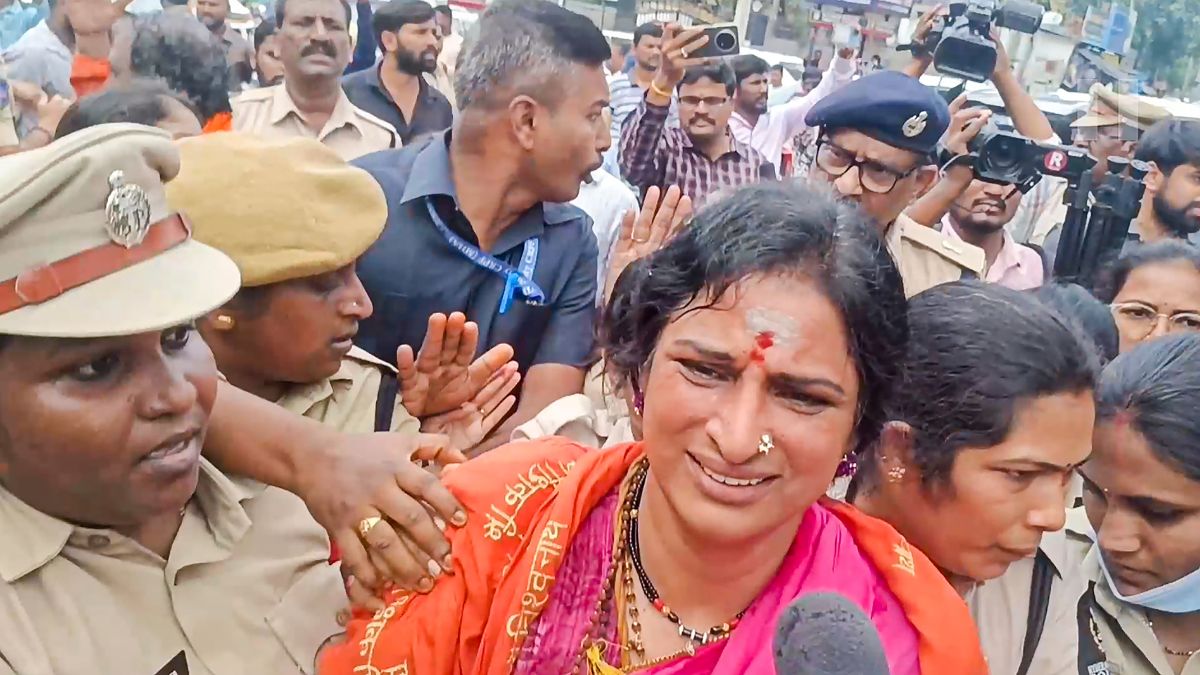
In a politically and emotionally charged incident that has created waves across Telangana and beyond, BJP leader Madhavi Latha was detained by Hyderabad police on July 24, 2025, while protesting against the demolition of a temple structure carried out by the municipal authorities. The action, described as an “anti-encroachment drive” by officials, has triggered a fierce reaction from Hindu organizations, opposition parties, and local residents, many of whom view it as an attack on faith and religious sentiment.
Madhavi Latha’s detention has now become the epicenter of a brewing political storm, with visuals of her defiant protest and subsequent arrest going viral on social media. This blog explores the entire incident in depth — from what led to the demolition, how Madhavi Latha responded, the government’s position, legal implications, and the wider political context in Telangana.
1. The Bulldozer Action: What Actually Happened?
The incident occurred in the heart of Hyderabad, in the Amberpet locality, where a small temple structure, which local devotees claimed had stood for decades, was demolished by municipal officials. The Greater Hyderabad Municipal Corporation (GHMC), in coordination with police, launched a sudden early-morning anti-encroachment drive to remove “unauthorized constructions” along public roads.
Among the structures razed was a temple that reportedly occupied a small section of the footpath. The bulldozer moved in around 6:00 AM, and within minutes, the temple’s outer structure, including idols and decorative walls, was reduced to rubble.
Locals allege that the demolition happened without prior notice and in utter disregard for religious sentiment. Several devotees and shopkeepers gathered around the temple in protest, but by the time crowds formed, the demolition was already underway.
2. BJP Leader Madhavi Latha Enters the Scene
BJP Hyderabad South candidate and prominent Hindu activist Madhavi Latha reached the site shortly after learning about the demolition through locals and social media. Known for her outspoken style and firm Hindu identity, she began protesting outside the demolished site, chanting religious slogans and accusing the Telangana government of selectively targeting Hindu religious structures.
In front of the media, Madhavi Latha said:
“This is not an encroachment. This is an attack on Sanatan Dharma. How dare they bring down a place of worship without consultation with the community?”
She sat on a dharna (protest) right in front of the temple debris, holding a saffron flag and surrounded by supporters.
3. Police Detention and Drama on the Streets
Within an hour, police arrived in large numbers and attempted to persuade Madhavi Latha to disperse. When she refused, citing her constitutional right to protest peacefully, she was detained under Section 151 of CrPC — for preventive custody.
As police lifted her and placed her in a waiting van, chants of “Jai Shri Ram” and “Mandir Wahi Banayenge” echoed through the area. Several of her supporters were also detained. The entire scene was captured by television news channels and quickly went viral on social media platforms.
Many BJP leaders condemned the police action, calling it authoritarian and disrespectful to the democratic right of protest.
4. GHMC’s Explanation: Was It Legal?
In a press conference, GHMC officials claimed that the structure was part of an ongoing drive to clear public spaces of unauthorized religious and commercial encroachments. According to them:
- The temple structure was not registered officially with the Endowments Department.
- The GHMC had already sent notices in April and June, but no response was received.
- The structure had grown beyond its original footprint, obstructing pedestrian movement.
However, locals dispute this claim, saying they never received any official notice. They allege that the demolition was politically motivated and timed just before key Hindu festivals to provoke public unrest.
5. Religious Sentiments vs Urban Planning: A Deep Divide
This incident once again opens up the long-standing debate in India between urban development authorities and religious communities. Across Indian cities, hundreds of small temples, mosques, and dargahs exist on roadsides, corners, and public lands.
While civic bodies aim to keep cities free from obstructions and illegal constructions, they often face backlash when such drives target places of worship. In this case:
- Urban planners argue that illegal constructions create traffic chaos and safety risks.
- Devotees and activists believe that religious structures, especially those that have existed for decades, are part of heritage and faith, and deserve protection.
The absence of a uniform national policy on religious encroachments adds to the confusion.
6. Political Reactions: War of Words Begins
The BJP has come down heavily on the Telangana government, accusing the ruling BRS (Bharat Rashtra Samithi) of harboring anti-Hindu sentiments. BJP state president G. Kishan Reddy demanded immediate action against the municipal officers involved and called for the reconstruction of the demolished temple.
“This government protects encroachments by madrasas and mazars but targets Hindu temples. This is appeasement politics at its worst.”
In response, BRS leaders defended the action as “impartial and administrative.” Telangana’s Minister for Municipal Administration, K. T. Rama Rao (KTR), tweeted:
“The rule of law must prevail. All illegal constructions, irrespective of religious affiliation, will be removed. Hyderabad belongs to everyone.”
Congress leaders have remained mostly silent but called for a “sensitive approach” while handling religious sites.
7. Social Media Reactions: Viral Videos and Hashtag Wars
Madhavi Latha’s video, in which she is seen resisting police and chanting religious slogans, has been viewed over 10 million times within 24 hours. Hashtags such as #MadhaviLatha, #SaveTemples, and #TelanganaTempleDemolition started trending on X (formerly Twitter), Instagram, and Facebook.
Some user comments include:
- “Respect to Madhavi Latha for standing up for Dharma.”
- “This is not urban planning, this is targeted religious bias.”
- “Where are the secular voices now?”
On the other hand, several activists and urban reformers defended the GHMC action, saying public spaces must be protected.
8. Legal and Administrative Action: What Next?
BJP has announced it will file a Public Interest Litigation (PIL) in the Telangana High Court seeking:
- Judicial inquiry into the demolition
- Compensation for temple damages
- Immediate reconstruction of the structure
- Punishment for municipal officers involved
Meanwhile, Madhavi Latha and her supporters were released by the evening, but BJP has declared a statewide protest on July 26 and temple protection yatras in all major districts.
9. Who is Madhavi Latha? Why Her Protest Matters?
Madhavi Latha is a prominent BJP leader and social activist known for her involvement in women’s rights, temple protection movements, and nationalistic causes. She had contested in the Hyderabad Lok Sabha elections earlier and has a significant following among conservative Hindu groups.
Her protest has now become symbolic of the larger ideological battle BJP seeks to highlight — “Hindu interests vs State apathy.”
By positioning herself at the frontline of the protest, Madhavi Latha has not only reignited the temple protection narrative but also sharpened BJP’s political messaging in Telangana ahead of municipal elections.
10. Broader Implications: Politics of Faith and Civic Order
This incident is not just a local event — it reflects the rising tensions between:
- Faith and administrative authority
- Political ideology and governance policies
- Urban planning and cultural heritage
The balancing act between maintaining public order and respecting centuries-old faith structures is delicate, and Telangana has now become the latest state caught in this fire.
The timing is also crucial — with upcoming civic elections in Hyderabad and a rising sentiment of Hindu identity politics, such incidents could alter voter behavior significantly.
Conclusion: More Than Just a Demolition
The bulldozer that brought down a temple structure in Hyderabad may have razed bricks and stones, but it has also exposed deeper cracks — in our systems, our politics, and our understanding of coexistence.
Madhavi Latha’s protest and detention are not just about one temple. They reflect a growing perception among a section of society that Hindu symbols and spaces are under threat from state machinery in the name of legality and urban order.
Whether this perception holds truth or is part of political narrative-building, the incident has certainly stirred emotions and forced a conversation. A democracy must protect its public spaces — both physical and spiritual.
Read more latest news

