
🔥 Inferno at Sea: The KM Barcelona Ferry Fire and the Human Struggle for Survival
1. Incident Overview: Fire Erupts in Mid‑Sea
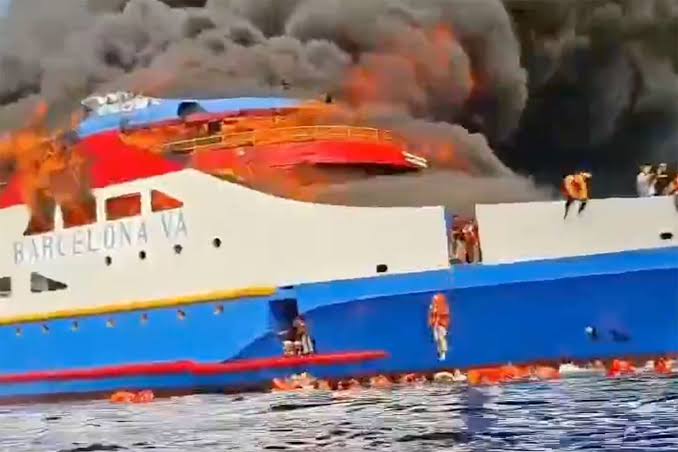
280 passengers caught fire, people jumped On July 20, 2025, midday calm in the waters off Talisei Island, North Sulawesi, Indonesia, turned catastrophic. The passenger ferry KM Barcelona VA, reportedly carrying 280 passengers, erupted in flames while en route from the Talaud Islands to Manado.
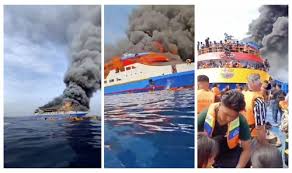
Videos capturing the horror depict terrified travelers jumping—some clutching children—into the sea to escape the inferno. Scenes of thick black smoke, dancing flames, and the desperate chorus of cries will haunt any who witness them.
Immediate Human Response
Struck by panic, many passengers donned life jackets as they leaped into open water. Others later spoke of waiting in the sea for nearly an hour before rescuers arrived.
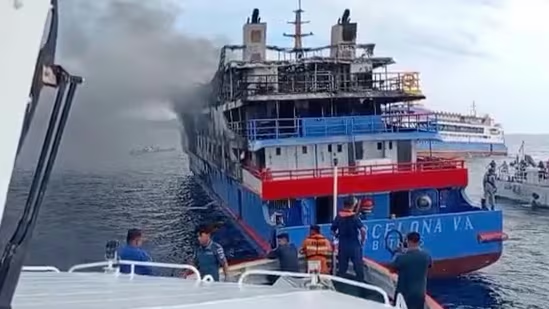
Rescue teams—including the Manado Harbormaster and Port Authority (KSOP), naval vessels, local fishing boats, and SAR units—swarmed the area, retrieving survivors and rushing them to Ganga Island, a nearby haven for the evacuated.
Casualties and Confusion
Initial reports tallied one fatality, but subsequent updates from AP and Euronews confirmed three deaths, including at least one pregnant woman. Embroiled in conflicting numbers, authorities clarified that while the manifest listed 280 passengers and 15 crew, actual survivor counts reached 568, with a maximum capacity of 600—highlighting chronic record-keeping issues.
2. On-the-Ground Rescue: Boats, Vessels, Heroes
The rescue response was swift:
- Local fishing boats were first on the scene, pulling people from the water.
- Port Authority deployed three vessels: KM Barcelona III, KM Venecian, and KM Cantika Lestari 9F.
- SAR agents and navy ships launched an intense operation, pulling countless survivors and ferrying them to safety.
One passenger, Abdul Rahmad Agu, livestreamed as he held a toddler—hoping for rescue. Another, Alwina Inang, waited in water nearly an hour before being saved.
3. Eyewitness Accounts: Trauma and Survival
Survivors shared harrowing recollections:
- Abdul Rahmad Agu spoke calmly on his livestream: “Help… we are burning at sea… we need help… fast.”
- Alwina Inang recalled, “We immediately jumped into the sea” after flames engulfed the bridge.
- Another survivor, exposed to water for nearly an hour, expressed fear of drowning and exhaustion.
These testimonies offer visceral insight into a mass emergency and the razor-thin line between survival and disaster.
4. Ship Safety: Common Causes of Ferry Fires
Maritime fires often stem from:
- Engine-room malfunctions—fuel drips, oil leaks, overheating parts
- Electrical shorts from outdated wiring or overloaded circuits
- Sabotage or arson—though unverified here
- Negligent maintenance and safety drills that are irregular or ignored
Indonesia’s track record shows recurring vessel incidents—rusted fire suppression systems, minimal crew training, and insufficient drills.
5. Regulatory Landscape: The Ferry Safety Gap
Indonesia relies heavily on maritime transport across 17,000+ islands, yet:
- Safety enforcement is lax—lack of mandatory capacity enforcement, lifejackets, fire drills, and fire suppression maintenance.
- Record inconsistencies—manifest declared 280, but 568 rescued—point to trafficking through overboarding.
- Authorities acknowledge weak oversight; the BASARNAS admits enforcement must improve.
6. Historical Comparisons: When Ships Burn
This tragedy echoes many past disasters:
- 2021 Bangladesh ferry fire: 40+ dead, hundreds injured, ignition in engine room, overcrowding worsened casualties.
- SS Morro Castle (1934, USA): Fire onboard with poor evacuation training led to 137 deaths.
- MV Doña Paz (1987, Philippines): Collision and fire killed over 1,500 amidst locked life jacket lockers.
These share features: aging infrastructure, insufficient crew drills, and chaotic evacuation.
7. Passenger Survival: Human Resilience at Sea
Survivors faced chilling odds:
- Life jackets enabled drifting in choppy waters
- Rescuers rescued many amid confusion
- Community boats filled rescue gaps
- Medical aid awaited survivors on Ganga Island
Despite heroics, at least three lives were lost, including a pregnant woman, underscoring both courage and heartbreak.
8. Media Coverage: The Viral Impact
- Footage was shared widely—on X, TikTok, YouTube, and Al Jazeera.
- The Daily Beast, People, NDTV, ABC News, Euronews, AP carried vivid narratives.
- Social media buzzed with rescue cabins, audience empathy, and criticism of lax safety—Reddit’s PublicFreakout sparked debates on maintenance and evacuation protocols.
9. Analysis: Why This Happened
Multiple factors converged:
- Overcrowding and poor recordkeeping—manifest more than double the reported 280.
- Poor maintenance—fire suppression systems likely unchecked, wiring outdated.
- Inadequate drills—passengers unaided, crew evacuation slow or unorganized.
- Lack of enforcement—regulatory structures failing to impose safety protocols.
10. Lessons Learned & Future Outlook
This disaster must prompt sweeping reforms:
- Strict passenger manifest procedures to prevent overcrowding
- Routine safety checks and fire drills mandated for all vessels
- Emergency training to empower crew in evacuation and firefighting
- Enforcement of safety protocols, backed by penal consequences
- Public awareness on safety standards and evacuation plans
11. Global Context: Ferry Safety Challenges Worldwide
This is part of a broader pattern:
- Bangladesh suffers frequent ferry fires and capsizes.
- Small craft near Europe—migrant rescue boats—face similar chaos.
- Historical liners like Morro Castle and Doña Paz exemplify centuries-old problems.
Modern maritime infrastructure demands strong regulation, transparent records, trained crew, and robust rescue frameworks.
12. Aftermath & Regulatory Response in Indonesia
Authorities have pledged:
- Investigation into the fire’s cause—electrical, fuel lines, or negligence
- Overhaul in safety enforcement—capacity checks and vessel certification
- Transparency measures after past manifest failures
- SAR investment to reduce rescue times, improving survival rates
Implementation remains key—a crisis must catalyze action, not fade from headlines.
13. Stories of Hope & Heroism
Amid tragedy, acts of bravery emerge:
- Local fisherfolk who risked their boats for dozens
- Rescuers in inflatable craft snatching drifting victims
- Selfless passengers passing life jackets, aiding children
- Medical teams tending survivors upon arrival
Such community spirit is the lifeboat of humanity in crisis.
14. Psychological Impact: Trauma & Recovery
Passengers face emotional but invisible scars:
- Flashbacks to burning decks and drowning panic
- Survivors’ guilt haunting those who escaped but lost others
- PTSD stemming from helplessness and chaos
Mental-health support must accompany physical rescue—counseling, community outreach, trauma therapy.
15. Maritime Safety: A Call to Action
This tragedy is a clarion call:
- Regulated transit—capacity adherence and manifest accuracy enforced
- Fire systems maintained and inspected regularly
- Crew trained in real-world drills and emergency casualty extraction
- Public informed of exits and safety procedures
- Rescue infrastructure upgraded with GPS tracking, rapid deployment
Such changes can prevent future Pyres at sea—and save lives.
16. Epilogue: Flames That Should Ignite Change
The KM Barcelona ferry fire is more than a momentary headline. It’s a stark embodiment of systemic failure—of regulations, accountability, and human preparation.
But it also holds hope: the rescue success, human compassion, and global reaction show that when people act decisively, lives can be saved. Now, authorities, communities, and leaders must ensure these lessons transform policy and practice.
✅ Key Takeaways
| Lesson | Insight |
|---|---|
| Overcrowding is lethal | Accurately tracked passengers save lives |
| Maintenance matters | Prevent mechanical ignition points |
| Training saves lives | Drills create calm amidst chaos |
| Community rescue works | Fisherfolk and locals are frontline heroes |
| Mental health matters | Post-trauma support is essential |
| Policy must respond | Enforcement prevents repeat disasters |

