

Shubhanshu Shukla Is Back on Earth… A Happy Moment for the Country
A Historic Return
On July 15, 2025, Group Captain Shubhanshu Shukla, a decorated test pilot in the Indian Air Force, returned safely to Earth. As pilot of SpaceX’s Dragon spacecraft “Grace” on the Axiom Mission 4, he splashed down off the San Diego coast after an 18-day mission aboard the International Space Station (ISS). This moment marked India’s return to human spaceflight since Rakesh Sharma’s 1984 mission—and for the first time, an Indian aboard the ISS.
A Journey Beyond the Blue
Shukla launched on June 25, 2025, following several schedule adjustments, and docked with the ISS on June 26. Over the mission duration, he orbited Earth over 310 times , traveling at more than 28,000 km/h, circling the globe more than 113 times—covering about 4.66 million km. His was the longest Indian space stay, surpassing Sharma’s 8-day voyage in 1984.
Science and Symbolism
The Axiom-4 crew conducted over 60 experiments from 31 countries, bringing back 580 lb of research material. Shukla conducted seven ISRO-designed experiments aboard the ISS. These ranged from microgravity impacts on human physiology, AI-driven health monitoring, and studies with cyanobacteria, microalgae, plant sprouting (including methi and moong), to tardigrade biology and stem-cell differentiation. These data hold promise for not only human health and agriculture on Earth but also extended missions to the Moon and Mars.
In a poignant echo of Rakesh Sharma, Shukla noted from space, “Today’s India still looks ‘Saare Jahan Se Accha’—ambitious, fearless, confident, and proud”.
Life in Microgravity
Life aboard the ISS demands routine adjustments. Shukla received the first ever haircut in microgravity by fellow astronaut Nichole Ayers. Showers don’t exist—astronauts clean up with wipes. He adapted admirably, visibly shaving off a stubble illuminated in the cupola’s magnificent Earth views.
Yet these small moments—sharing meals like gajar ka halwa, aam ras, and moong dal halwa, and holding communications with family—show that human warmth transcends boundaries.
Return, Recovery, Recognition
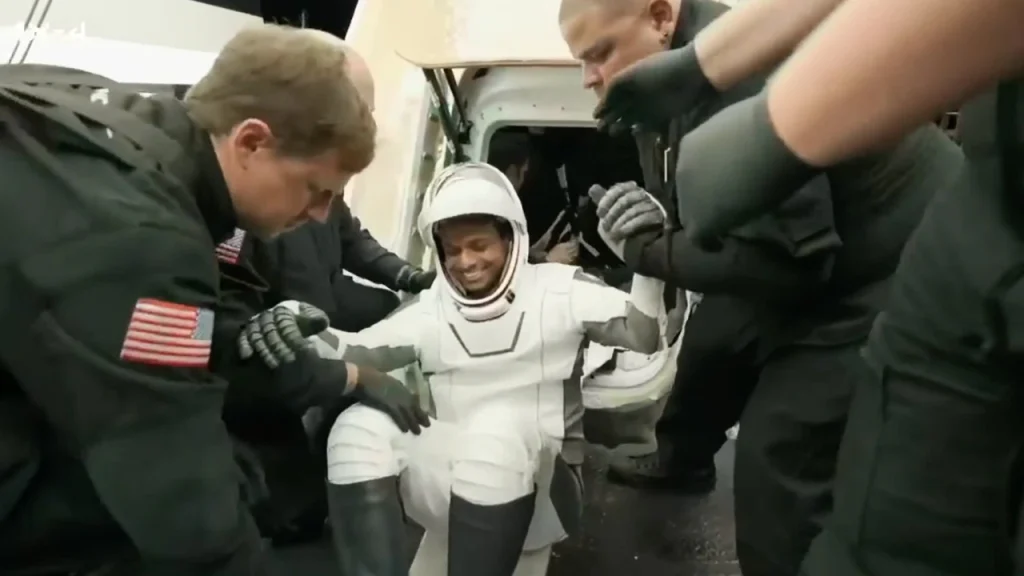
After undocking on July 14 at 4:45 pm IST, a 22.5-hour journey brought him home. The Dragon capsule splashed down at 3:01 pm IST, recovered by SpaceX’s recovery ship Shannon.
Post-splashdown, Shukla and his crew stepped out alive, smiling and waving to cameras—captured by global media. Heat-shielded and heroic, they returned as world-class explorers.
Medical and psychological recovery began immediately on the recovery ship and continued at NASA’s Johnson Space Center in Houston—where he will remain about 10 days for quarantine and detailed health assessments. He is also undergoing a seven-day rehabilitation program to readjust to Earth’s gravity.
National Celebration and Gratitude
The nation erupted in pride and emotion. In Lucknow, family celebrations and tears of joy made headlines. Public screenings nationwide kept eyes glued to the return.
Political leaders expressed heartfelt appreciation:
- Prime Minister Modi applauded Shukla’s mission as shattering ceilings and inspiring millions.
- President Murmu hailed his feat as “a new milestone for India’s space exploration and international collaboration”.
- Other dignitaries—Defence Minister Rajnath Singh, ministers Jitendra Singh, JP Nadda, Mamata Banerjee, Mayawati, and Yogi Adityanath—all lauded Shukla’s triumph as a source of national pride .
Paving the Way for Gaganyaan
The Axiom-4 mission serves as a critical pathfinder for India’s own crewed mission, Gaganyaan, scheduled for 2027. ISRO’s investment from this mission—over ₹550 crore—undoubtedly fuels knowledge-sharing in spacecraft systems, human adaptation protocols, medical safety, and mission operations.
Shukla’s first-hand ISS insights will shape astronaut training, telemetry, life support systems, nutrition, and contingency planning—elements vital to India’s self-reliant spaceflight ambitions .
A Symbol of India’s Aspiration
Shukla’s journey is more than a technical success—it’s a symbol of a confident, rising India. The sight of an Indian in the ISS, moving beyond boundaries, inspires an entire generation.
He emerges as a beacon of courage, discipline, and international cooperation. He fulfills dreams, cementing India’s place among global explorers while laying foundations for indigenous human spaceflight.

Looking Ahead
- Returning home: Post-rehab, Shukla is likely to land in India around August 17, once protocols are complete.
- Debriefs & publications: His mission will spawn debrief reports, peer-reviewed scientific publications, and technical recommendations.
- Honors & recognition: Felicitations from ISRO, the IAF, and the government are expected—paving the way for an enduring legacy.
- Gaganyaan momentum: As India’s first indigenous crewed vehicle’s 2027 launch draws near, Shukla remains key as both technical resource and national icon.
Conclusion
When Group Captain Shubhanshu Shukla touched down on July 15, he gave a face to national aspiration. He stood as India’s second space voyager and its first to reach the ISS. He carried forward dreams kindled by Rakesh Sharma, yet gave them global modern resonance with science and shared vision.
His mission underscores global collaboration—teams across the USA, Poland, Hungary, and India working in unison. It highlights India’s rise as a serious and reliable player in human spaceflight.
Shukla’s journey also reminds us that heralds of progress are not distant celebrities—they come from middle-class homes in Lucknow, inspired by air shows, committed to service, and thriving on resilience. They bring home knowledge, experience, and renewed pride.
For India, this is just the beginning. With Gaganyaan on the horizon, Shukla’s legacy will guide future astronauts beyond Earth’s cradle—to new challenges, new frontiers, and a new bold century of space dreams.
Welcome home, Captain. And thank you for giving a billion dreams wings.
Read more latest news

