
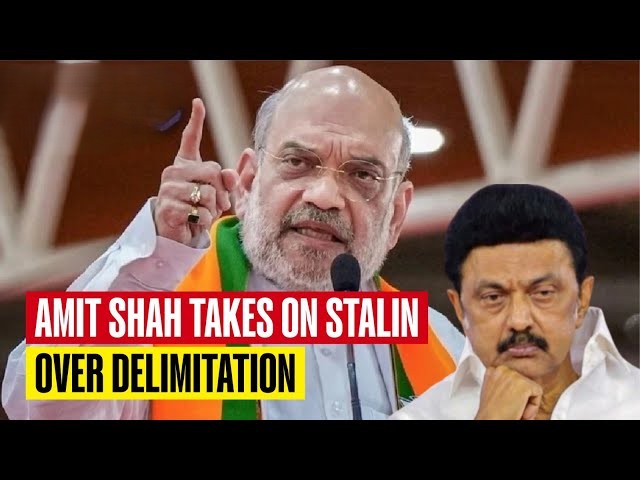
India, the world’s largest democracy, has been grappling with several administrative and political challenges that go beyond mere governance. Among these challenges, the issue of delimitation — the process of redrawing electoral boundaries to reflect changes in population — has emerged as one of the most contentious. Delimitation, if carried out equitably, has the potential to alter the political landscape of the country, and it has become a hotbed of intense debate in recent months. The ongoing deadlock surrounding delimitation, which has escalated amidst the political rivalry between Union Home Minister Amit Shah and Tamil Nadu Chief Minister MK Stalin, as well as delayed census data, is exacerbating the issue.
This blog delves deep into the current situation, the ramifications of the delayed census, the impact of a potential North-South divide, and the caste concerns that dominate the debate. The culmination of these factors has pushed the delimitation issue to the center of India’s political discourse, raising questions about fairness, representation, and the future of Indian democracy.
The Issue of Delimitation
Delimitation, in its simplest form, refers to the process of redefining the boundaries of electoral constituencies to reflect the changes in population and demographic shifts. It is designed to ensure that political representation is in line with the population distribution, ensuring equal representation across different regions. Every ten years, the Indian government conducts a census, which serves as the basis for any revision of these boundaries. In the past, the last delimitation was carried out in 2002, with the data derived from the 2001 Census.
However, the issue of delimitation has recently taken on a political dimension. The delay in conducting the 2021 Census, which was supposed to be the basis for the next round of delimitation, has created a logjam. This delay, coupled with the backdrop of political maneuvering between the ruling Bharatiya Janata Party (BJP) and opposition parties, has led to a standoff over how and when the process should take place.
The need for delimitation becomes particularly crucial as the distribution of population has been dynamic. While some states in the north, particularly Uttar Pradesh, Bihar, and Madhya Pradesh, have seen a significant rise in population, others like Tamil Nadu, Kerala, and West Bengal have experienced a stagnation or even a decline. This population disparity directly influences the number of seats each state gets in the Lok Sabha, India’s lower house of Parliament, and the State Legislative Assemblies. A state with a higher population should logically have more seats in the legislature to represent the growing demographic.
Yet, this process has historically led to political friction. While some states fear losing their fair share of representation, others, like those in the South, worry that the new delimitation could unfairly benefit Northern states, whose populations have grown rapidly, potentially exacerbating regional imbalances.
The Amit Shah-MK Stalin Duel: Political Rivalry Intensifies
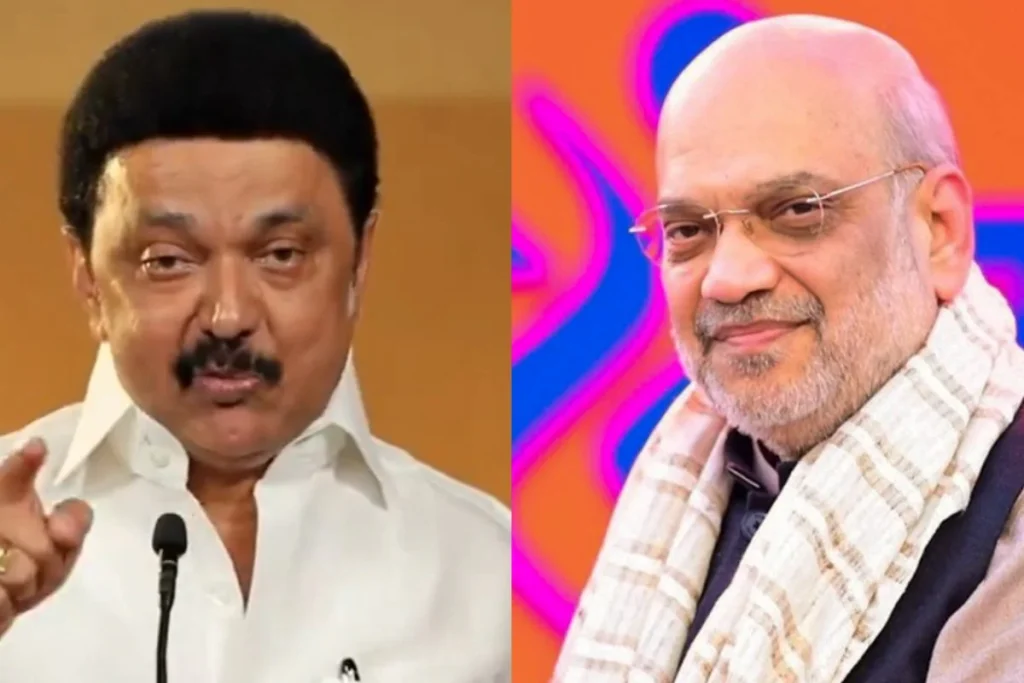
Amid the complicated backdrop of delimitation, the rivalry between Union Home Minister Amit Shah and Tamil Nadu Chief Minister MK Stalin has intensified the political heat. Amit Shah, a prominent leader of the BJP, has been pushing for the implementation of delimitation based on the 2021 Census data. He asserts that the exercise is necessary for ensuring a fair and representative democracy. On the other hand, MK Stalin, a leader from the opposition and head of the Dravida Munnetra Kazhagam (DMK), has opposed the move, expressing concerns that it could disproportionately affect the South, particularly Tamil Nadu, by sidelining the principle of equal representation for all regions.
MK Stalin’s objections are grounded in fears that the Northern states, with their much larger population bases, might gain an unfair advantage, leaving Southern states like Tamil Nadu, Kerala, and Andhra Pradesh with reduced representation. This, Stalin argues, would not only be an affront to the federal structure of the country but would also hurt the political balance within Parliament.
The tension surrounding this issue has given rise to heated debates, both in Parliament and across the political spectrum, as regional leaders and state-based parties fear that the central government’s push for delimitation is aimed at consolidating the BJP’s power in key regions. The DMK, which has a long-standing history of opposing centralization of power, has been vocal in rejecting this proposal, citing its potential to upset the federal structure that ensures equitable representation for all states.
The Delayed Census: A Key Factor in the Deadlock
A significant reason for the current delimitation deadlock lies in the delay of the 2021 Census. Originally scheduled for 2021, the Census has been delayed primarily due to the COVID-19 pandemic, and the current government has yet to announce a clear timeline for its completion. The Census is critical because it provides the official data necessary to determine the population distribution across the country. Without this data, the government cannot proceed with delimitation, which relies heavily on the updated population figures to redraw electoral boundaries.
The delay in the Census has had far-reaching consequences. The lack of updated data has left political parties in a state of uncertainty, unsure of how to formulate strategies in future elections. It has also further complicated the situation, as opposition parties argue that any attempt to carry out delimitation without the fresh data will be skewed and unfair, undermining the integrity of the electoral system.
The government, meanwhile, has sought to downplay the delay, arguing that it is a temporary setback and that the Census will be conducted as soon as it is feasible. However, the delay has caused dissatisfaction among the public, as it is viewed as a missed opportunity for a more representative electoral process that could address imbalances in the current system.
North-South Divide: A Tension in Representation
One of the core concerns surrounding the delimitation debate is the perceived North-South divide in India. While Northern states like Uttar Pradesh, Bihar, Madhya Pradesh, and Rajasthan have witnessed rapid population growth, the Southern states of Tamil Nadu, Kerala, Andhra Pradesh, and Karnataka have seen either stagnation or a decline in population. As a result, Southern states are concerned that the process of delimitation, when it is finally carried out, could disadvantage them in terms of electoral representation.
The North-South divide in India has always been a sensitive issue. Historically, the Southern states have been more prosperous, with better education and healthcare outcomes, but they fear that the ongoing population growth in the North could lead to a skewed allocation of seats in Parliament and state assemblies. The concerns are particularly pronounced in Tamil Nadu, which already has one of the highest population densities in the country, and Kerala, where the fertility rate has decreased significantly in recent decades.
If delimitation were to occur without factoring in the nuances of population stagnation in the South, it could lead to a situation where Northern states receive a disproportionate share of political power. This is particularly problematic because the Southern states, which have long been the engines of economic growth, do not want to lose their political influence as a result of demographic changes that are beyond their control.
The fear is that this will lead to a reduced voice for the Southern states in the national dialogue, with the North holding more sway in the formation of policies and decisions that impact the entire country. Given that many of the larger political parties, including the BJP, have a stronghold in the North, the Southern states fear that a new delimitation could exacerbate this regional imbalance and marginalize their interests even further.
Caste Concerns and Delimitation
Another dimension that adds complexity to the delimitation issue is caste-based politics, which plays an influential role in India’s electoral landscape. Caste is a sensitive issue in Indian society, and electoral representation often has deep-rooted implications in terms of ensuring adequate representation for marginalized communities, including Scheduled Castes (SCs), Scheduled Tribes (STs), and Other Backward Classes (OBCs).
Caste concerns become more pronounced when the process of delimitation involves redrawing constituencies in a way that could alter the demographic composition of the electorate. If the delimitation process is not conducted carefully, it could lead to underrepresentation of marginalized communities or create constituencies that dilute their voting power.
The Indian government has long implemented affirmative action measures such as reserving seats for SCs, STs, and OBCs in both Parliament and state assemblies to ensure that these groups have a voice in the legislative process. However, the process of delimitation has often led to accusations that these measures are not implemented fairly, particularly when it comes to redrawing boundaries in areas where caste-based voting patterns are most pronounced.
Given that the census data has been delayed, and no updated population numbers are available, there is a lack of clarity regarding the distribution of marginalized groups across the country. As a result, caste-based concerns are becoming an increasingly critical issue. Opposition parties, particularly those from the South, argue that the delimitation process, if done hastily or without considering caste composition, could disproportionately affect communities that rely on political representation for social mobility and justice.
The Way Forward: Navigating the Deadlock
The current delimitation deadlock, fuelled by political rivalries, delayed census data, the North-South divide, and caste-based concerns, has the potential to reshape India’s political landscape in profound ways. At the heart of the issue is the question of fairness — how can India ensure that its electoral boundaries are drawn in a way that is representative, just, and mindful of regional disparities and social concerns?
There are several ways forward. First, it is crucial that the government completes the 2021 Census as soon as possible. The updated data will provide the necessary foundation for a transparent and informed delimitation process. A delay in the census is no longer an option if the integrity of India’s electoral system is to be maintained.
Second, there needs to be a national dialogue on the North-South divide and the demographic disparities that exist between the regions. Both the BJP and opposition parties must work together to ensure that the delimitation process takes into account regional sensitivities, balancing the interests of all states fairly.
Finally, the government and political leaders must ensure that caste-based concerns are addressed in the delimitation process. Marginalized communities should not be left behind, and any changes to electoral boundaries should not dilute their representation.
In conclusion, the delimitation deadlock in India is a complex issue, one that involves competing political interests, regional disparities, and concerns about fairness. Amid the ongoing Amit Shah-MK Stalin duel, the delayed Census, and the growing concerns about caste and regional representation, India finds itself at
a crossroads. It is crucial that the government approaches this issue with transparency, inclusivity, and a commitment to justice, ensuring that every citizen, regardless of their region or social standing, has an equal voice in India’s democracy.
read more latest news

