
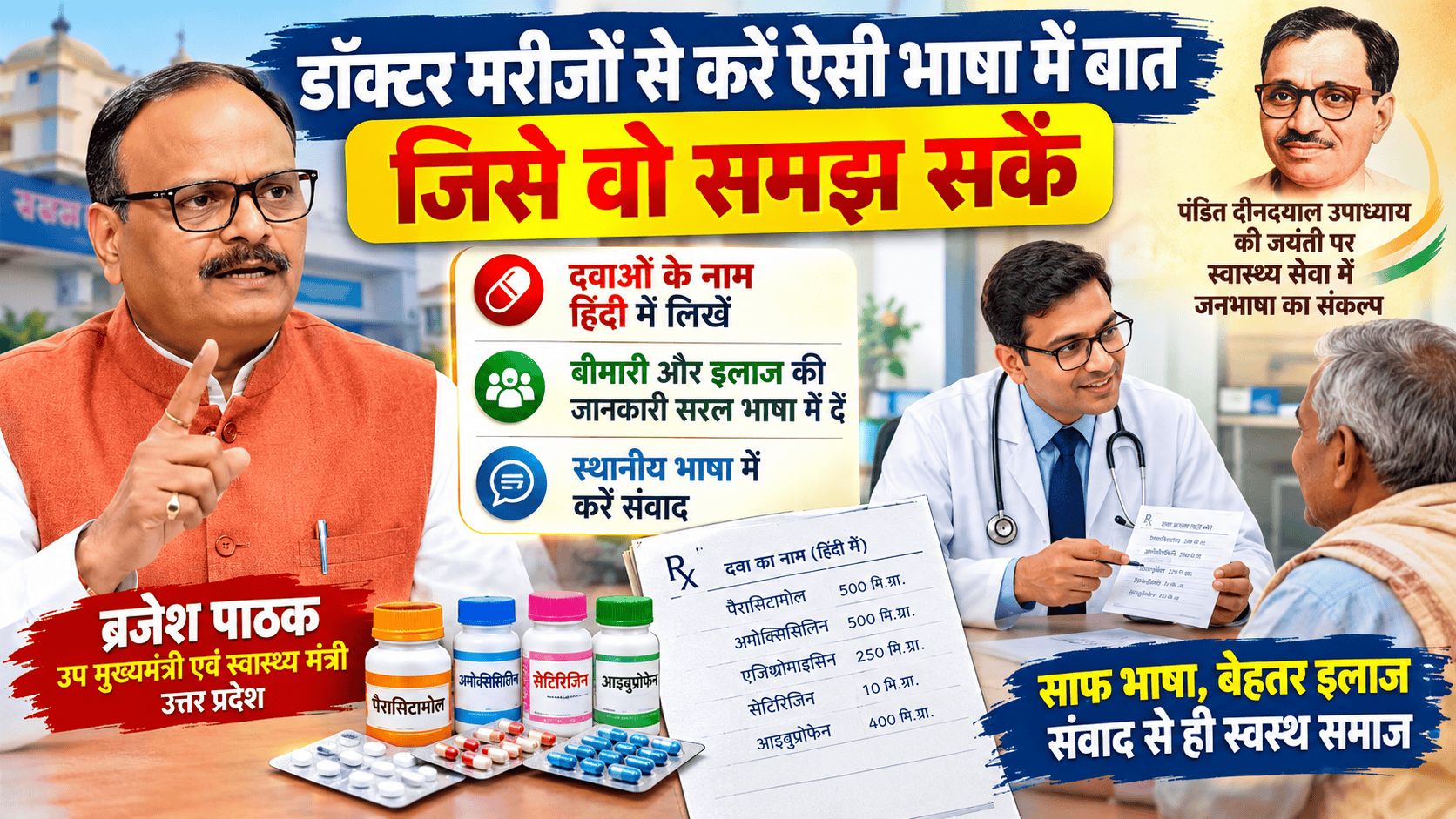
Brajesh Pathak Urges Doctors to Write Medicine Names in Hindi and Explain Treatment in Patients’ Language
UP Health Minister Brajesh Pathak Appeals for Patient-Friendly Medical Communication
Uttar Pradesh Deputy Chief Minister and Health Minister Brajesh Pathak has appealed to doctors across the state to make medical communication easier for patients by using languages they can understand. In an open letter addressed to doctors on the birth anniversary of Pandit Deendayal Upadhyaya, Pathak emphasized that patients should be given clear information about their illnesses, medicines, tests and treatment in simple language.
One of the key points of his appeal was that the names of the medicines in Hindi or Devanagari script should also be written on prescriptions. According to reports, Pathak said this would help patients understand exactly which medicines had been prescribed to them. He also encouraged doctors to communicate with patients in their mother tongue or familiar local languages, including Bhojpuri, Awadhi and Braj Bhasha.
Why Hindi Medicine Names Are Being Emphasized
Medical prescriptions frequently contain technical terminology and medicine names written in English. For patients who are not comfortable reading English, understanding a prescription can sometimes become difficult. Pathak’s appeal focuses on reducing this communication gap.
The demand for names of the medicines in Hindi is connected with the broader objective of making healthcare communication more accessible. When patients can identify the medicine written on a prescription, they may have a clearer understanding of what the doctor has prescribed.
Pathak has reportedly asked doctors to give preference to writing medicine and test names in Hindi or Devanagari. He also said that he would personally give preference to medicines whose names are written in Hindi, according to reports about his letter.
For example, when discussing language and script, common medicine names can be represented in Hindi as Paracetamol — पैरासिटामोल, Amoxicillin — अमोक्सिसिलिन, Azithromycin — एज़िथ्रोमाइसिन, Cetirizine — सेटिरिज़िन, and Ibuprofen — आइबुप्रोफेन. These are examples of transliteration only and should not be understood as recommendations to take any particular medicine.

Patients May Find Prescriptions Easier to Understand
The focus on the names of the medicines in Hindi is particularly relevant for patients who may have limited familiarity with English medical terminology. A prescription is an important part of the treatment process, but its usefulness also depends on whether the patient understands what has been written.
Pathak’s appeal suggests that medical communication should not end with writing a prescription. Doctors should also explain the illness, treatment process and necessary precautions in language that patients can easily follow.
Reports said Pathak urged doctors to communicate with patients in their mother tongue or local dialect wherever possible. The letter specifically referred to languages and dialects such as Bhojpuri, Awadhi and Braj Bhasha.
This approach could make conversations between doctors and patients more direct. Patients may be able to explain their symptoms more comfortably when they are speaking in a familiar language, while doctors can provide instructions in terms that are easier for the patient to understand.
Medicine and Test Names in Devanagari
Another important aspect of the appeal concerns medical tests. Pathak has reportedly urged doctors to write not only the names of the medicines in Hindi but also the names of medical tests in Hindi or Devanagari script.
Medical tests can involve technical terminology that may be unfamiliar to patients. If such information is presented in a familiar script and explained clearly, patients may find it easier to understand what has been advised.
The proposal is therefore broader than simply changing the script used on a prescription. It is about making medical information more accessible at different stages of treatment.
The names of the medicines in Hindi could help patients identify their prescribed medicines, while Hindi or local-language explanations could help them understand the purpose of treatment and instructions given by doctors.
Importance of Doctor-Patient Communication
The doctor-patient relationship depends heavily on communication. Patients need to explain their symptoms accurately, understand medical advice and follow treatment instructions. Language can become a barrier when complicated terminology is not explained clearly.

Pathak’s appeal for the names of the medicines in Hindi comes alongside his request for doctors to speak with patients in familiar languages. Reports quoting his letter said that communication in local languages could help patients explain their problems more effectively and understand medical advice better.
The approach could be particularly relevant in areas where regional languages and dialects are widely spoken. Uttar Pradesh has a large and linguistically diverse population, and the use of familiar languages may make healthcare interactions more comfortable for many people.
At the same time, the use of Hindi or Devanagari does not necessarily replace existing medical terminology. Rather, Pathak’s appeal is focused on making important information understandable to ordinary patients.
Appeal Made on Pandit Deendayal Upadhyaya Birth Anniversary
Pathak made the appeal on the birth anniversary of Pandit Deendayal Upadhyaya. According to reports, he connected the occasion with the wider use of Indian languages, particularly Hindi, in public services.
The letter reportedly emphasized the importance of Indian languages in communication and encouraged doctors to incorporate familiar languages into their interactions with patients.
In this context, the names of the medicines in Hindi have become an important part of the discussion about making healthcare communication more accessible.
Pathak’s appeal also reflects a broader question about how government and public services communicate with citizens. Healthcare is an area where clear communication is particularly important because misunderstandings can affect a patient’s ability to follow medical instructions.
A Focus on Simpler Healthcare Communication
The call for the names of the medicines in Hindi is ultimately linked to the larger objective of simplifying healthcare communication. Patients should be able to understand what is written on their prescriptions and what their doctors are explaining to them.
Pathak’s letter asks doctors to consider the patient’s language while discussing illness and treatment. The request also covers medical tests and prescription information.
For many patients, familiar language can make complicated medical information easier to understand. A doctor explaining a condition in simple Hindi, Bhojpuri, Awadhi or another familiar language may help bridge the gap between technical medical terminology and everyday understanding.
The names of the medicines in Hindi could therefore form one part of a wider patient-friendly communication system.
What the Appeal Means for Patients
The names of the medicines in Hindi initiative, as described in reports about Pathak’s letter, is aimed at improving clarity rather than changing medical treatment itself. Doctors would continue to determine appropriate medicines and treatment based on the patient’s medical needs.
The names of the medicines in Hindi can help patients recognize what has been prescribed, while explanations in familiar languages can provide additional clarity.
The names of the medicines in Hindi may also make it easier for family members and caregivers to understand prescriptions when they assist patients with treatment.

The names of the medicines in Hindi are especially relevant to the discussion around health literacy, where understanding medical information is an important part of accessing healthcare.
The names of the medicines in Hindi could also encourage greater attention to the language used in prescriptions and medical instructions.
Conclusion
Brajesh Pathak’s open letter to doctors has brought the issue of language into focus within Uttar Pradesh’s healthcare system. His appeal asks doctors to communicate with patients in languages they understand and to write medicine and test names in Hindi or Devanagari where appropriate.
The names of the medicines in Hindi are one element of this broader appeal for simpler communication. The names of the medicines in Hindi can make prescriptions more accessible, while communication in local languages may help patients better understand their illnesses and treatment.
Ultimately, the names of the medicines in Hindi discussion highlights the importance of making medical information understandable to the people who receive it. The names of the medicines in Hindi request is therefore part of a wider emphasis on patient-friendly healthcare communication in Uttar Pradesh.
Read more latest news

