
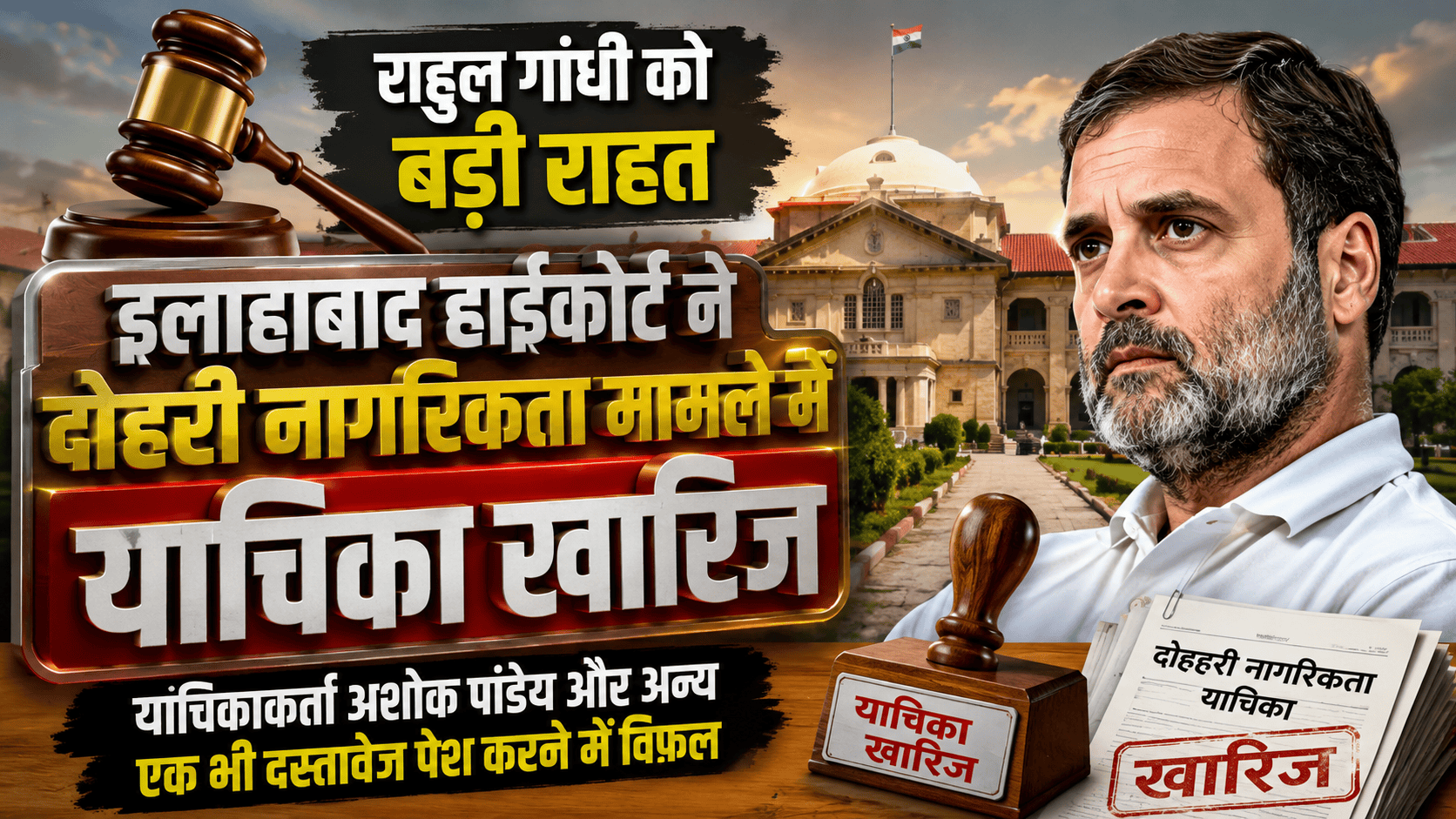
Allahabad High Court Rejects Petition Alleging Dual Citizenship Against Rahul Gandhi
The Allahabad High Court has dismissed a petition alleging that Congress leader and Leader of the Opposition in the Lok Sabha, Rahul Gandhi, holds dual citizenship. The court observed that the petitioner, lawyer Ashok Pandey, and others failed to produce even a single document capable of substantiating the allegations. The development has once again brought attention to the importance of documentary evidence in cases involving serious claims about the citizenship status of a public representative.
The High Court has Rejected the petition after considering the material presented before it. The court’s observation indicates that allegations of this nature cannot be sustained merely on the basis of claims or assumptions. Concrete and verifiable evidence is essential when a petitioner seeks judicial intervention in a matter as significant as citizenship.
Court Seeks Evidence for Serious Citizenship Allegations
The petition reportedly raised allegations concerning Rahul Gandhi’s citizenship and sought action based on claims of dual citizenship. However, during the proceedings, the petitioners were unable to provide documentary evidence supporting their allegations.
The High Court has Rejected the petition because the material placed before the court did not establish the claims being made against Rahul Gandhi. The court’s approach highlights the principle that accusations, particularly those involving constitutional or legal status, must be supported by credible evidence.
Citizenship is a legally defined status, and questions concerning it require appropriate documentation and evidence. Courts cannot ordinarily rely on unverified allegations when deciding whether a person’s citizenship status should be questioned.
Rahul Gandhi and the Citizenship Controversy
Rahul Gandhi, a prominent Congress leader and the Leader of the Opposition in the Lok Sabha, has faced questions and political controversies on several occasions. Allegations concerning his citizenship have also appeared in public and political discussions.
In the present matter, however, the High Court has Rejected the petition after finding that the petitioners had not produced sufficient documentary material to support their allegations.
The ruling is significant because it demonstrates the importance of evidence in judicial proceedings. While citizens have the right to approach courts when they believe that a legal issue requires examination, the claims made in such petitions must have a factual and documentary foundation.
Importance of Documentary Evidence
A major aspect of the court’s observation was the absence of documentary evidence. According to the information presented about the case, the petitioners failed to produce a single document that could substantiate the allegation of dual citizenship.
The High Court has Rejected the petition in circumstances where the allegations were not backed by supporting documents. This observation serves as an important reminder that legal proceedings are based on evidence rather than speculation.
Documents can include official records, government communications, citizenship records, or other legally relevant materials. Without such evidence, an allegation may remain only an assertion and may not be sufficient for a court to take further action.
What Does the Court’s Decision Mean?
The dismissal of the petition does not necessarily mean that courts cannot examine citizenship-related questions in the future. Rather, it emphasizes that anyone seeking judicial intervention must establish a credible factual basis for the relief being requested.
The High Court has Rejected the petition because the material available before it did not substantiate the allegations. The decision therefore reinforces the importance of presenting reliable evidence when making serious legal claims.
For Rahul Gandhi, the court’s decision means that this particular petition has not resulted in the requested judicial action. The matter also illustrates how courts assess petitions involving public figures, especially when allegations have potentially serious legal and political consequences.
Political Reactions May Follow
Whenever a major political leader becomes the subject of a court case, the development often attracts considerable public and political attention. Rahul Gandhi is one of India’s most prominent opposition leaders, making any legal proceeding involving him a matter of significant interest.
The High Court has Rejected the petition after the petitioners failed to establish their allegations through documentary evidence. Political parties and supporters may interpret the development differently, but the central judicial observation remains focused on the evidence presented before the court.
Such developments also underline the distinction between political debate and judicial proceedings. Political allegations may be discussed publicly, but courts require legally admissible and credible material before granting relief.
Why Evidence Matters in Court
The judicial system depends heavily on evidence. A person making an allegation has to provide sufficient grounds for the court to examine the matter. Serious allegations cannot automatically become legally actionable simply because they attract public attention.
In this case, the High Court has Rejected the petition because the petitioners reportedly could not produce documentary material supporting their claims. The observation reinforces the broader legal principle that courts must make decisions based on facts and evidence rather than unverified assertions.
This principle is especially important when the allegations concern an individual’s citizenship, constitutional position, or eligibility for public office.
Impact on Public Discourse
The case may also influence public discussion surrounding Rahul Gandhi and citizenship-related allegations. Social media and political platforms frequently witness debates over the legal status of prominent leaders. However, a judicial proceeding requires a significantly higher standard of proof.
The High Court has Rejected the petition, and the court’s observation regarding the lack of documentary evidence is likely to remain the central point of discussion surrounding the case.
The development serves as a reminder to the public that allegations circulating in political discourse should not automatically be treated as established facts. Judicial findings depend on evidence presented through the appropriate legal process.
A Reminder About Responsible Legal Claims
The case also highlights the importance of making responsible claims about public figures. Allegations involving citizenship can have serious consequences for an individual’s reputation and public standing. Therefore, such claims should be supported by reliable information.
The High Court has Rejected the petition after finding that the petitioners failed to substantiate their allegations with documentary proof. The decision reinforces the idea that legal challenges must be supported by evidence capable of withstanding judicial scrutiny.

For members of the public, the episode demonstrates why official records and verified information are important when evaluating controversial claims.
Conclusion
The Allahabad High Court’s decision to dismiss the petition alleging dual citizenship against Rahul Gandhi has brought the issue back into focus. The court reportedly observed that lawyer Ashok Pandey and others failed to produce a single document supporting their allegations.
The High Court has Rejected the petition, emphasizing the absence of evidence presented by the petitioners. The decision highlights a fundamental aspect of the legal system: serious allegations require credible and verifiable proof.
The High Court has Rejected the petition after considering the material placed before it, and the ruling demonstrates that courts cannot act solely on unsubstantiated claims. The High Court has Rejected the petition in this particular matter, leaving the allegations without the judicial relief sought by the petitioners.
Ultimately, the case serves as an important reminder that legal claims must be supported by evidence. The High Court has Rejected the petition, and the court’s observation about the lack of documentary proof remains the key feature of the development. For readers following Indian politics and constitutional issues, the case illustrates the difference between political allegations and claims that can be established through judicial evidence.
Read More latest news

