
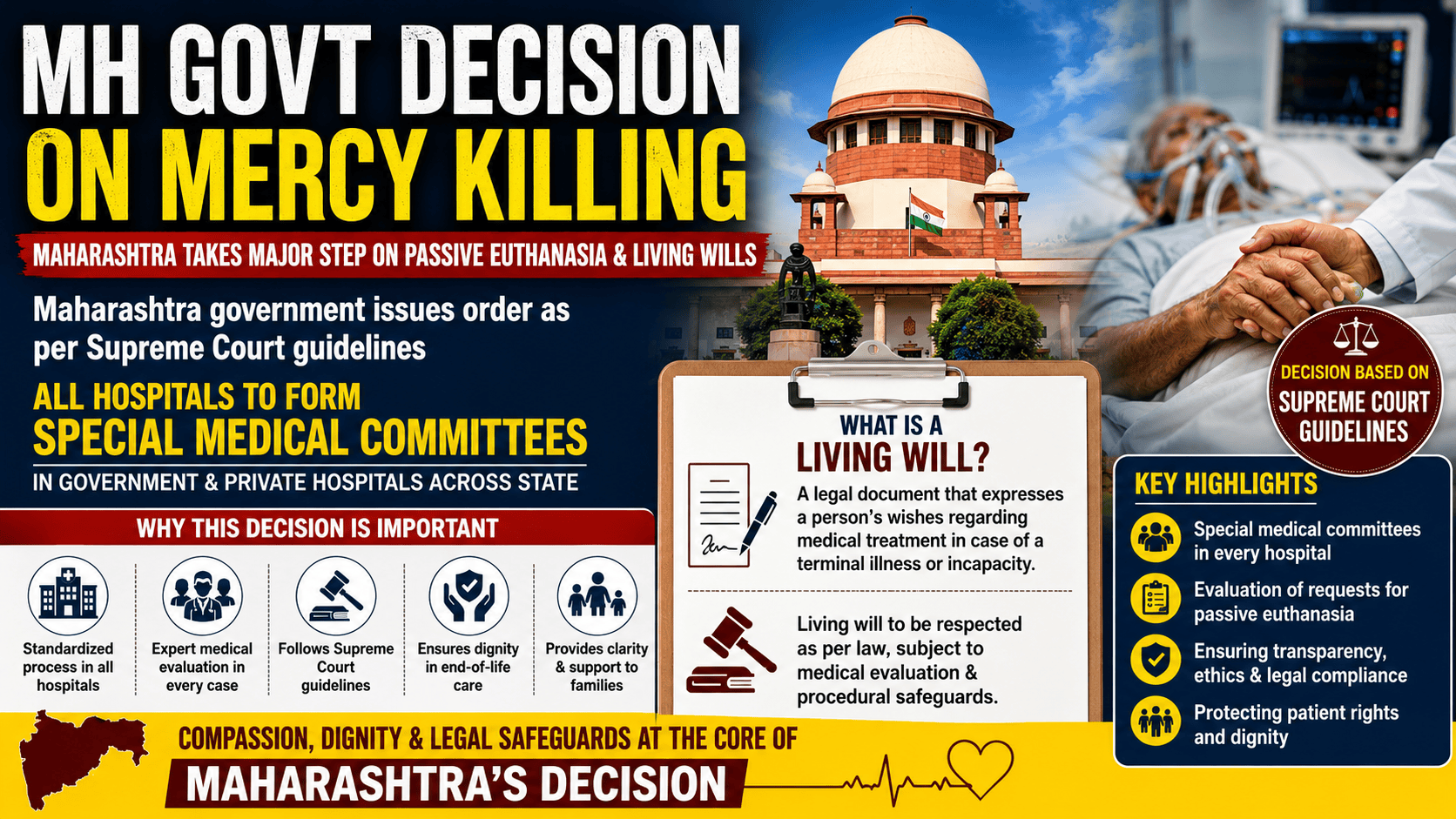
MH Govt Decision on Mercy Killing: Maharashtra Issues Major Order on Passive Euthanasia and Living Wills, Hospitals to Form Special Medical Committees
The MH govt decision on mercy killing has emerged as a significant development in India’s healthcare and legal framework. The Maharashtra government has issued an important order regarding passive euthanasia and “living wills,” directing all government and private hospitals across the state to establish special medical committees. This move follows the guidelines laid down by the Supreme Court of India and aims to ensure that decisions related to passive euthanasia are made through a transparent, ethical, and legally compliant process.
The MH govt decision on mercy killing is expected to bring greater clarity to hospitals, doctors, patients, and families dealing with end-of-life medical care. By implementing a standardized procedure, the government seeks to protect patient rights while ensuring that sensitive medical decisions are handled responsibly.
MH Govt Decision on Mercy Killing: What Has Changed?
The MH govt decision on mercy killing requires every government and private hospital in Maharashtra to constitute dedicated medical boards for cases involving passive euthanasia. These committees will evaluate requests related to the withdrawal or withholding of life-sustaining treatment in accordance with the law.
The order has been issued in line with the Supreme Court’s directions, which recognize passive euthanasia under specific circumstances while laying down detailed procedural safeguards. Hospitals are now required to follow these guidelines to ensure that every case is examined carefully and ethically.
This decision is seen as a major step toward creating a uniform system for handling end-of-life care across the state.
Understanding Passive Euthanasia
The MH govt decision on mercy killing specifically relates to passive euthanasia and not active euthanasia.
Passive euthanasia refers to the withdrawal or withholding of life-support systems or life-sustaining treatment in cases where a patient has no realistic chance of recovery and continued treatment only prolongs suffering.
Examples may include:
- Withdrawal of ventilator support.
- Stopping artificial life-support systems.
- Discontinuing certain life-sustaining medical interventions after due legal and medical evaluation.
It is important to note that active euthanasia, which involves deliberately causing a patient’s death through medical intervention, remains illegal in India.
What Is a Living Will?
A major aspect of the MH govt decision on mercy killing concerns the implementation of “living wills.”
A living will is a legal document prepared by an individual while mentally competent. It specifies the person’s wishes regarding future medical treatment if they become incapable of communicating decisions due to terminal illness or irreversible medical conditions.
Through a living will, individuals can indicate whether they wish to receive or decline life-sustaining treatment under specific circumstances.
The Supreme Court has recognized the validity of living wills subject to prescribed safeguards, and Maharashtra’s latest order seeks to ensure their proper implementation.
Supreme Court Guidelines
The MH govt decision on mercy killing is based on guidelines issued by the Supreme Court, which has repeatedly emphasized balancing individual autonomy with medical ethics and legal safeguards.
The Court laid down procedures to ensure that passive euthanasia is not misused. These safeguards include:
- Verification of the patient’s medical condition.
- Review by qualified medical experts.
- Compliance with legal procedures.
- Documentation of all decisions.
- Protection of patient rights.
The Maharashtra government’s latest order operationalizes these guidelines across healthcare institutions in the state.
Formation of Special Medical Committees
One of the most important aspects of the MH govt decision on mercy killing is the mandatory establishment of special medical committees in all government and private hospitals.
These committees are expected to include experienced medical professionals from different specialties who will independently evaluate each request for passive euthanasia.
Their responsibilities include:
- Assessing the patient’s medical condition.
- Reviewing medical records.
- Examining the validity of any living will.
- Determining whether legal conditions have been fulfilled.
- Providing independent medical opinions.
Such committees are intended to ensure that decisions are made objectively and without external pressure.
Protecting Patients and Families
The MH govt decision on mercy killing also aims to reduce uncertainty for patients and their families during emotionally challenging situations.
Families often face difficult choices when a loved one is terminally ill or permanently unconscious. Clear legal procedures can help ensure that medical decisions are taken transparently and in accordance with the patient’s wishes wherever possible.
The structured review process also protects healthcare professionals by providing legal clarity while making sensitive end-of-life decisions.
Importance for Hospitals
Hospitals across Maharashtra will now need to establish systems for implementing the MH govt decision on mercy killing effectively.
Healthcare institutions may need to:
- Constitute medical review boards.
- Train doctors regarding Supreme Court guidelines.
- Maintain proper documentation.
- Verify living wills.
- Coordinate with legal authorities when necessary.
- Ensure ethical compliance.
These steps are expected to improve consistency in handling passive euthanasia requests.
Ethical Considerations
The MH govt decision on mercy killing has once again highlighted the ethical complexities surrounding end-of-life medical care.
Supporters argue that terminally ill patients should have the right to refuse extraordinary medical treatment when recovery is medically impossible.
They believe that respecting patient autonomy is an important aspect of modern healthcare.
At the same time, strict legal safeguards remain essential to prevent misuse and ensure that decisions are made solely in the patient’s best interests.
The establishment of independent medical committees is intended to maintain this balance.
Legal Significance
The MH govt decision on mercy killing demonstrates how states are implementing judicial guidelines within their healthcare systems.
Rather than introducing a new law, Maharashtra has issued administrative directions to ensure hospitals follow the Supreme Court’s existing legal framework on passive euthanasia and living wills.
This provides greater administrative clarity while promoting uniform implementation across public and private healthcare institutions.
Impact on Healthcare System
The MH govt decision on mercy killing may significantly improve the handling of end-of-life medical decisions across Maharashtra.
Potential benefits include:
- Standardized decision-making.
- Better legal compliance.
- Protection of patient rights.
- Greater transparency.
- Improved ethical oversight.
- Reduced confusion among hospitals.
- Clearer guidance for medical professionals.
Healthcare experts believe that a structured system can improve trust between patients, families, and healthcare providers.
Conclusion
The MH govt decision on mercy killing marks an important step toward implementing the Supreme Court’s guidelines on passive euthanasia and living wills across Maharashtra. By directing all government and private hospitals to establish special medical committees, the state government aims to ensure that sensitive end-of-life decisions are handled with transparency, legal compliance, and medical ethics.
The MH govt decision on mercy killing is expected to provide greater clarity for hospitals, doctors, patients, and families navigating complex medical situations. While passive euthanasia remains subject to strict safeguards, the formation of independent medical boards and recognition of living wills reinforce the importance of patient autonomy within a carefully regulated legal framework.
As Maharashtra strengthens its healthcare governance through the MH govt decision on mercy killing, the initiative could serve as a model for improving the implementation of Supreme Court guidelines on passive euthanasia while ensuring dignity, accountability, and compassion in end-of-life medical care.
Read more latest news

