
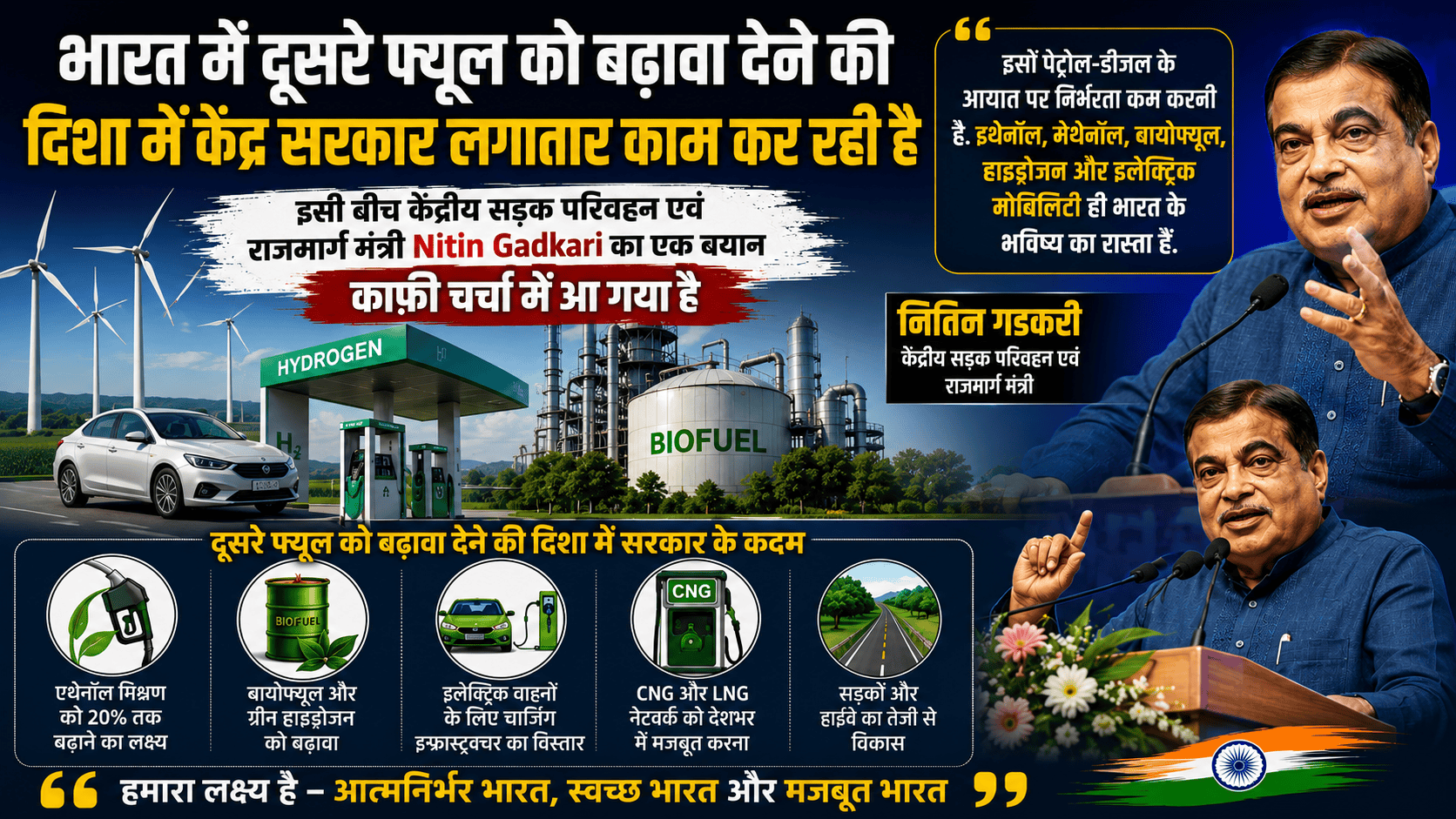
Nitin Gadkari Say About Petroleum: Why India Must Reduce Dependence on Petrol and Move Towards Ethanol Fuel
Introduction
The phrase Nitin Gadkari say about petroleum has since become one of the most searched topics related to India’s energy future.
India is rapidly moving toward cleaner, greener, and more sustainable energy solutions. As one of the world’s fastest-growing economies, the country faces the challenge of meeting rising energy demands while reducing pollution and dependence on imported fossil fuels. In this context, a recent statement by Union Road Transport and Highways Minister Nitin Gadkari has attracted widespread attention.
At the launch of a flex-fuel motorcycle, Gadkari made a strong remark about the future of fuel in India. The statement quickly became a major topic of discussion across political, industrial, and environmental circles.
His comments reflect the government’s long-term vision of promoting alternative fuels such as ethanol, biofuels, electric mobility, and green hydrogen. The objective is not only to reduce fuel imports but also to create economic opportunities for farmers and improve environmental sustainability.
The Statement That Sparked Discussion
During the launch event, Gadkari expressed his strong preference for alternative fuels and stated that he does not even want to see the face of petrol. His remarks immediately generated headlines because they highlighted the government’s determination to reduce dependence on conventional fuels.
The discussion surrounding Nitin Gadkari say about petroleum is important because it signals a broader policy direction rather than a simple personal opinion. The minister has consistently advocated the use of ethanol-blended fuels and alternative energy sources.
According to Gadkari, India spends a massive amount of money importing crude oil from foreign countries. Reducing dependence on petrol could strengthen the country’s economy while simultaneously addressing environmental concerns.
Why India Wants to Reduce Petrol Dependence
One of the biggest reasons behind the debate generated by Nitin Gadkari say about petroleum is India’s heavy dependence on imported crude oil.
India imports a significant portion of its petroleum requirements. This dependence creates multiple challenges:
- Increased import bills
- Exposure to global oil price fluctuations
- Pressure on foreign exchange reserves
- Energy security concerns
When international oil prices rise, consumers often face higher fuel costs. This can increase transportation expenses and contribute to inflation throughout the economy.
Reducing reliance on petrol can help mitigate these risks and create a more stable energy future.

The Rise of Ethanol as an Alternative Fuel
A key aspect of Nitin Gadkari say about petroleum is his emphasis on ethanol fuel.
Ethanol is a renewable biofuel produced from agricultural products such as sugarcane, maize, and other biomass sources. Unlike petroleum, ethanol can be produced domestically, reducing dependence on imported fossil fuels.
India has already made significant progress in ethanol blending programs. The government has encouraged oil marketing companies to increase ethanol content in petrol, helping reduce emissions and support domestic agriculture.
The promotion of ethanol is seen as a win-win solution because it benefits both farmers and consumers.
What Are Flex-Fuel Vehicles?
The launch event that triggered discussions around Nitin Gadkari say about petroleum focused on flex-fuel vehicle technology.
Flex-fuel vehicles are designed to operate on multiple fuel combinations, including petrol and ethanol blends. Some vehicles can run on fuel mixtures containing up to 85% ethanol.
The advantages of flex-fuel vehicles include:
- Lower emissions
- Reduced fuel imports
- Greater fuel flexibility
- Support for domestic agriculture
As more manufacturers introduce such vehicles, consumers may gain access to cleaner and potentially more affordable fuel options.
Benefits for Indian Farmers
One of the strongest arguments behind Nitin Gadkari say about petroleum involves the economic opportunities created for farmers.
India produces large quantities of sugarcane, maize, and agricultural waste that can be converted into ethanol. Increased demand for ethanol can create additional income streams for farmers.
This can help:
- Improve rural incomes
- Reduce agricultural waste
- Create new markets for crops
- Encourage biofuel production
Gadkari has repeatedly emphasized that energy policy should not only benefit consumers but also strengthen rural economies.
Environmental Advantages
Environmental concerns are another major factor influencing Nitin Gadkari say about petroleum.
Petrol and diesel combustion contribute significantly to air pollution and greenhouse gas emissions. Urban centers across India continue to struggle with poor air quality.
Ethanol-based fuels can help reduce:
- Carbon emissions
- Air pollutants
- Dependence on fossil fuels
Although ethanol is not completely emission-free, it is generally considered cleaner than conventional petroleum fuels.
As countries worldwide pursue climate goals, alternative fuels are becoming increasingly important.
Energy Security for India
The concept of energy security is central to understanding Nitin Gadkari say about petroleum.
Energy security refers to a nation’s ability to maintain reliable access to affordable energy supplies. Countries heavily dependent on imports often face risks from geopolitical tensions, conflicts, and market disruptions.
Recent global events have demonstrated how international crises can impact oil supplies and fuel prices.
By promoting domestic biofuel production, India can reduce vulnerability to external shocks and strengthen long-term energy stability.
Economic Impact of Reduced Oil Imports
India spends billions of dollars each year importing crude oil. This has significant implications for the economy.
Supporters of the vision reflected in Nitin Gadkari say about petroleum argue that reducing oil imports could:
- Lower foreign exchange outflows
- Strengthen the rupee
- Improve trade balances
- Support domestic industries
The savings generated through reduced imports could potentially be redirected toward infrastructure, education, healthcare, and technological innovation.

Government Initiatives Supporting Alternative Fuels
The discussion surrounding Nitin Gadkari say about petroleum aligns with several government initiatives aimed at promoting alternative energy.
These include:
- Ethanol blending programs
- Electric vehicle incentives
- Biofuel development policies
- Green hydrogen initiatives
- Sustainable mobility projects
Together, these measures form part of a broader strategy to transform India’s transportation and energy sectors.
The government’s objective is to create a diversified energy ecosystem that is cleaner, more efficient, and less dependent on imported fossil fuels.
Challenges in the Transition
Despite the optimism surrounding Nitin Gadkari say about petroleum, several challenges remain.
Some of the key obstacles include:
Infrastructure Development
Widespread adoption of ethanol requires:
- Storage facilities
- Distribution networks
- Refueling stations
Vehicle Compatibility
Not all existing vehicles can operate on high ethanol blends. Upgrading vehicle technology will take time.
Production Capacity
Meeting future ethanol demand will require substantial investment in production facilities and supply chains.
Addressing these challenges is essential for achieving long-term success.
Industry Response
Automobile manufacturers have shown increasing interest in flex-fuel technology.
The growing attention generated by Nitin Gadkari say about petroleum has encouraged companies to explore alternative fuel solutions more aggressively.
Several automakers are:
- Developing flex-fuel engines
- Expanding electric vehicle production
- Investing in sustainable mobility technologies
Industry participation will play a critical role in determining how quickly India can transition away from traditional petroleum dependence.
Consumer Perspective
For ordinary consumers, the most important considerations are affordability and convenience.
The conversation around Nitin Gadkari say about petroleum often focuses on whether alternative fuels can offer cost savings without compromising vehicle performance.
Consumers generally look for:
- Lower fuel costs
- Reliable vehicle performance
- Easy availability
- Reduced maintenance expenses
If ethanol and other alternatives meet these expectations, adoption rates could increase significantly.
Global Trends in Alternative Fuels
India is not alone in exploring alternatives to petroleum.
Countries around the world are investing in:
- Biofuels
- Electric vehicles
- Hydrogen fuel technologies
- Renewable energy systems
The international shift toward sustainable energy supports the broader vision reflected in Nitin Gadkari say about petroleum.
Many governments recognize that reducing fossil fuel dependence is essential for environmental and economic reasons.
The Future of Transportation in India
Transportation is undergoing rapid transformation globally. Electric vehicles, autonomous systems, and alternative fuels are reshaping the industry.
The ideas highlighted through Nitin Gadkari say about petroleum suggest that India aims to become a leader in sustainable mobility.
Future transportation systems may rely on a combination of:
- Ethanol fuels
- Electric vehicles
- Green hydrogen
- Advanced biofuels
This diversified approach can provide flexibility while reducing environmental impact.
Conclusion
The widespread discussion generated by Nitin Gadkari say about petroleum reflects the growing importance of energy policy in India’s future development. His remarks at the flex-fuel bike launch were not merely about petrol; they represented a broader vision for a cleaner, more self-reliant, and economically stronger India.
By promoting ethanol and other alternative fuels, the government hopes to reduce crude oil imports, support farmers, improve air quality, and strengthen energy security. While challenges remain, the direction is clear: India is seeking to diversify its energy sources and reduce dependence on conventional fossil fuels.
The debate surrounding Nitin Gadkari say about petroleum is likely to continue as new technologies emerge and policies evolve. Whether through ethanol, electric mobility, or hydrogen-based solutions, the future of transportation in India appears increasingly focused on sustainability and innovation.
As the country moves forward, the principles emphasized in Nitin Gadkari say about petroleum could play a major role in shaping India’s economic, environmental, and energy future for decades to come.
Read more latest news

