

US Navy Ready to Lift Blockade: Trump Signals Major Shift on Strait of Hormuz Crisis
Introduction
Trump announced that the US Navy ready to lift blockade in the strategically important waterway if Iran agrees to permanently abandon its nuclear weapons ambitions.
In a significant geopolitical development, US President Donald Trump made a major statement on Friday, May 29, 2026, regarding the future of the Strait of Hormuz and ongoing tensions with Iran.
The statement has attracted worldwide attention because the Strait of Hormuz remains one of the most important maritime routes for global energy supplies. Any disruption in this region directly impacts oil prices, international trade, and global security. Trump’s remarks suggest that Washington may be willing to ease military pressure in exchange for strong guarantees from Tehran regarding its nuclear program.
The announcement that the US Navy ready to lift blockade marks a potentially historic turning point in relations between the United States and Iran. However, the proposal also raises several questions about regional security, diplomatic negotiations, and the future of nuclear non-proliferation efforts.
Why the Strait of Hormuz Matters
The Strait of Hormuz is one of the world’s most critical maritime chokepoints. Located between Iran and Oman, the narrow waterway connects the Persian Gulf with the Gulf of Oman and the Arabian Sea.
Nearly one-fifth of the world’s oil supply passes through this route every day. Countries such as Saudi Arabia, the United Arab Emirates, Kuwait, Iraq, and Qatar rely heavily on the Strait of Hormuz to export oil and natural gas to global markets.
Whenever tensions rise in the region, energy markets react immediately. Even rumors of military conflict can trigger spikes in oil prices. Therefore, Trump’s declaration that the US Navy ready to lift blockade has major implications for global economic stability.
International investors, energy companies, and governments closely monitor developments in the Strait of Hormuz because any disruption could affect fuel prices, transportation costs, and inflation worldwide.
Trump’s Major Announcement
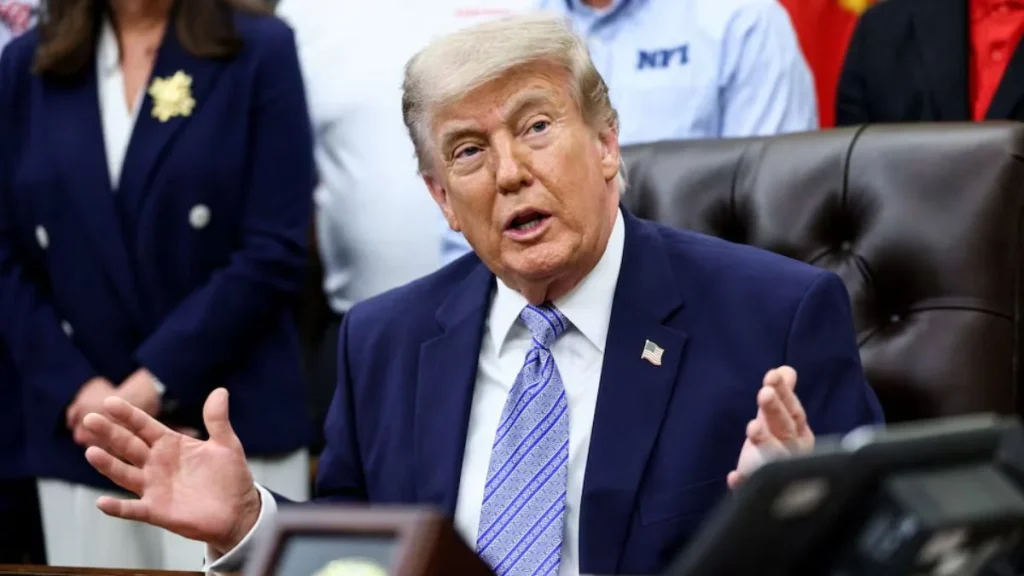
Speaking to reporters, President Trump emphasized that the United States is prepared to reduce military restrictions in the region if Iran makes a clear commitment never to develop nuclear weapons.
According to Trump, the US Navy ready to lift blockade provided that Tehran accepts strict conditions and permanently abandons any effort to build nuclear bombs.
The president also urged Iranian leaders to make a final decision quickly. He stated that the opportunity for diplomatic resolution exists now but may not remain open indefinitely.
The announcement reflects Trump’s broader strategy of combining pressure with negotiation. While maintaining a strong military presence, Washington appears willing to offer concessions if its security concerns are addressed.
The statement that the US Navy ready to lift blockade has already generated reactions from diplomats, security analysts, and international organizations around the world.
Iran’s Nuclear Program at the Center of Negotiations
The primary condition outlined by Trump revolves around Iran’s nuclear ambitions. For decades, the United States and several Western nations have expressed concern that Iran could eventually develop nuclear weapons.
Iran has repeatedly insisted that its nuclear program is intended solely for peaceful purposes, including electricity generation and scientific research. However, critics argue that certain aspects of the program could potentially be used for military purposes.
Trump’s proposal makes it clear that the US Navy ready to lift blockade only if Iran provides credible assurances regarding its nuclear activities.
Experts believe that any future agreement would likely involve extensive inspections, monitoring systems, and international verification mechanisms.
Such measures would be designed to ensure compliance and build confidence among regional and global stakeholders.
Impact on Global Oil Markets
Energy markets reacted cautiously to Trump’s announcement. Traders recognize that the Strait of Hormuz remains essential for global oil transportation.
The possibility that the US Navy ready to lift blockade could reduce tensions and improve stability in the region. Reduced military confrontation generally lowers risk premiums attached to oil prices.
Analysts suggest that a successful agreement could lead to more predictable energy flows and greater market confidence.
Many countries heavily dependent on imported oil would welcome any development that enhances security in the Gulf region.
However, experts also caution that negotiations can be lengthy and complicated. Until a formal agreement is reached, uncertainty is likely to remain.
Strategic Importance for the United States
The United States has long maintained a significant naval presence in the Middle East. American forces help safeguard commercial shipping lanes and deter potential threats to international trade.
Trump’s statement that the US Navy ready to lift blockade reflects a strategic calculation aimed at achieving security objectives through diplomacy rather than prolonged confrontation.
A successful agreement could allow the United States to reduce military tensions while still preventing nuclear proliferation.
American policymakers view preventing the emergence of new nuclear-armed states as a critical national security priority.
Therefore, any arrangement involving the Strait of Hormuz would likely include robust enforcement mechanisms.
Regional Reactions
Countries across the Middle East are carefully evaluating Trump’s proposal. Gulf nations have historically expressed concerns about Iran’s regional influence and missile capabilities.
Some regional governments may welcome signs that the US Navy ready to lift blockade if it results in greater stability and reduced risk of military conflict.
Others may remain cautious until they see concrete evidence that Iran is willing to accept stringent nuclear restrictions.
Israel, which has consistently opposed Iran’s nuclear ambitions, is also expected to closely monitor developments.
Regional reactions will play an important role in shaping the success or failure of future negotiations.
International Community Responds
The announcement that the US Navy ready to lift blockade has sparked discussion among major world powers, including European nations, China, and Russia.
Many governments support diplomatic efforts aimed at preventing nuclear proliferation while maintaining regional stability.
International organizations have repeatedly called for peaceful dialogue and negotiated solutions to disputes involving Iran’s nuclear program.
Diplomats believe that renewed negotiations could create opportunities for broader cooperation on security and economic issues.
However, achieving consensus among multiple stakeholders remains a complex challenge.
Economic Consequences of a Potential Agreement
If negotiations succeed, the economic benefits could be substantial. Stable maritime trade routes support global commerce and help prevent supply chain disruptions.
The prospect that the US Navy ready to lift blockade may encourage investment and improve market sentiment.
Lower geopolitical risk often translates into reduced transportation costs and greater confidence among businesses.
Energy-importing countries could benefit from more stable fuel prices, while exporters would gain from uninterrupted access to international markets.
Financial institutions and multinational corporations are therefore closely following developments.
Challenges Ahead
Despite the optimism generated by Trump’s remarks, significant obstacles remain.
Negotiations involving nuclear programs are inherently complex. Issues such as inspection protocols, enrichment limits, sanctions relief, and verification mechanisms require extensive discussion.
Even though the US Navy ready to lift blockade, reaching a final agreement may take considerable time.
Trust remains a major issue between Washington and Tehran. Decades of political tensions have created deep divisions that cannot be resolved overnight.
Both sides will need to demonstrate flexibility and commitment if progress is to be achieved.
Security Implications
A successful agreement could significantly improve regional security conditions.
The fact that the US Navy ready to lift blockade may reduce the likelihood of accidental military confrontations in the Gulf.
Greater stability could also encourage diplomatic engagement among neighboring countries.
Security experts argue that reducing tensions benefits not only regional actors but also the broader international community.
However, maintaining peace would require continued monitoring and cooperation among multiple stakeholders.
The Future of US-Iran Relations
Trump’s proposal may represent an opportunity to redefine relations between the United States and Iran.
The statement that the US Navy ready to lift blockade suggests that Washington remains open to negotiation despite years of hostility.
Future relations will depend largely on how Iran responds to the conditions outlined by the US administration.
If both sides can find common ground, a new chapter in diplomatic engagement may emerge.
Nevertheless, many observers remain cautious given the history of previous negotiations and disputes.
Global Strategic Significance
Beyond the immediate region, the proposal carries broader strategic implications.
The declaration that the US Navy ready to lift blockade demonstrates how maritime security and nuclear diplomacy are interconnected.
Major powers around the world have a vested interest in maintaining freedom of navigation and preventing nuclear proliferation.
The outcome of these negotiations could influence future approaches to international security challenges.
Success could provide a model for resolving other complex disputes through diplomacy and verification.
Conclusion
President Donald Trump’s announcement regarding the Strait of Hormuz has introduced a significant new element into international diplomacy. By stating that the US Navy ready to lift blockade if Iran permanently abandons nuclear weapons ambitions, Washington has presented a clear proposal aimed at reducing tensions while advancing non-proliferation goals.
The coming weeks and months will determine whether Iran accepts the conditions and whether meaningful negotiations can move forward. The stakes are exceptionally high because the Strait of Hormuz remains a vital artery for global energy supplies and international trade.
If an agreement is reached, it could improve regional security, stabilize energy markets, and create opportunities for broader diplomatic engagement. If negotiations fail, tensions may continue to affect one of the world’s most strategically important regions.
For now, the world is watching closely as leaders evaluate the proposal and consider the future of the Gulf region. The announcement that the US Navy ready to lift blockade has opened a new chapter in one of the most important geopolitical discussions of 2026.
Read more latest news

