
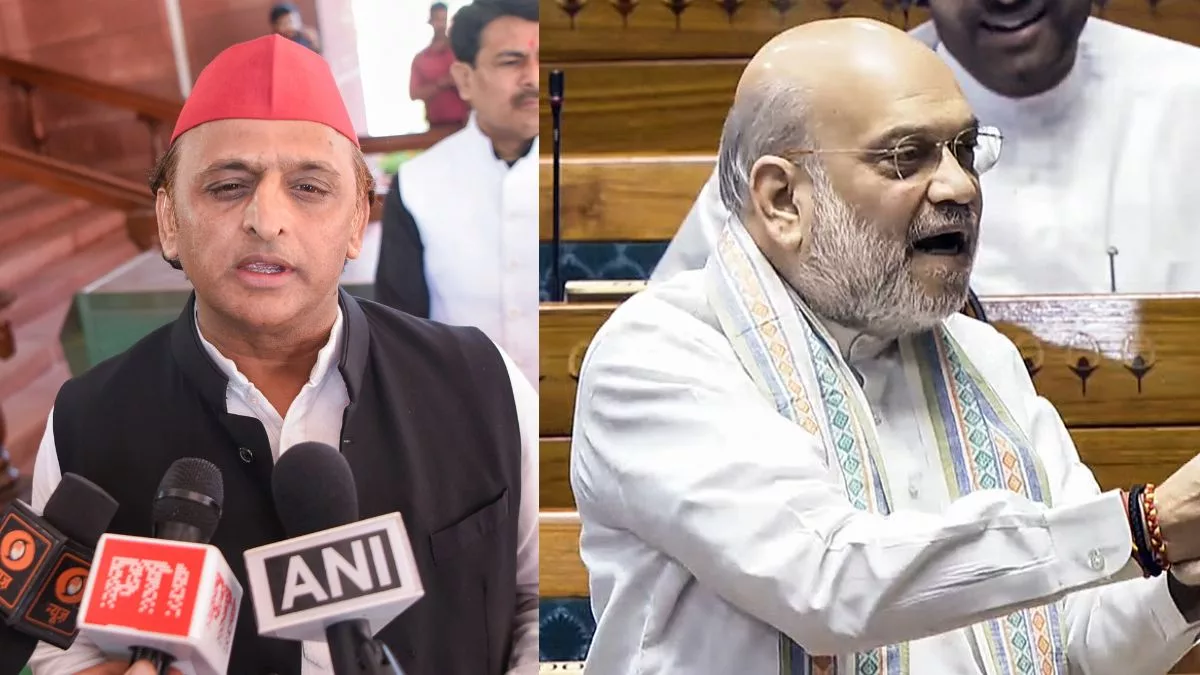
Akhilesh Yadav’s Jibe on Amit Shah’s “Hindu Cannot Be a Terrorist” Remark and the NIA Court’s Verdict: Clash Between Rhetoric, Politics, and Justice
Introduction: When Parliament Rhetoric Meets Court Verdict
Home Minister Amit Shah’s statement in Rajya Sabha In Indian politics, sharp rhetoric is nothing new. But when a country’s Home Minister makes a sweeping statement in the Upper House of Parliament, and on the same day, a special court delivers a crucial verdict that contradicts the very spirit of that statement—the event captures national attention.
On August 1, 2025, during a heated Rajya Sabha debate, Union Home Minister Amit Shah asserted:
“A Hindu can never be a terrorist.”
The ruling party cheered the remark, while the opposition, particularly Samajwadi Party MP Akhilesh Yadav, launched a scathing counterattack.
Home Minister Amit Shah’s statement in Rajya Sabha Quoting him:
“Just saying that a Hindu can’t be a terrorist doesn’t change the reality. Has today’s NIA court verdict opened the government’s eyes?”
The comment referred to a verdict by the National Investigation Agency (NIA) court earlier that day, which convicted individuals associated with Hindu outfits in a terror case.
This blog dives deep into this incident—exploring the implications of Amit Shah’s statement, Akhilesh Yadav’s rebuttal, and the legal weight of the NIA court’s judgment.
1. Amit Shah’s Parliament Statement: Political Messaging or Ideological Stand?
While responding to opposition attacks in Rajya Sabha, Home Minister Amit Shah remarked:
“A Hindu can never be a terrorist because Hinduism and its values never permit violence.”
This remark was interpreted on two levels:
- A political signal aimed at the BJP’s core voter base.
- An ideological assertion of Hinduism’s non-violent ethos.
But was this statement appropriate in Parliament, a constitutionally secular forum?
Does it compromise the perception of investigative neutrality or judicial independence?
Opposition parties were quick to challenge the intent and consequences of such remarks.
2. Akhilesh Yadav’s Rebuttal: “Don’t Just Make Statements—Look at the Verdict”
Samajwadi Party leader and former Uttar Pradesh Chief Minister Akhilesh Yadav was quick to respond, saying:
“If the Home Minister declares in Parliament that people of a particular religion cannot be terrorists, what happens to the objectivity of investigative agencies or the judiciary?”
He referenced the NIA court’s verdict, which convicted members of a Hindu right-wing group in the 2011 Malegaon blast case. The court held that:
“Based on presented evidence and witness testimony, it is proven that the accused deliberately conspired and executed the attack.”
Yadav used this moment to question BJP’s long-standing narrative that “Hindu terror” is a conspiracy propagated by the opposition.

3. NIA Court Verdict: A Stern Message from Judiciary
The NIA’s special court verdict sent shockwaves. The judge categorically stated that the convicted individuals were influenced by religious radicalism and ideological motivations.
In its order, the court emphasized:
“Anyone who kills innocents for ideological or religious motives is a terrorist, regardless of their faith.”
This declaration came at a time when the government is battling narratives around terrorism—particularly, to delink terrorism from any association with Hindu nationalist organizations.
4. The History of the Term “Hindu Terrorism”
The phrase “Hindu terrorism” emerged in the late 2000s, especially after a series of blasts—Malegaon (2008), Samjhauta Express, and Mecca Masjid—in which individuals linked to Hindu outfits were accused.
At the time, then-Home Minister P. Chidambaram used the term publicly, sparking fierce backlash from the BJP.
Since then, BJP leaders like Amit Shah and PM Modi have consistently claimed that the term was part of Congress’s agenda to malign Hinduism.
However, Indian courts have repeatedly maintained that crime has no religion, and each case must be judged solely on facts and evidence.
5. Political Responses: Rhetoric vs. Responsibility
Opposition parties responded aggressively to Amit Shah’s comment.
Congress spokesperson Pawan Khera said:
“The Home Minister’s statement attempts to influence the judiciary. Is he indirectly instructing investigative agencies?”
TMC MP Derek O’Brien added:
“No government can link religion with crime. BJP is crossing that line.”
Meanwhile, BJP members defended Shah’s statement, calling it a “cultural truth” and “a philosophical position about the peaceful nature of Hinduism.”
6. Public Reaction: From Twitter Trends to Primetime Debates
The issue exploded on social media. Hashtags like #HinduTerrorist, #AmitShahResign, and #NIAverdict trended for hours.
Opinions were sharply divided:
- One side demanded that all communities be treated equally under the law.
- The other side saw the verdict and media coverage as an “attack on Hinduism.”
Primetime news debates echoed these sentiments. Legal experts argued that ministerial statements could create perceptional bias, while others felt Amit Shah was only echoing a “cultural truth.”
7. Religion and Terrorism: Is There a Link?
This controversy rekindled an age-old question—Can terrorism have a religion?
Linking an entire religion to the actions of a few individuals is deeply problematic—be it Islam, Christianity, or Hinduism.
The Supreme Court of India has already made it clear that no person is above the law due to their religious identity. Everyone is equal before the law, and evidence—not identity—should drive judicial decisions.
8. Investigative Neutrality vs. Political Influence
This case also raises serious questions about investigative impartiality. When the Home Minister categorically denies the possibility of members of a particular religion being terrorists, does it not risk influencing the course of investigations?
A retired NIA officer, on condition of anonymity, stated:
“Investigations are based on facts. But political rhetoric can skew the public narrative and indirectly pressure investigators.”
9. Global Optics: What Message Does India Send to the World?
As the world’s largest democracy, India is under the global lens. When its Home Minister issues blanket religious statements, and a court delivers a contrasting verdict the same day, it sends mixed messages internationally.
The United Nations’ Counter-Terrorism Office has always maintained:
“Terrorism has no religion.”
India has supported this stance at global forums. So why does the internal political discourse contradict that principle?
10. Conclusion: Which Path Will India Choose?
This entire episode leaves us with key questions:
- Should ministers publicly make religiously loaded remarks in Parliament?
- Should court verdicts be religiously interpreted?
- Can the opposition counter political narratives with legal facts?
In a mature democracy, law, religion, and justice must remain distinct. Religion should not be used to influence investigations or judicial proceedings.
India’s judiciary has once again shown that truth and evidence—not identity—define justice.
Now the people of India must decide: Do they stand with political narratives or with judicial truth?
Final Thought:
Whether it’s Amit Shah’s sweeping remark or Akhilesh Yadav’s sharp rebuttal—both are part of democratic expression.
But when a court’s gavel delivers a verdict grounded in evidence, it reaffirms faith in the Indian Constitution.
That is democracy’s ultimate strength.
Read more latest news

