

Introduction
Ram Navami, the auspicious Hindu festival that celebrates the birth of Lord Ram, is observed with great devotion across India. It is a day marked by processions, prayers, and celebrations that unite people in faith and reverence. However, in recent times, such celebrations have sometimes intersected with more contentious events, shedding light on the evolving relationship between communities, religious identity, and national politics.
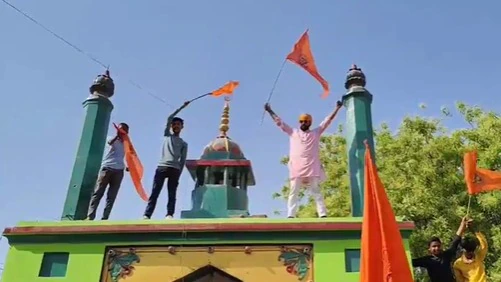
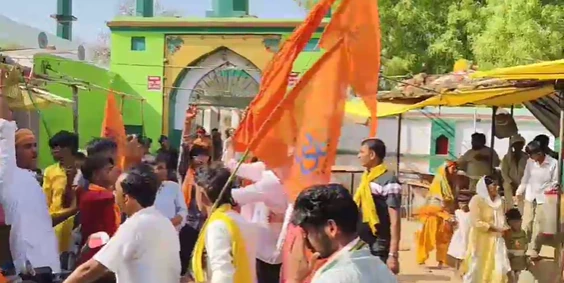
A recent incident in the Sikandra area of Bahria in Prayagraj, Uttar Pradesh, where a group of youths waved saffron flags and raised slogans at the shrine of Syed Salar Masood Ghazi Miyan, brings the complexities of religion, politics, and interfaith relations to the forefront. This incident, which occurred on the occasion of Ram Navami, has sparked discussions on various social, political, and cultural aspects of contemporary India Ram Navami.
In this blog, we will delve into the details of the incident, explore its cultural and religious significance, and reflect on the broader implications it holds for communal harmony and religious tolerance in India. By examining historical context, interfaith dynamics, and the socio-political landscape of India, we can better understand the significance of such events and their potential consequences Ram Navami.
The Sikandra Incident: What Happened?
On the occasion of Ram Navami, a group of youths in the Sikandra area of Bahria, Prayagraj, raised saffron flags and chanted slogans at the shrine of Syed Salar Masood Ghazi Miyan. This particular shrine, dedicated to a revered Muslim saint, is a site of deep devotion for local Muslims, who regard it as an important place of pilgrimage. However, during the celebrations of Ram Navami, the presence of saffron flags and Hindu slogans at the shrine raised tensions and caught the attention of local authorities and the public.
The youths’ actions were seen by some as an expression of religious assertiveness or a symbolic claim of Hindu identity, while for others, it was a provocative and disrespectful act that violated the sanctity of a Muslim religious site. The incident led to protests and calls for action from various religious groups, with accusations of communal disharmony and disrespect.
Understanding the Cultural and Religious Context
Ram Navami is a festival that holds immense significance for Hindus, especially those who worship Lord Ram as the ideal incarnation of virtue, dharma, and justice. The festival is celebrated with fervor across the country, particularly in states like Uttar Pradesh, where Lord Ram’s birthplace, Ayodhya, is located. The processions, chanting of mantras, and the display of saffron flags are integral to the Ram Navami celebrations, symbolizing the victory of good over evil.
On the other hand, Syed Salar Masood Ghazi Miyan is an important figure in Islamic history, revered as a martyr who fought valiantly for the cause of Islam. His shrine in Sikandra has become a significant place of worship for Muslims, who visit it to seek blessings, solace, and spiritual guidance. The shrine represents centuries of Islamic heritage in the region and is an integral part of the local Muslim community’s religious identity.
The intersection of these two religious spaces — one associated with Hinduism and the other with Islam — is a sensitive and complex issue, especially in the context of contemporary Indian society. Historically, India has been a land of diverse religious traditions, but the relationship between Hindu and Muslim communities has been fraught with tensions, particularly in recent decades. The rise of religious nationalism, the political instrumentalization of religious identity, and incidents of communal violence have further strained interfaith relations.
The Political Dimensions of Ram Navami Celebrations
The events in Sikandra raise several questions about the role of religion in politics and the instrumentalization of festivals like Ram Navami for political purposes. Over the years, Ram Navami has increasingly become a platform for the assertion of Hindu identity and the promotion of Hindu nationalist ideals. The display of saffron flags, chanting of slogans, and the participation of politically charged groups in the celebrations are indicative of a broader shift in the way religious festivals are being politicized.
The rise of Hindu nationalism, particularly under the leadership of the Bharatiya Janata Party (BJP), has led to the transformation of many religious events into expressions of political power. In some cases, these events are used as a means to assert dominance over religious minorities, particularly Muslims. The Sikandra incident can be viewed as part of this broader trend, where religious celebrations take on a more militant and exclusionary character.
At the same time, it is important to acknowledge that not all Ram Navami celebrations are politically motivated. For many Hindus, the day is a deeply spiritual occasion, and the display of saffron flags and chanting of slogans are simply expressions of religious devotion. However, in a highly charged political environment, the lines between religion and politics are often blurred, and the potential for conflict is high.
Communal Tensions and the Risk of Escalation
The Sikandra incident is a stark reminder of the delicate nature of communal relations in India. While the majority of citizens are committed to peaceful coexistence and respect for diversity, there is a significant minority that seeks to stoke communal tensions for political gain. The display of saffron flags and the chanting of Hindu slogans at a Muslim religious site can be seen as an attempt to provoke a response from the Muslim community, and such acts have the potential to escalate into larger-scale communal violence.
The history of communal riots in India provides a grim reminder of how religious differences can quickly spiral into violence when they are manipulated by political forces. The Babri Masjid demolition in 1992, the Gujarat riots in 2002, and the more recent incidents in places like Delhi and Lucknow show how easily tensions can boil over. In this context, the Sikandra incident, while perhaps not leading to immediate violence, has the potential to inflame passions and lead to further polarization.
It is crucial for political leaders, religious leaders, and civil society organizations to intervene and defuse the situation before it escalates. The message of peace, unity, and tolerance needs to be emphasized, and efforts must be made to build bridges between communities rather than deepen the divides.
The Role of the State and Law Enforcement
In such sensitive situations, the role of law enforcement and the state becomes pivotal. The authorities in Prayagraj acted swiftly by deploying police forces to maintain law and order, ensuring that the situation did not escalate. However, the question remains whether the state is doing enough to address the underlying issues that fuel communal tensions.
Law enforcement agencies must adopt a balanced approach, ensuring that the rights of all communities are respected and that no group feels marginalized or threatened. At the same time, the state must take strong action against individuals or groups that seek to sow discord and disrupt public order. The challenge for the state is to maintain a fine balance between ensuring security and upholding the principles of religious freedom and tolerance.
The Need for Dialogue and Understanding
In the wake of the Sikandra incident, it is important for the Hindu and Muslim communities to engage in open dialogue and mutual understanding. Both communities have shared a long history of coexistence in India, and it is crucial to draw upon this shared heritage to promote harmony and peace.
Religious leaders from both communities have a significant role to play in this process. They can help counter the rhetoric of hate and division and work towards fostering an environment of respect and understanding. Interfaith dialogues, community initiatives, and joint celebrations of festivals can help bridge the gap and build trust between communities.
Conclusion: A Path Forward
The Sikandra incident on Ram Navami is a microcosm of the larger challenges that India faces in terms of communal relations, religious identity, and the role of politics in shaping religious discourse. While such incidents are concerning, they also present an opportunity for reflection and dialogue. In a country as diverse and complex as India, it is essential to navigate the delicate balance between religious expression, political identity, and communal harmony.
As we move forward, it is crucial for all stakeholders — religious leaders, political figures, civil society, and citizens — to work towards fostering a climate of tolerance, respect, and understanding. Only through collective effort can we ensure that the diverse fabric of India remains intact and that festivals like Ram Navami continue to be celebrations of faith, unity, and peace.
The events in Sikandra, while troubling, serve as a reminder of the importance of maintaining the principles of secularism and inclusivity that are enshrined in India’s Constitution. By doing so, we can ensure that India remains a beacon of religious diversity and coexistence for generations to come.
read more latest news


https://myteana.ru/forums/index.php?autocom=gallery&req=si&img=6608
http://wish-club.ru/forums/index.php?autocom=gallery&req=si&img=5234