
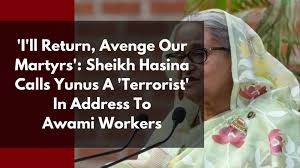
Martyrs The political landscape of Bangladesh has long been shaped by strong personalities and fierce rivalries, none more intense than the animosity between Prime Minister Sheikh Hasina and Nobel laureate Dr. Muhammad Yunus. Sheikh Hasina’s recent speech to Awami League workers has reignited this feud, with the Prime Minister’s fiery comments drawing the attention of political analysts, critics, and citizens alike. In her address, Hasina declared her intention to return and avenge the martyrs of the 1971 Liberation War, naming Yunus as a “terrorist” in an unprecedented escalation of the ongoing battle between the two. This blog will delve into the historical context of this rivalry, Sheikh Hasina’s statement, and the political ramifications of her words.
Historical Context: The Legacy of 1971 and the Rise of Sheikh Hasina Martyrs
The political rift between Sheikh Hasina, the current Prime Minister of Bangladesh, and Dr. Muhammad Yunus, a Nobel Prize-winning economist and founder of Grameen Bank, goes beyond personal differences. It is deeply rooted in the history of Bangladesh’s Liberation War in 1971, where the country fought for independence from Pakistan.
Sheikh Hasina’s father, Sheikh Mujibur Rahman, is considered the “Father of the Nation” and played a pivotal role in leading the country to independence. The sacrifices made by the martyrs of the war are sacred to Hasina, and she has consistently been vocal about protecting their legacy and ensuring their sacrifices are honored.
Dr. Yunus, on the other hand, made his mark internationally through his work in microfinance, specifically through Grameen Bank. He was awarded the Nobel Peace Prize in 2006 for his pioneering efforts in providing financial services to the poor, especially women. However, Yunus’ involvement in politics has also been controversial. His opposition to Hasina’s leadership, particularly his alleged attempts to influence national policies, has fueled a bitter rivalry.
The Power Struggle: The Personal and Political Rivalry Martyrs
The rivalry between Hasina and Yunus escalated when Yunus was removed from his position as the managing director of Grameen Bank in 2011, which he had led for decades. Sheikh Hasina’s government initiated the move to remove him, citing his age (Yunus was 71 at the time) and his position as a public figure in the political sphere. Yunus, however, viewed this as a politically motivated decision aimed at diminishing his influence, especially given his vocal criticism of the government.
What followed was a series of confrontations that saw Yunus criticize Hasina’s governance, with accusations of human rights abuses, autocratic rule, and the erosion of democratic values. Hasina, in turn, accused Yunus of being involved in political conspiracies aimed at undermining her leadership.
This personal and political feud only grew more intense in subsequent years. Sheikh Hasina’s Awami League party and Yunus became two sides of an ideological divide, with Hasina representing the legacy of Bangladesh’s independence struggle and Yunus embodying a global humanitarian and economic vision.
Sheikh Hasina’s Speech: A Vow for Revenge Martyrs
In her recent speech to Awami League workers, Sheikh Hasina took the gloves off. She made it clear that she would not rest until those who had betrayed the country and its martyrs were held accountable. “I will return, and I will avenge our martyrs,” she declared, drawing attention to the sacrifices of those who fought for Bangladesh’s independence in 1971.
While Hasina’s remarks were directed at multiple political figures who she believes have betrayed the ideals of the Liberation War, her specific targeting of Dr. Yunus as a “terrorist” stunned many observers. For Hasina, the word “terrorist” was not just a condemnation of Yunus’s political activities but a direct accusation of his alleged involvement in the 1971 war crimes, a charge that has been used by her government to discredit critics who oppose her stance on national identity and history.
Hasina’s mention of “avenging martyrs” was also a pointed reminder of the deep-seated nationalism that fuels her policies. For Hasina, the Liberation War is not just a historical event—it is the foundation of her political legitimacy, and anyone who challenges her interpretation of the war’s outcome becomes an enemy of the nation’s identity.
Yunus’s Alleged Role in Politics and the Accusations Against Him Martyrs
The accusation of being a “terrorist” is serious and demands a closer look at Dr. Yunus’s involvement in Bangladesh’s political landscape. Yunus has long been seen as a critic of Sheikh Hasina’s government. Though he has denied any involvement in politics, his actions and public statements suggest a more nuanced engagement.
For one, Yunus has frequently spoken out against the rise of authoritarianism in Bangladesh, especially under Hasina’s rule. He has been an advocate for greater political freedom, human rights, and democratic reforms in the country. He has also shown support for opposition parties, which has led to accusations of political partisanship.
Critics of Hasina argue that Yunus’s critiques are legitimate concerns about the erosion of democratic principles in Bangladesh. However, Hasina’s camp sees Yunus’s advocacy for political reforms as an attempt to destabilize the country and erode the government’s legitimacy. It is in this context that the Prime Minister’s inflammatory remarks about Yunus being a “terrorist” take on a sharper meaning.
For Hasina, Yunus’s actions go beyond mere political opposition—they are seen as part of a larger conspiracy against the nation’s identity and its founding principles. By branding Yunus a “terrorist,” Hasina is attempting to position him as not just a political opponent but as someone who is actively working against the national interest.
The Role of the International Community: Balancing Criticism and Support Martyrs
Sheikh Hasina’s comments come at a time when Bangladesh is under international scrutiny. The international community has been critical of the government’s human rights record, particularly with regard to the treatment of opposition figures, freedom of speech, and the rule of law. In contrast, Yunus remains a global symbol of social entrepreneurship and development, with many international organizations continuing to support his work.
The ongoing feud between Hasina and Yunus has thus attracted international attention, with many Western nations and human rights organizations aligning themselves with Yunus’s calls for greater political freedoms. They view him as a defender of civil liberties, while Hasina’s critics accuse her of consolidating power and undermining democratic norms.
For Hasina, these criticisms are part of the broader geopolitical battle in which she sees herself as a protector of national sovereignty against foreign influence. The Prime Minister’s invocation of nationalistic rhetoric is a strategy to rally domestic support, especially in the face of mounting international pressure.
Implications for Bangladesh’s Future Martyrs
Hasina’s fiery speech, and her personal attack on Yunus, raise important questions about the future of Bangladesh’s political landscape. As the leader of the Awami League, she has solidified her position as the dominant political force in the country. However, her speech also underscores the deep divisions within the country, especially between those who support her government and those who see her leadership as increasingly authoritarian.
The war of words between Sheikh Hasina and Dr. Yunus is not just about personal grievances; it is a battle for the soul of Bangladesh. On one hand, Hasina’s supporters see her as the defender of the nation’s independence and its values. On the other hand, Yunus’s supporters view him as a champion of democratic ideals and human rights.
The question remains: can Bangladesh reconcile these competing visions of its future? Or will the bitter rivalry between Hasina and Yunus continue to define the country’s political discourse for years to come?
Conclusion: A Nation Divided Martyrs
Sheikh Hasina’s recent comments calling Dr. Muhammad Yunus a “terrorist” are emblematic of a larger struggle that defines Bangladesh’s political climate. The feud between the two figures is not just a personal dispute—it represents a clash between nationalism and internationalism, between authoritarianism and democracy, and between the past and the future.
As Hasina continues to invoke the memory of the martyrs of 1971, she aims to solidify her position as the true heir to the legacy of Bangladesh’s independence. However, in doing so, she risks deepening the divisions within the country and alienating those who see her leadership as increasingly undemocratic.
For Yunus, his reputation as a global humanitarian and his continued fight for political reform put him at odds with Hasina’s vision. Whether he can continue to champion democratic values in the face of such intense opposition remains to be seen Martyrs.
In the end, the rivalry between Sheikh Hasina and Dr. Muhammad Yunus will continue to shape the political landscape of Bangladesh, with both figures representing contrasting visions for the country’s future. As the nation moves forward, it will be important to remember that the true cost of political conflict is borne by the people of Bangladesh, whose future hangs in the balance Martyrs.
This blog captures the essence of Sheikh Hasina’s speech, the complex political rivalry with Yunus, and the broader implications for Bangladesh’s future. Let me know if you need any further details or adjustments!
read more latest news

