

Supreme Court’s Stay on Defamation Case:
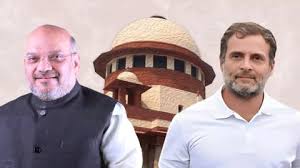
The recent development where the Supreme Court of India stayed the proceedings in a defamation case against Congress leader Rahul Gandhi has drawn widespread attention. The case involves remarks made by Rahul Gandhi during the 2019 Lok Sabha elections in which he allegedly accused Union Home Minister Amit Shah of being a “murderer.” The ruling has profound implications for defamation laws in India and how they are applied in cases involving public figures.
In this article, we will explore the details of the case, the legal arguments presented, the implications of the Supreme Court’s decision, and the larger context of defamation laws in Indian politics.
The Defamation Case: A Timeline
The defamation case at the heart of the matter dates back to 2019, during the heat of India’s general elections. In a speech delivered by Rahul Gandhi in Chaibasa, Jharkhand, he reportedly made a statement that Amit Shah was involved in the murder of former Gujarat Home Minister Haren Pandya. Gandhi allegedly referred to Shah as a “murderer,” a remark that caught the attention of political circles and the media.
The Complainant: Navin Jha
- Navin Jha, a BJP supporter, filed the defamation case against Gandhi. He argued that Gandhi’s comments were not only untrue but were made with malicious intent to tarnish Amit Shah’s reputation.
- Legal Basis: Jha claimed that such remarks could potentially harm Shah’s public image, especially given the prominence of both Gandhi and Shah in national politics.
Initial Legal Proceedings
- The case initially came before a Ranchi court, where it was dismissed on the grounds that there was insufficient evidence to substantiate the claim that Gandhi had defamed Amit Shah.
- However, the dismissal was overturned by a judicial commissioner in Ranchi. The commissioner ordered a fresh review of the case based on the evidence available and directed the lower court to issue summons for Rahul Gandhi to appear before the court.
The Jharkhand High Court’s Role
In February 2024, the Jharkhand High Court became involved in the case when Rahul Gandhi petitioned to quash the summons issued by the trial court. The High Court, however, rejected his plea, allowing the defamation case to proceed.
- Rejection of Plea: The High Court’s decision to not quash the summons meant that the case would continue in the lower courts unless overturned by a higher authority.
- Political Context: The case has significant political overtones, as it involves two prominent political figures — Rahul Gandhi, a leader of the Congress Party, and Amit Shah, a key figure in the Bharatiya Janata Party (BJP) and the current Union Home Minister.
Supreme Court Intervention: A Moment of Relief for Rahul Gandhi
Faced with the High Court’s decision, Rahul Gandhi turned to the Supreme Court, seeking a stay on the proceedings. On January 20, 2025, the Supreme Court intervened and issued a stay on the defamation case, temporarily halting the legal proceedings.
- Stay of Proceedings: The Supreme Court’s order effectively paused the defamation case, providing immediate relief to Rahul Gandhi. The court also issued notices to both the Jharkhand government and the complainant, Navin Jha, seeking responses to Gandhi’s petition challenging the High Court’s ruling.
- Reason for the Stay: While the precise reasons for the stay are yet to be fully outlined in the public domain, it is likely that the Supreme Court will consider the balance between free speech and the protection of individual reputations, especially in cases involving public figures.
Key Legal Issues in the Case
This case raises several important legal questions, particularly related to the scope of defamation laws in India and their application to political speech.
Defamation Law in India
Under Indian law, defamation is both a civil and criminal offense. Section 499 of the Indian Penal Code (IPC) defines defamation as an act of harming the reputation of an individual through false statements. However, there are exceptions to this law, particularly when the statements made are in the public interest or are part of fair criticism.
- Public Figures and Defamation: In the case of public figures like Rahul Gandhi and Amit Shah, defamation claims are often more complicated. The threshold for what constitutes defamatory speech can be higher for public figures, as their actions and statements are often subject to public scrutiny.
- Political Speech: Political speech enjoys a certain degree of protection under the law, especially in a democratic setup. However, this does not mean that defamatory remarks cannot be prosecuted, especially when they cause harm to an individual’s reputation.
The Role of the Judiciary
- Balancing Freedom of Speech and Reputation: The judiciary has the delicate task of balancing the fundamental right to free speech with the need to protect an individual’s reputation. This is especially complex in politically charged cases, where the intent behind the remarks is often questioned.
- Precedents: The Supreme Court has dealt with defamation cases involving public figures in the past, including those involving politicians. These cases often set precedents that shape how similar cases are handled in the future.
Public Reaction and Political Ramifications
The defamation case between Rahul Gandhi and Amit Shah has not only attracted legal attention but also sparked political debates across the country. The case has been heavily politicized, with both sides using it as an opportunity to make political points.
Rahul Gandhi’s Supporters
- Gandhi’s supporters argue that the case is politically motivated, designed to silence the opposition and prevent critical voices from speaking out against the ruling party. They believe that the case is an attempt to suppress free speech and stifle political dissent.
- Criticism of Amit Shah: Gandhi’s critics often argue that his remarks about Shah were unsubstantiated and aimed at deflecting attention from other issues. However, his defenders maintain that such criticism is a legitimate part of political discourse.
Amit Shah’s Supporters
- On the other side, Amit Shah’s supporters contend that defamation cases like this are necessary to protect the reputations of public figures who are often subject to baseless and malicious allegations. They argue that allowing such defamatory speech without consequences could set a dangerous precedent for political discourse in India.
What’s Next in the Legal Battle?
With the Supreme Court’s stay on the proceedings, the case is now at a crossroads. The next steps will depend on how the court addresses the issues raised by Rahul Gandhi’s petition.
- Possible Outcomes: The Supreme Court may either decide to dismiss the defamation case altogether or send it back to the lower courts for further proceedings. The final verdict could have significant implications for defamation law in India, especially in the context of political speech.
- Impact on Future Defamation Cases: The outcome of this case may set a precedent for future defamation cases involving political leaders. It could influence how defamation laws are applied to speech made by public figures in the public domain.
Conclusion: The Fine Line Between Political Speech and Defamation
The defamation case against Rahul Gandhi underscores the complex relationship between political speech and the legal framework that protects individuals from harm to their reputation. As the case continues to unfold, the Supreme Court’s decision will likely have lasting effects on the interpretation of defamation laws in India, particularly in the political sphere.
For now, the stay on the proceedings offers temporary relief to Rahul Gandhi, but the case is far from over. It will be closely monitored by legal experts, political analysts, and the general public as it progresses through the courts. The final judgment will undoubtedly shape the future of defamation law in India and its application to the country’s dynamic political landscape.
Read more Latest news

