
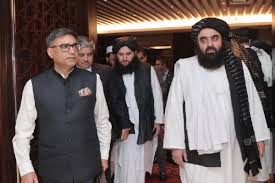
Straight Talk | By Engaging With the Taliban, India Has Cornered Pakistan in Afghanistan
India’s diplomatic engagement with Afghanistan has historically been a strategic pillar of its foreign policy in South Asia. Following the Tali ban’s return to power in 2021, India cautiously recalibrated its approach to maintain influence in the war-torn nation while addressing emerging regional dynamics. The recent outreach to the Tali ban, characterized by pragmatic engagement, has been a masterstroke in cornering Pakistan and redefining the regional balance. This article explores how India’s calculated moves in Afghanistan have strategically isolated Pakistan while advancing India’s interests.
Historical Context: India, Pakistan, and Afghanistan
Afghanistan’s geostrategic location has made it a focal point of rivalry between India and Pakistan. While Pakistan has long sought “strategic depth” in Afghanistan to counterbalance India, New Delhi has historically pursued soft power initiatives, including developmental aid and infrastructure projects, to build goodwill among Afghan citizens.
After the Taliban’s takeover, the dynamics shifted drastically:
- Pakistan’s Traditional Influence: Pakistan has been a key backer of the Taliban since its inception, providing logistical, financial, and political support.
- India’s Developmental Approach: India invested over $3 billion in Afghanistan, constructing schools, hospitals, roads, and the Afghan Parliament building.
The return of the Taliban initially appeared to sideline India, but recent developments have revealed a nuanced strategy that has effectively countered Pakistan’s influence.
India’s Engagement with the Taliban
India’s diplomatic overtures towards the Taliban have been subtle but impactful. Despite no official recognition, India reopened its embassy in Kabul in 2022 and engaged in dialogue with Taliban leaders. This engagement serves several strategic objectives:
1. Securing Indian Interests
India’s investments in Afghanistan were at risk following the Taliban’s resurgence. By maintaining dialogue, India ensured the safety of its projects and personnel.
2. Addressing Security Concerns
The Taliban’s connections to Pakistan-based terror groups like Jaish-e-Mohammed (JeM) and Lashkar-e-Taiba (LeT) pose a direct threat to India. Engagement allows India to monitor and mitigate these threats while pressuring the Taliban to curb such groups.
3. Filling the Void Left by Others
The international community’s cautious stance towards the Taliban provided India with an opportunity to step in and assert influence, particularly in humanitarian aid and development sectors.

How India Has Cornered Pakistan
1. Exposing Pakistan’s Overreach
Pakistan’s deep ties to the Taliban have long been viewed with suspicion. However, its inability to control the Taliban’s actions post-2021—particularly in addressing Tehreek-e-Taliban Pakistan (TTP) insurgency—has exposed its lack of leverage. India has capitalized on this vulnerability by presenting itself as a more stable and reliable partner for Afghanistan.
2. Leveraging Humanitarian Aid
India’s provision of food, medicine, and humanitarian assistance to Afghanistan has strengthened its position as a benevolent neighbor. This contrasts starkly with Pakistan, which has often been accused of exploiting Afghanistan for strategic gains.
3. Reducing Pakistan’s Strategic Depth
By engaging directly with the Taliban, India has bypassed Pakistan’s attempts to act as an intermediary. This reduces Pakistan’s leverage over Afghanistan and undermines its long-standing goal of strategic depth.
4. Strengthening Regional Alliances
India’s engagement with Iran, Central Asian Republics, and Russia on Afghan issues has further isolated Pakistan. The use of Chabahar Port to bypass Pakistan for trade with Afghanistan exemplifies this strategic shift.
Challenges in India’s Approach
While India’s engagement with the Taliban has been largely positive, it is not without challenges:
1. Taliban’s Unpredictability
The Taliban’s ideological rigidity and internal factionalism make it an unreliable partner. While India has sought assurances on security and development, the group’s long-term intentions remain unclear.
2. Pakistan’s Continued Meddling
Pakistan’s intelligence agency, the ISI, continues to wield influence over Taliban factions. This poses a constant challenge to India’s efforts in Afghanistan.
3. Global Perceptions
Engaging with a regime accused of human rights violations risks damaging India’s global image. Balancing pragmatism with principles remains a delicate task.
4. Terror Threats
The Taliban’s ties to extremist groups remain a significant concern. India must navigate these challenges while ensuring its security interests are not compromised.
Key Outcomes of India’s Strategy
India’s calibrated approach has yielded several tangible benefits:
1. Enhanced Regional Influence
India’s engagement has positioned it as a key player in Afghanistan’s reconstruction, ensuring its voice is heard in regional forums.
2. Diplomatic Wins
By reopening its embassy and maintaining dialogue with the Taliban, India has signaled its intent to remain engaged despite challenges. This has won appreciation from Afghan citizens and leaders alike.
3. Economic Opportunities
Afghanistan’s vast mineral wealth and potential for trade via Central Asia provide significant economic opportunities for India. Engagement ensures India remains a stakeholder in these prospects.
4. Marginalizing Pakistan
India’s direct engagement with the Taliban has reduced Pakistan’s ability to dictate Afghanistan’s foreign policy. This has been a major blow to Pakistan’s regional aspirations.
Global Implications of India’s Engagement
India’s outreach to the Taliban is not just a regional maneuver but a move with global ramifications:
1. Countering China
China’s growing investments in Afghanistan, including mining and infrastructure projects, pose a challenge to India. By maintaining a presence, India can counterbalance China’s influence.
2. Aligning with US Objectives
The US has expressed concerns over Pakistan’s duplicity in the war on terror. India’s proactive stance aligns with US interests in ensuring Afghanistan does not become a hub for terrorism.
3. Leading by Example
India’s emphasis on development and humanitarian aid sets a positive example for other nations, reinforcing its reputation as a responsible global actor.
Conclusion
India’s strategic engagement with the Taliban marks a significant shift in its foreign policy towards Afghanistan. By bypassing Pakistan and directly interacting with the Taliban, India has successfully cornered its western neighbor while securing its own interests.
This pragmatic approach not only bolsters India’s position in South Asia but also reinforces its role as a key player in shaping Afghanistan’s future. However, sustaining this momentum will require a delicate balance of diplomacy, strategic foresight, and a clear understanding of the complex dynamics at play.
In the evolving geopolitical landscape, India’s ability to adapt and innovate will be crucial in maintaining its edge and ensuring long-term stability in the region.
Read more Latest News

