
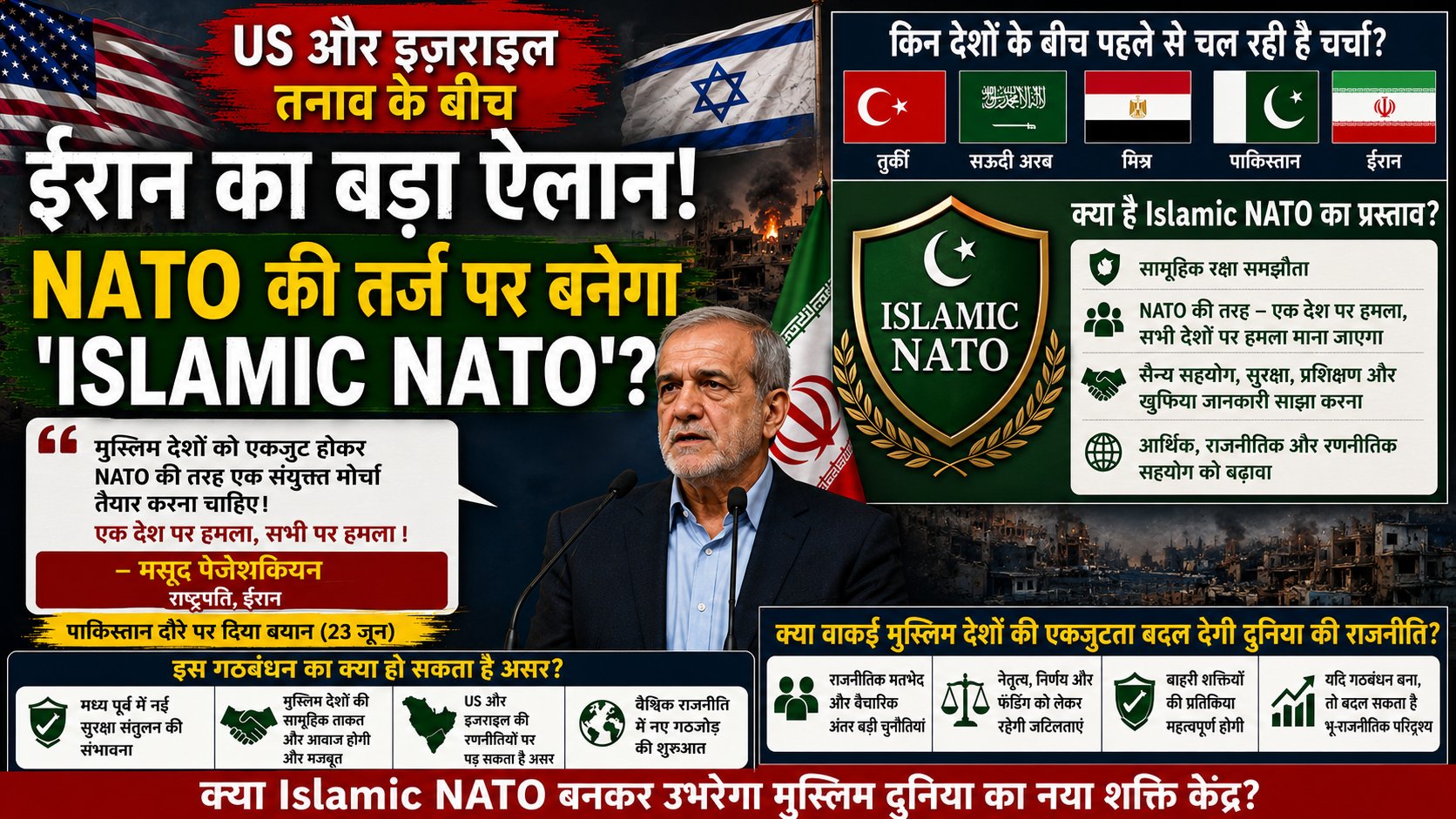
Conflict Involving the US and Israel: Iran Calls for a NATO-Style Muslim Alliance
Introduction
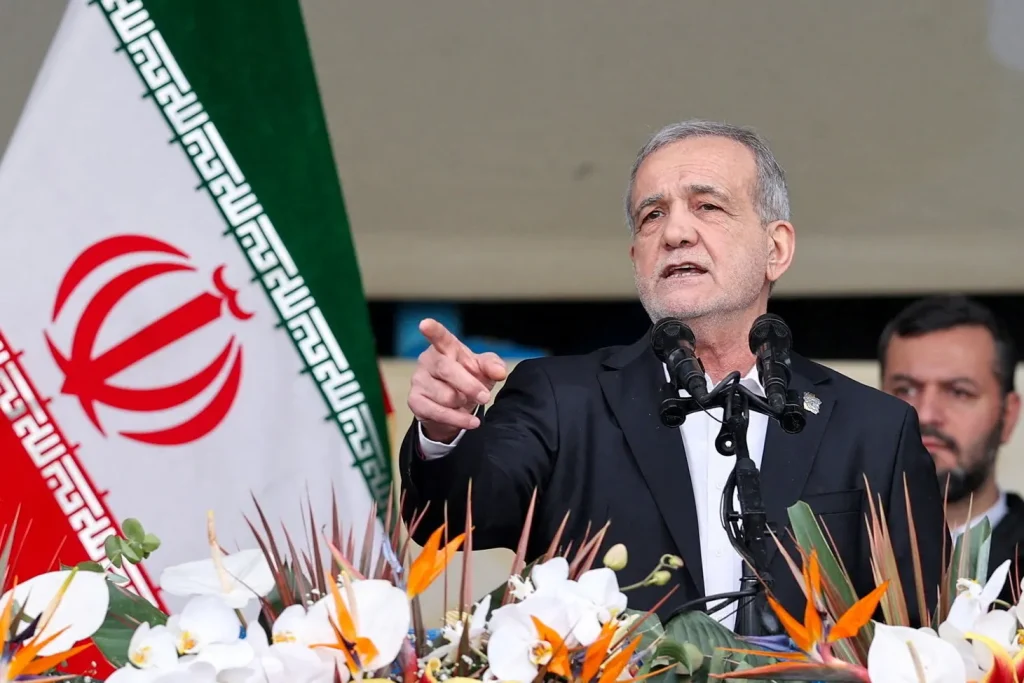
The geopolitical landscape of the Middle East is undergoing significant changes as tensions continue to rise amid the conflict involving the US and Israel. Against this backdrop, Iranian President Masoud Pezeshkian has made a noteworthy proposal that could potentially reshape regional security dynamics. During his visit to Pakistan on June 23, the Iranian leader called upon Muslim-majority nations to unite and establish a collective security framework modeled on NATO.
The proposal comes at a time when discussions about greater military and strategic cooperation among Muslim countries have gained momentum. According to reports, countries such as Turkey, Saudi Arabia, Egypt, and Pakistan have previously explored ideas related to a coordinated defense structure. Now, Iran has publicly advocated for a broader alliance that would function according to NATO’s principle that an attack on one member is considered an attack on all.
As the conflict involving the US and Israel continues to influence regional politics, Iran’s proposal has generated intense debate among policymakers, analysts, and governments across the Muslim world.
Iran’s Call for Unity
President Masoud Pezeshkian emphasized the need for greater cooperation among Islamic nations during his meetings in Pakistan. According to Iranian officials, the primary goal is to strengthen regional security, reduce dependence on external powers, and create a united front capable of responding to common threats.
The proposal gained attention because it emerged during a period marked by the conflict involving the US and Israel, which has heightened concerns among several governments about regional stability. Iranian leaders argue that Muslim nations possess significant economic, military, and strategic resources but often fail to coordinate effectively.
Pezeshkian reportedly stated that unity among Muslim countries would help address shared challenges and provide a stronger collective voice in international affairs. The Iranian president suggested that a NATO-style framework could enhance security cooperation while promoting political and economic partnerships.
What Is an “Islamic NATO”?
The term “Islamic NATO” has been used by analysts and media outlets to describe potential military cooperation among Muslim-majority countries. However, no formal organization currently exists under that name.
The idea generally refers to a collective defense arrangement in which member states agree to support one another in the event of external aggression. Similar to NATO, the proposed alliance would operate on the principle that an attack against one member would be treated as an attack against all members.
Supporters argue that such a framework could provide greater strategic independence, particularly during periods of tension such as the ongoing conflict involving the US and Israel. They believe coordinated defense policies could enhance deterrence and strengthen regional stability.
Critics, however, question whether political differences among Muslim countries would make such an alliance difficult to establish and maintain.
Historical Background
The concept of military cooperation among Islamic nations is not new. For decades, leaders across the Muslim world have discussed mechanisms for improving collective security and political coordination.
Organizations such as the Organization of Islamic Cooperation (OIC) already provide platforms for diplomatic engagement. However, these institutions are not military alliances and do not possess collective defense obligations.
Recent regional developments, including the conflict involving the US and Israel, have renewed interest in more robust security arrangements. Some governments believe existing institutions are insufficient to address emerging geopolitical challenges.
Iran’s latest proposal builds upon these earlier discussions by advocating a structure with clearer defense commitments and stronger military cooperation.

Why Pakistan Matters
Pakistan occupies a central position in discussions about any future Muslim security alliance. As one of the world’s largest Muslim-majority countries and a nuclear power, Pakistan possesses significant military capabilities.
President Pezeshkian’s decision to raise the issue during his visit to Pakistan reflects Islamabad’s strategic importance. Pakistan maintains relationships with multiple regional powers, including Saudi Arabia, Turkey, China, and Iran.
The conflict involving the US and Israel has prompted several countries to reassess their security priorities, making Pakistan’s role particularly significant. Analysts believe any serious attempt to create a NATO-style Muslim alliance would require Pakistan’s participation.
However, Pakistan must carefully balance its relationships with various global and regional partners before endorsing any such initiative.
Turkey’s Strategic Role
Turkey is another key player frequently mentioned in discussions about a potential Islamic defense alliance. As a member of NATO itself, Turkey possesses advanced military capabilities and extensive experience in collective security arrangements.
The conflict involving the US and Israel has encouraged renewed debate within Turkey regarding regional cooperation among Muslim nations. Turkish leaders have often advocated stronger coordination on issues affecting the Islamic world.
At the same time, Turkey maintains complex relationships with Western countries, Russia, and Middle Eastern states. These competing interests could influence Ankara’s approach to any future alliance proposal.
Saudi Arabia and Egypt
Saudi Arabia and Egypt are widely considered essential participants in any large-scale regional security initiative. Both countries possess substantial military resources and significant political influence across the Middle East.
The conflict involving the US and Israel has increased diplomatic activity among regional powers, leading to discussions about long-term security arrangements. While Riyadh and Cairo may share concerns about regional stability, they also maintain distinct foreign policy priorities.
Observers note that achieving consensus among these major powers would be one of the most significant challenges facing any proposed alliance.
Iran’s Strategic Objectives
Iran’s support for a NATO-style Muslim alliance reflects several strategic objectives. First, Tehran seeks to strengthen cooperation among countries that share concerns about external intervention in regional affairs.
Second, the proposal could enhance Iran’s diplomatic influence at a time when the conflict involving the US and Israel remains a dominant issue in Middle Eastern politics.
Third, Iranian leaders believe greater military coordination could improve regional deterrence capabilities and reduce vulnerabilities to external pressure.
Supporters within Iran argue that a unified Islamic security framework would create opportunities for greater political and economic collaboration.
Challenges to Formation
Despite growing discussion, significant obstacles remain.
Political rivalries among Muslim countries continue to shape regional relations. Differences regarding foreign policy, economic priorities, and security concerns could complicate efforts to establish a unified alliance.
The conflict involving the US and Israel may provide motivation for cooperation, but it does not automatically eliminate longstanding disagreements among regional powers.
Questions also remain regarding leadership, decision-making structures, funding mechanisms, and operational responsibilities.
Without clear answers to these issues, transforming the concept into a functioning organization would be difficult.
International Reactions
The proposal has attracted attention beyond the Middle East. Governments and analysts worldwide are evaluating its potential implications for regional and global security.
Some observers view the initiative as a response to the evolving strategic environment created by the conflict involving the US and Israel. Others see it as part of a broader effort by regional powers to increase strategic autonomy.
Western policymakers may closely monitor developments to determine whether the proposal remains a diplomatic concept or evolves into a concrete institutional framework.
Economic and Defense Implications
A successful alliance could significantly affect defense cooperation, military procurement, intelligence sharing, and joint training exercises.
The conflict involving the US and Israel has highlighted the importance of coordinated security planning, prompting some governments to consider new forms of regional collaboration.
In addition to defense matters, proponents argue that closer cooperation could strengthen trade, investment, infrastructure development, and technological partnerships among member states.
Such benefits could enhance the attractiveness of the proposal, particularly for countries seeking greater regional integration.
Impact on Regional Geopolitics
If established, a NATO-style Muslim alliance could become a major geopolitical force. The combined population, economic resources, and military capabilities of potential member countries would give the organization considerable influence.
The ongoing conflict involving the US and Israel has already altered regional calculations, encouraging governments to explore new partnerships and security arrangements.
A collective defense framework could reshape power dynamics across the Middle East, South Asia, and North Africa.
However, much would depend on membership, organizational structure, and political cohesion.
The Future of the Proposal
Whether the proposal ultimately succeeds remains uncertain. While interest in regional cooperation appears to be growing, translating political rhetoric into practical action requires sustained diplomatic effort.
The conflict involving the US and Israel continues to serve as a catalyst for discussions about collective security and regional independence. Yet the success of any alliance will depend on the willingness of member states to overcome differences and commit to shared objectives.
Many analysts believe that even if a formal alliance does not emerge immediately, the proposal could lead to increased military cooperation and deeper strategic dialogue among Muslim-majority countries.

Conclusion
Iranian President Masoud Pezeshkian’s call for a NATO-style Muslim alliance represents one of the most significant regional security proposals in recent years. Emerging amid the conflict involving the US and Israel, the initiative seeks to unite Muslim nations under a collective defense framework based on mutual protection and strategic cooperation.
Supporters argue that such an alliance could enhance regional security, strengthen diplomatic influence, and promote greater unity among Islamic nations. Critics point to political divisions, competing interests, and practical challenges that could hinder implementation.
Regardless of its ultimate outcome, the proposal has already sparked important discussions about the future of regional security architecture. As the conflict involving the US and Israel continues to shape global geopolitics, debates over collective defense, strategic autonomy, and international cooperation are likely to remain at the center of Middle Eastern diplomacy for years to come.
Read more latest news

